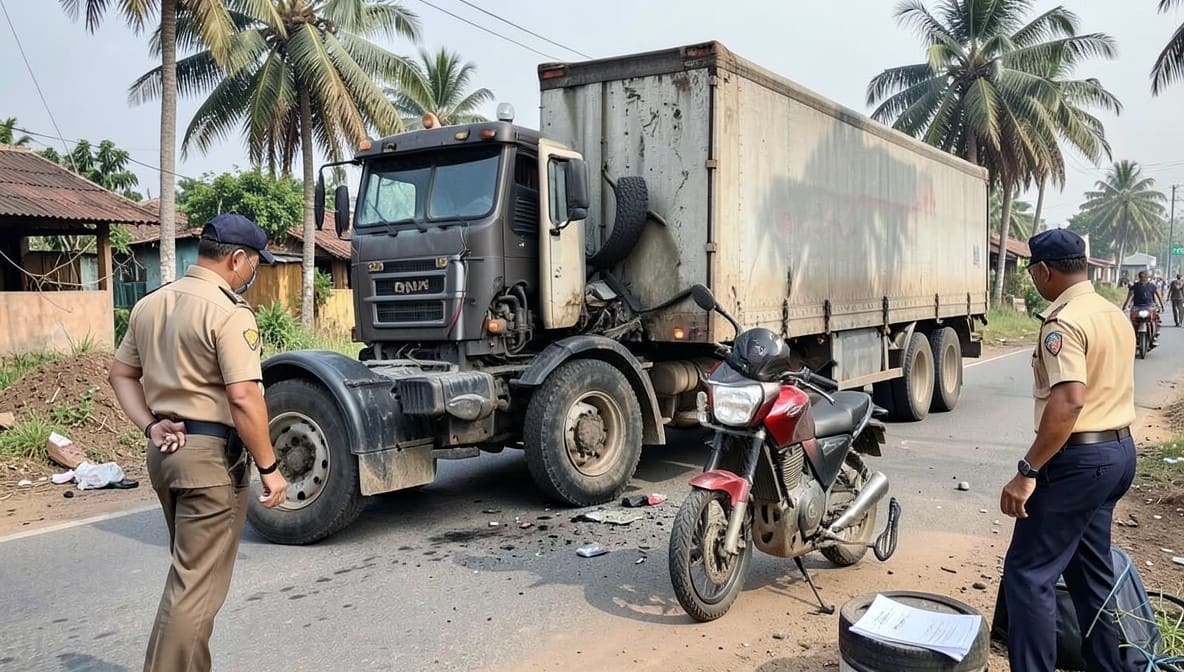
The Andhra Pradesh High Court has reaffirmed that motor accident claims must be adjudicated on the basis of preponderance of probability, not the stricter beyond reasonable doubt standard applicable in criminal cases. In a significant ruling, the Court set aside a Motor Accidents Claims Tribunal (MACT) order that had dismissed a compensation claim, holding that the MACT erred in disbelieving eyewitness testimony without sufficient contrary evidence. The Court awarded Rs. 18,95,792 with 6% interest to the dependents of a deceased police constable, emphasizing the social welfare nature of the Motor Vehicles Act and the duty to award just compensation even if it exceeds the claimed amount.
Background & Facts
The Dispute
The appellants, legal heirs of Khangala Narasanna Dora (the deceased), filed a claim petition before the Motor Vehicles Accidents Claims Tribunal (MACT), Rajahmundry, seeking compensation of Rs. 15,00,000 for his death in a road accident on 30.03.2009. The deceased, a Police Constable (PC No. 2796) under the Superintendent of Police, East Godavari District, was returning on his motorcycle from Draksharamam to Rayavaram when he was hit by a tractor-trailer driven by Respondent No. 1 (Vungarala Krishna Murthy). The offending vehicle, bearing Nos. AP 5T 4858 and AP 5X 2839, was owned by Respondent No. 2 (Velugula Latcha Rao) and insured by Respondent No. 3 (United India Insurance Co. Ltd.).
Key Facts
- Date of accident: 30.03.2009 at approximately 02:00 p.m.
- Deceased’s profile: Aged 30 years, earning Rs. 15,000 per month as a Police Constable
- Claimants:
- Claimant No. 1: Wife of the deceased
- Claimant Nos. 2-4: Unemployed daughters of the deceased
- Claimant No. 5: Mother of the deceased
- Respondent No. 1 (driver): Remained ex parte before the MACT
- Respondent No. 2 (owner): Contended that the deceased was drunk and negligent, causing the accident
- Respondent No. 3 (insurer): Argued violation of policy conditions and exaggeration of claims
Procedural History
- 15.06.2009: FIR registered at Rayavaram Police Station for offence under Section 304-A IPC against Respondent No. 1
- M.V.O.P. No. 613 of 2009: Claim petition filed before the MACT
- 28.10.2011: MACT dismissed the petition, holding that negligence was not proved and that the deceased’s own negligence caused the accident
- M.A.C.M.A. No. 1416 of 2012: Appeal filed before the Andhra Pradesh High Court
- 01.07.2026: High Court allowed the appeal, setting aside the MACT’s order
The Parties' Positions
Appellants’ Contentions
- The MACT erred in disbelieving P.W. 2, an eyewitness cited in the charge sheet, who testified that the accident occurred due to the rash and negligent driving of Respondent No. 1
- The MACT failed to quantify compensation despite framing the issue, violating its duty under Section 168 of the Motor Vehicles Act, 1988
- The social welfare nature of the Act mandates a holistic view of evidence, not strict proof beyond reasonable doubt
Respondents’ Contentions
- Respondent No. 2 (owner): Argued that the deceased was drunk and negligent, and that the insurer of the motorcycle should have been impleaded
- Respondent No. 3 (insurer): Contended that negligence was not proved, the claim was exaggerated, and there was violation of policy conditions
The Legal Issue
The appeal raised two central questions:
- Whether the accident occurred due to the negligent driving of Respondent No. 1, and if the MACT’s findings on negligence required interference?
- Whether the claimants were entitled to compensation, and if so, to what quantum?
Arguments Presented
For the Appellants
- Relied on Rule 476 of the A.P. Motor Vehicles Rules, 1989, which permits reliance on police records and eyewitness testimony to establish negligence
- Cited Bimla Devi v. Himachal Road Transport Corporation and Anitha Sarma v. New India Assurance Co. Ltd. to argue that preponderance of probability suffices in motor accident claims
- Contended that the MACT failed to discharge its statutory duty under Section 168 of the Motor Vehicles Act by not quantifying compensation despite framing the issue
For the Respondents
- Respondent No. 3 (insurer): Argued that the dismissal was justified as the claimants failed to prove negligence and exaggerated the claim
- Emphasized the absence of clear evidence to rebut the MACT’s finding that the deceased was negligent
The Court's Analysis
The Court conducted a detailed analysis of the evidence, statutory provisions, and precedents, focusing on the following key aspects:
Standard of Proof in Motor Accident Claims
The Court reiterated that motor accident claims are not adversarial litigation but social welfare measures governed by preponderance of probability, not the beyond reasonable doubt standard. It relied on:
"In a situation of this nature, the Tribunal has rightly taken a holistic view of the matter. It was necessary to be borne in mind that strict proof of an accident caused by a particular bus in a particular manner may not be possible to be done by the claimants. The claimants were merely to establish their case on the touchstone of preponderance of probability. The standard of proof beyond reasonable doubt could not have been applied."
(Bimla Devi v. Himachal Road Transport Corporation, para 15)
Reliance on Police Records and Eyewitness Testimony
The Court held that police records, including the FIR, charge sheet, and post-mortem report, are admissible evidence under Rule 476(7) of the A.P. Motor Vehicles Rules, 1989. It observed:
"The crime record maintained by the police can be relied on for the purpose of prima facie case, particularly when an eyewitness cited in the charge sheet speaks about the same. To contradict or rebut such evidence, there must be convincing evidence on the part of the respondents."
The Court noted that P.W. 2, an eyewitness cited in the charge sheet, testified that the accident occurred due to the negligent driving of Respondent No. 1. The MACT’s reasoning - that P.W. 2’s statement about the deceased hitting the angular portion of the trailer implied the deceased’s negligence - was rejected as speculative.
Distinction Between Composite and Contributory Negligence
The Court clarified the legal distinction between composite negligence (where two or more parties are jointly liable) and contributory negligence (where the injured party shares fault). It relied on Pavan Kumar v. Harkishan Dass Mohan Lal and T.O. Anthony v. Karvarnan, holding:
"Where the plaintiff/claimant himself is found to be a party to the negligence, the question of joint and several liability cannot arise, and the plaintiff’s claim to the extent of his own negligence will have to be severed."
However, in this case, the Court found no evidence of the deceased’s contributory negligence and held that the negligence of Respondent No. 1 was the sole cause of the accident.
Duty to Award Just Compensation
The Court criticized the MACT for failing to quantify compensation despite framing the issue, emphasizing that Section 168 of the Motor Vehicles Act imposes a statutory duty to award just compensation. It relied on Nagappa v. Gurudayal Singh and Kajal v. Jagadish Chand, which held:
"There is no restriction that the Tribunal/Court cannot award compensation exceeding the claimed amount. The function of the Tribunal/Court is to award ‘just’ compensation, which is reasonable on the basis of evidence produced on record."
Calculation of Compensation
The Court applied the guidelines laid down in Sarla Verma v. Delhi Transport Corporation and National Insurance Co. Ltd. v. Pranay Sethi, calculating compensation as follows:
- Multiplicand: Deceased’s net income (Rs. 8,676/month) + 50% future prospects (as he was below 40 years) = Rs. 1,56,168/annum
- Deduction for personal expenditure: 1/3rd = Rs. 1,04,112/annum
- Multiplier: 16 (for age 32)
- Loss of dependency: Rs. 16,65,792
- Conventional heads:
- Loss of estate: Rs. 15,000
- Funeral expenses: Rs. 15,000
- Loss of consortium: Rs. 40,000 per claimant (total Rs. 2,00,000)
- Total compensation: Rs. 18,95,792 with 6% interest from the date of petition
The Verdict
The appeal was allowed, and the MACT’s order dated 28.10.2011 was set aside. The Court directed:
- Compensation of Rs. 18,95,792 awarded to the claimants, with 6% interest per annum from the date of petition till realization
- Liability: Respondent No. 3 (insurer) held liable under the insurance policy
- Apportionment:
- Claimant No. 1 (wife): Rs. 6,95,792
- Claimant Nos. 2-4 (daughters): Rs. 3,00,000 each
- Claimant No. 5 (mother): Rs. 3,00,000
- Payment timeline: Within two months
- Court fee: Claimants liable for the enhanced part of compensation before the MACT
What This Means For Similar Cases
Preponderance of Probability Suffices
- Practitioners must argue that motor accident claims are not criminal trials - preponderance of probability is the sole standard
- Tribunals/Courts cannot apply beyond reasonable doubt or disbelieve evidence based on speculative reasoning
- Police records (FIR, charge sheet, post-mortem reports) are admissible and can corroborate eyewitness testimony
Duty to Award Just Compensation
- Failure to quantify compensation despite framing the issue is a violation of statutory duty under Section 168 of the Motor Vehicles Act
- Courts/Tribunals must holistically evaluate evidence and avoid technicalities that defeat the social welfare purpose of the Act
- Compensation can exceed the claimed amount if the evidence justifies it - no upper limit under Section 168
Eyewitness Testimony and Negligence
- Eyewitness testimony cited in police records carries significant weight unless contradicted by clear evidence
- Absence of the driver’s testimony (Respondent No. 1 remained ex parte) weakens the respondents’ case
- Contributory negligence must be proved, not presumed - mere speculation (e.g., deceased’s drunken state) is insufficient
Loss of Consortium for All Dependents
- Loss of consortium is not limited to the spouse - children and parents are also entitled under parental and filial consortium
- Rs. 40,000 per claimant is the standard award under this head, as per Magma General Insurance Co. Ltd. v. Nanu Ram