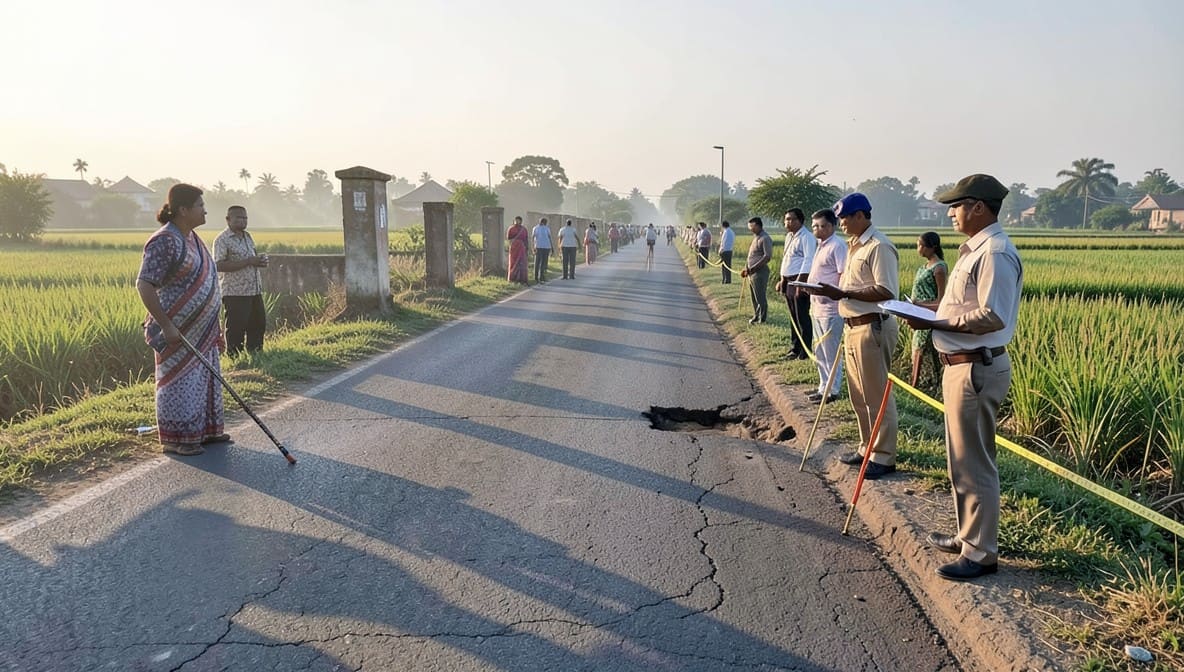
The Madras High Court dismissed a writ petition seeking enforcement against land encroachments after the authorities had already removed the illegal structures, underscoring that judicial intervention is unnecessary when administrative action has effectively resolved the grievance. The judgment reinforces the principle that courts will not entertain petitions where the relief sought has been rendered infructuous by prior compliance.
Background & Facts
The Dispute
The petitioner, T. Saravanan, filed a writ petition under Article 226 of the Constitution of India seeking a writ of mandamus to compel respondents 1 to 5 - the District Collector, District Revenue Officer, Revenue Divisional Officer, Tahsildar, and Block Development Officer of Salem District - to take action against respondents 6 to 9, who allegedly encroached upon a public road and a water body located in Survey Numbers 377/1, 377/3, 384/10, 384/12, 378/1, 104/1, 106/1, 107/4, 189/11, and 190/1 & 2 at Koneripatti Agraharam Village, Sankari Taluk, Salem District.
Key Facts
- The petitioner submitted two representations to the authorities: one dated 19.03.2022 and another dated 18.04.2022, requesting removal of encroachments on public land and a water body.
- The encroachments allegedly involved unauthorized construction and dumping on land designated for public use and water conservation.
- The Assistant Executive Engineer, Water Resources Department, Mettur Kalvai Division, issued a letter dated 18.04.2023 to the Tahsildar, Sankagiri, referencing the pending writ petition and confirming that notices had been issued to the encroachers.
- The encroachments were physically removed on 19.10.2023, as confirmed by the Water Resources Department’s communication.
Procedural History
- 19.03.2022: Petitioner submitted first representation to authorities seeking removal of encroachments.
- 18.04.2022: Petitioner submitted second representation, reiterating the demand.
- 18.04.2023: Water Resources Department communicated to Tahsildar regarding the encroachments and pending writ.
- 19.10.2023: Encroachments on public road and water body were removed by the authorities.
- 20.04.2026: Writ petition came up for hearing before the Madras High Court.
The Parties' Positions
- The petitioner sought mandatory direction to the revenue authorities to act against encroachers and ensure future compliance.
- The respondents 1 to 5 (government authorities) did not oppose the petition, acknowledging that action had been taken.
- Respondents 6 to 9 (encroachers) were not present or represented, and no opposition was filed.
Relief Sought
The petitioner sought a writ of mandamus directing respondents 1 to 5 to:
- Take action against respondents 6 to 9 for encroachment.
- Ensure removal of illegal structures.
- Prevent future encroachments on the public road and water body.
The Legal Issue
The central question was whether a writ petition under Article 226 remains maintainable when the relief sought - removal of encroachments - has already been fully accomplished by the authorities prior to judicial adjudication.
Arguments Presented
For the Petitioner
The petitioner contended that the failure of authorities to act promptly on his representations dated 19.03.2022 and 18.04.2022 constituted a dereliction of statutory duty under land revenue and public nuisance laws. He argued that judicial intervention was necessary to compel accountability and ensure systemic compliance.
For the Respondent
The Additional Government Pleader for respondents 1 to 5 conceded that the encroachments had been removed on 19.10.2023, as documented by the Water Resources Department. No substantive opposition was raised, as the relief sought had been rendered infructuous.
The Court's Analysis
The Court observed that the very purpose of the writ petition - removal of encroachments from public land and a water body - had been achieved by the administrative authorities before the matter reached final hearing. The letter from the Assistant Executive Engineer, Water Resources Department, dated 18.04.2023, confirmed that notices had been issued and the encroachments were removed on 19.10.2023.
"Since the encroachments have already been removed by the authorities, no further adjudication is required in this writ petition."
The Court emphasized that courts are not forums for routine enforcement of administrative duties when such duties have already been discharged. The principle of mootness applies: where the subject matter of litigation ceases to exist, the court has no occasion to adjudicate. The Court further noted that the writ jurisdiction under Article 226 is discretionary and should not be exercised when the object of the petition is already accomplished.
The Court also directed the authorities to ensure that no further encroachment is permitted on the water body, recognizing the ongoing public interest in preserving natural resources.
The Verdict
The writ petition was dismissed as infructuous. The encroachments on the public road and water body in Survey Numbers 377/1, 377/3, 384/10, 384/12, 378/1, 104/1, 106/1, 107/4, 189/11, and 190/1 & 2 were removed on 19.10.2023. The Court directed the respondents 1 to 5 to ensure no further encroachment occurs on the water body. No costs were awarded.
What This Means For Similar Cases
Writ Petitions Become Infructuous Upon Administrative Compliance
- Practitioners must verify whether the relief sought has already been granted before filing a writ petition.
- Courts will not entertain petitions where the subject matter is resolved prior to hearing, even if delay occurred.
- Filing a writ after compliance may be viewed as an abuse of process.
Proactive Enforcement by Authorities Is Judicially Recognized
- Administrative action taken in good faith, even if delayed, is sufficient to discharge statutory obligations.
- Documentation of removal (e.g., departmental letters, photographs, inspection reports) is critical to demonstrate compliance.
- Courts will issue preventive directions (e.g., "no further encroachment") even while dismissing the petition, reinforcing long-term accountability.
Public Interest Demands Continuous Vigilance
- The judgment does not absolve authorities of future duty; it reinforces their obligation to monitor and prevent recurrence.
- NGOs and citizens should continue reporting encroachments, as judicial remedies remain available if authorities fail to act again.
- This case sets a precedent for environmental and land-use writs: timely administrative action preempts judicial intervention.