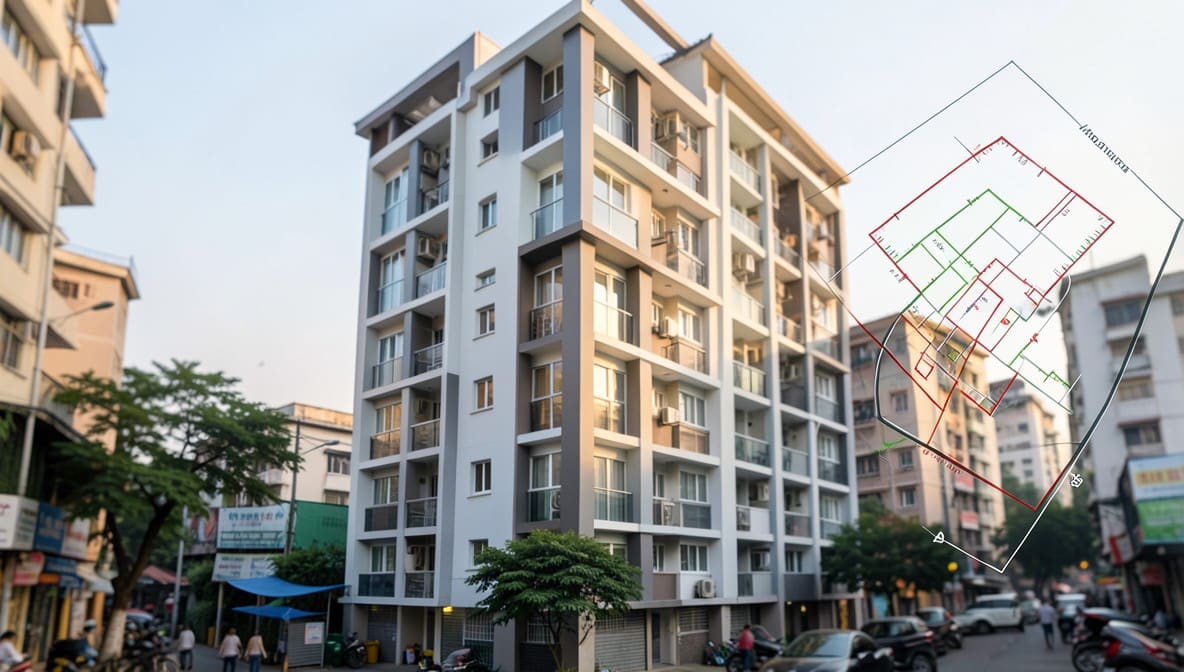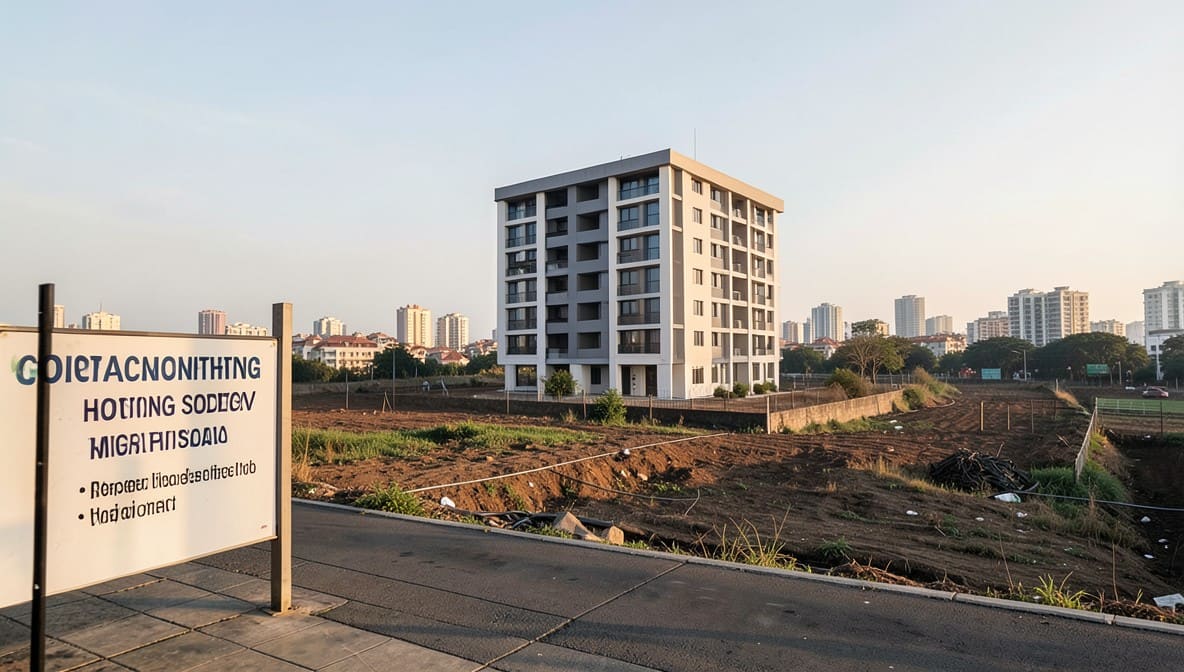
The Bombay High Court has clarified that deemed conveyance under the Maharashtra Ownership Flats Act, 1963, may be granted for authorized portions of a building even when the overall development contains unauthorized construction. The judgment affirms that statutory protection for flat purchasers does not extend to illegal structures, preserving the municipal authority’s power to enforce planning laws.
Background & Facts
The Dispute
The Municipal Corporation of Greater Mumbai, as the lessor of Plot No.9, Scheme No.58, Worli, challenged a deemed conveyance order passed in favor of seven cooperative housing societies. The land was originally leased in 1962 for industrial use, including offices and employee residences. In 1981, the State Government permitted change of user to residential for 13,049.45 square metres, subject to compliance with the Development Control Rules, 1967. Revised building plans proposing structures beyond five floors were rejected by the Corporation in 1984, yet construction continued without approval.
Procedural History
- 1981: Government granted change of user to residential use.
- 1984: Corporation rejected revised plans and issued stop-work notices under Section 354A of the Mumbai Municipal Corporation Act.
- 2010: Show-cause notice issued for unauthorized construction; no response received.
- 2013: Housing societies filed applications under Section 11(3) of the Maharashtra Ownership Flats Act for deemed conveyance.
- 2014: District Deputy Registrar granted ex parte deemed conveyance certificate.
- 2014: Municipal Corporation filed writ petition under Articles 226 and 227 of the Constitution.
Relief Sought
The petitioner sought quashing of the deemed conveyance order, arguing that it lacked privity of contract, violated lease terms, and improperly validated unauthorized construction. It contended that the Competent Authority exceeded jurisdiction by implying legality to structures never approved.
The Legal Issue
The central question was whether the Competent Authority under Section 11 of the Maharashtra Ownership Flats Act can grant deemed conveyance for a housing project where only a portion of the construction is authorized, and whether such conveyance extinguishes or impairs the original lessor’s ownership rights.
Arguments Presented
For the Petitioner
The Municipal Corporation argued that: (1) it had no contractual relationship with the societies, making Section 11 inapplicable; (2) the development was illegal and unauthorized beyond five floors; (3) no occupancy certificate had been issued; (4) the Competent Authority had no jurisdiction to determine legality of construction; and (5) conveyance of rights over unauthorized structures would violate the lease deed and municipal law.
For the Respondent
The housing societies and promoters countered that: (1) the Government order of 1980 and the Corporation’s own Intimation of Disapproval and commencement certificate in 1981 validated construction up to five floors; (2) the deemed conveyance certificate explicitly limited transfer to authorized portions; (3) the statutory purpose of Section 11 is to protect purchasers who have paid full consideration; and (4) the Corporation’s ownership rights were expressly preserved in the conveyance order.
The Court's Analysis
The Court examined the statutory framework of Section 11 of the Maharashtra Ownership Flats Act, emphasizing its protective intent: to prevent promoters from withholding title after purchasers have paid and occupied. The Court held that the Competent Authority’s role is not to adjudicate the legality of construction in full, but to determine whether the promoter’s transferable rights - limited to what was lawfully sanctioned - can be conveyed.
"The concept of deemed conveyance recognizes that delay or refusal by the promoter cannot be permitted to defeat the collective rights of purchasers."
The Court reviewed the documentary record and found that the Corporation had sanctioned plans permitting construction up to ground plus five floors. The Intimation of Disapproval and commencement certificate issued in June 1981 confirmed this approval. The Competent Authority, therefore, acted within its mandate by confining the conveyance to this authorized portion.
The Court emphasized that the conveyance certificate explicitly stated that transfer was subject to the petitioner’s ownership rights and the original lease terms. This reservation demonstrated the Authority’s awareness of its limits. The judgment noted that the certificate did not convey rights over additional floors, nor did it purport to regularize illegal construction.
The Court distinguished between the promoter’s transferable rights and the Corporation’s reversionary interest. While the societies acquired the promoter’s rights in the authorized portion, the Corporation retained full ownership and enforcement powers over unauthorized portions. The absence of a separate Property Register Card or subdivision did not invalidate the statutory conveyance, as Section 11 operates independently of municipal land records.
The Court further held that privity between the Corporation and individual flat purchasers is not a prerequisite for deemed conveyance. The statute contemplates application by a society formed by purchasers, regardless of direct contractual ties with the lessor.
The Verdict
The writ petition was dismissed. The Bombay High Court upheld the deemed conveyance order, holding that Section 11 of the Maharashtra Ownership Flats Act permits transfer of the promoter’s rights in respect of authorized construction, even when the broader development contains unauthorized elements. The conveyance was strictly limited to ground plus five floors as per sanctioned plans, and the petitioner’s ownership rights remained intact.
What This Means For Similar Cases
Deemed Conveyance Is Limited to Sanctioned Portions
- Practitioners must ensure applications under Section 11 MOFA clearly identify and restrict conveyance to areas with valid approvals.
- Societies cannot claim rights over unauthorized floors, even if they are occupied; such portions remain subject to demolition or penalties.
- Competent Authorities must expressly qualify conveyance certificates to preserve the lessor’s ownership and municipal enforcement powers.
Municipal Ownership Rights Are Not Erased by Statutory Conveyance
- Municipal corporations retain full reversionary rights under lease deeds, even after deemed conveyance.
- Failure to issue a Property Register Card or subdivide the plot does not bar conveyance under Section 11.
- Municipalities may still initiate proceedings under the Mumbai Municipal Corporation Act against unauthorized construction, regardless of conveyance.
Statutory Protection for Purchasers Prevails Over Procedural Defects
- The absence of privity between the lessor and purchasers does not invalidate a deemed conveyance application.
- Courts will prioritize statutory protection for flat purchasers who have paid and occupied, provided the conveyance is confined to lawful development.
- Legal remedies against promoters for fraud or non-disclosure remain available separately and are not extinguished by deemed conveyance.