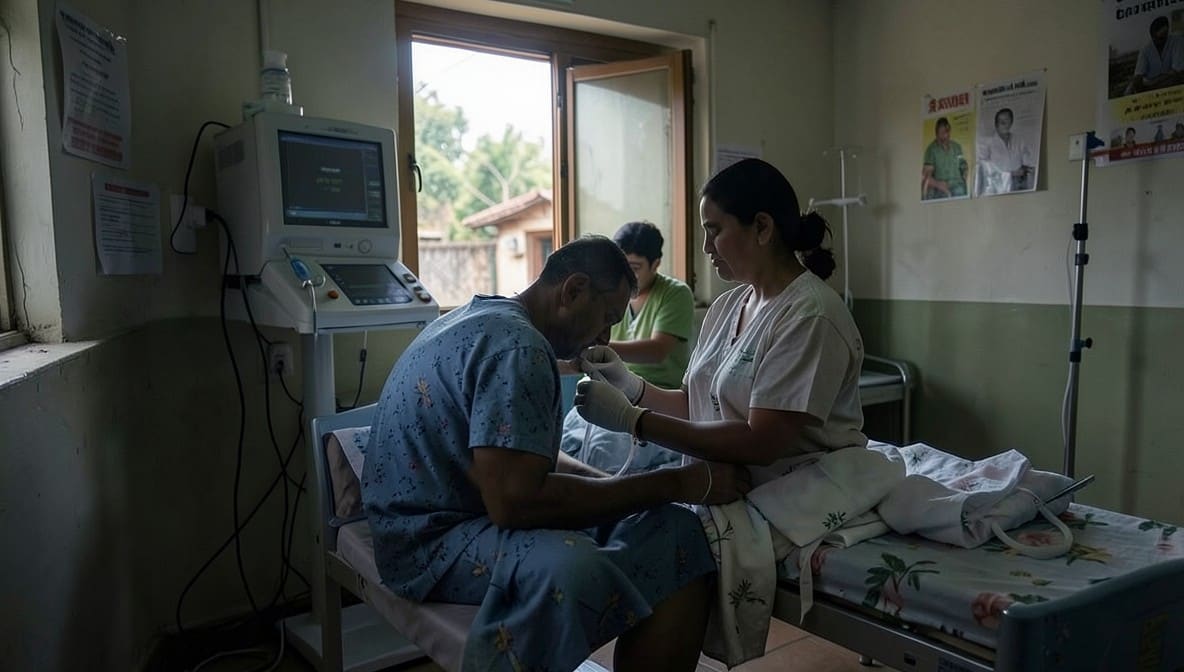
The Madhya Pradesh High Court has recognized that prolonged incarceration in the face of life-threatening custodial injuries constitutes a violation of the right to life under Article 21. In a rare but necessary intervention, the Court granted temporary release to an accused suffering from deteriorating medical conditions, setting a clear precedent that health emergencies arising from custody cannot be ignored in the administration of justice.
Background & Facts
The Dispute
The appellant, Anantu @ Hakim Singh, is a convict currently serving a custodial sentence in connection with a criminal case pending before the trial court. While in custody, he was allegedly assaulted, resulting in serious injuries to his eye and jaw. Despite receiving initial medical treatment, his condition has not stabilized and continues to worsen.
Key Facts
- The appellant sustained injuries during custody, with documented medical reports confirming trauma to the right eye and mandibular region
- Medical records indicate ongoing complications including impaired vision, chronic pain, and risk of permanent damage
- He has been advised by treating physicians to undergo specialized ophthalmic evaluation and further diagnostic imaging
- No prior application for medical bail had been granted by the trial court
- The appellant has not been convicted of any offense at the time of this application; he is serving a sentence imposed by the trial court
Procedural History
- The appellant was sentenced by the trial court on an unspecified date prior to 2025
- I.A. No. 9685 of 2026 was filed on behalf of the appellant seeking temporary suspension of jail sentence
- The application was heard on 13-05-2026 before the Division Bench of the Madhya Pradesh High Court at Jabalpur
- The State opposed the application but conceded that medical documents submitted by the appellant were duly verified
Relief Sought
The appellant sought interim bail for a period of three months to enable him to undergo specialized medical treatment for his eye and jaw injuries, which are reportedly life-threatening and require urgent specialist care.
The Legal Issue
The central question was whether a convict serving a custodial sentence may be granted interim bail on grounds of deteriorating health arising from custodial injuries, even in the absence of a pending appeal against conviction.
Arguments Presented
For the Appellant
Learned counsel argued that the appellant’s continued incarceration would amount to cruel and unusual punishment, violating Article 21 of the Constitution. He relied on the principle that the right to health is an integral component of the right to life, and that the State has a positive obligation to ensure medical care for those in custody. He emphasized that the injuries were sustained while in State custody and that the appellant’s condition is progressively worsening, with medical experts advising urgent specialist intervention.
For the Respondent
The State opposed the application on the grounds that the appellant is a convicted person and that interim bail is not ordinarily available to convicts. However, the State’s counsel fairly conceded that the medical documents submitted were authentic and verified, and did not dispute the severity of the appellant’s condition.
The Court's Analysis
The Court acknowledged that while interim bail is typically granted to undertrials, the principle of human dignity and the State’s duty to preserve life extend even to convicts. The Court held that the right to life under Article 21 does not cease upon conviction, and that the State cannot be absolved of its responsibility to ensure adequate medical care when injuries are sustained in custody.
"The Court is of the view that it would be just and proper to allow the application for temporary suspension of jail sentence."
The Court distinguished this case from routine bail applications by emphasizing the causal link between the injuries and custodial conditions. It noted that the State had not contested the medical evidence, and that the appellant’s condition posed a real risk of irreversible harm or death. The Court further observed that a short-term release for medical treatment, subject to strict conditions, would not undermine the administration of justice.
The Verdict
The Court allowed I.A. No. 9685 of 2026 and granted interim release for a period of one month from the date of his release. The appellant was directed to furnish a personal bond of Rs. 50,000 with one solvent surety in the same amount, to be approved by the trial court. He was ordered to surrender before the trial court upon completion of one month. The Court explicitly warned that failure to surrender would result in immediate re-arrest. The matter was listed for final hearing in due course.
What This Means For Similar Cases
Custodial Injuries Trigger a Duty to Provide Medical Relief
- Practitioners may now invoke Article 21 to seek interim release for convicts suffering injuries sustained in custody, even without a pending appeal
- Medical reports must be submitted with expert certification detailing the risk of deterioration or death
- The State’s concession on authenticity of medical records strengthens the applicant’s position significantly
Conditions for Medical Bail Are Now Clarified
- Personal bond with solvent surety is a minimum requirement
- Duration of release must be strictly limited to the period required for treatment
- Surrender condition is non-negotiable and must be explicitly stated
- Failure to return triggers automatic re-arrest without fresh proceedings
Judicial Discretion Extends to Convicts in Health Emergencies
- Courts are now empowered to suspend sentences temporarily for medical reasons, even if the conviction is final
- This does not amount to a stay of sentence but a conditional suspension for humanitarian grounds
- The ruling reinforces that the State’s custodial responsibility does not end with incarceration