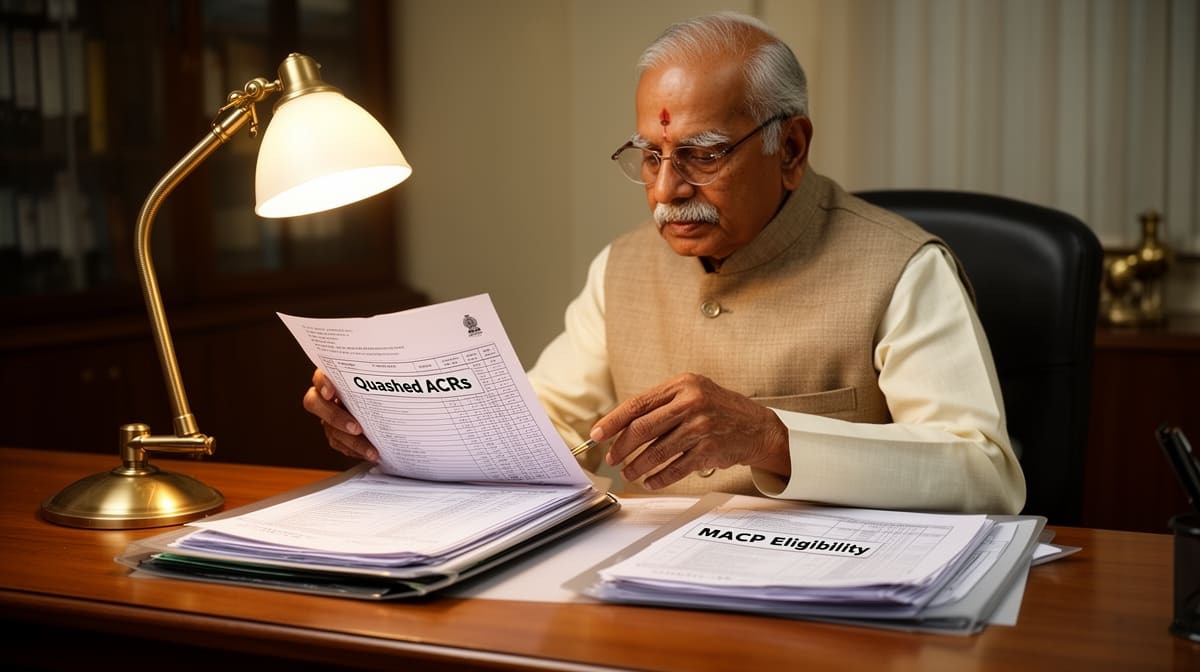
The Central Administrative Tribunal, Ernakulam Bench, has clarified that the denial of a second Military Administrative Career Progression (MACP) upgradation cannot be justified by relying on Annual Performance Appraisal Report (APAR) scores from a period outside the statutorily mandated five-year window. This ruling reinforces the principle that MACP eligibility must be assessed strictly within the prescribed timeframe, ensuring procedural fairness and consistency in service benefits.
Background & Facts
The Dispute
The respondent, P. Rajagopalan, a retired Postman, sought the grant of his second Military Administrative Career Progression (MACP) benefit, which he claimed was due from 30.03.2023, upon completion of ten years from the date of grant of his first MACP on 13.03.2003. The Departmental Screening Committee declined his application, citing an APAR grading of 5.75 for the year 2017-2018 as below the prescribed benchmark. The respondent challenged this refusal before the Central Administrative Tribunal (CAT), seeking quashing of Annexure-A4, the official communication denying the benefit.
Key Facts
- The respondent was granted his first MACP on 13.03.2003
- He claimed entitlement to the second MACP effective 30.03.2023, after completing ten years of service post-first MACP
- His APAR ratings for the five years immediately preceding 30.03.2023 (i.e., 2018-2019 to 2022-2023) were consistently rated as 'very good'
- The only adverse APAR grading cited by the Department was for the year 2017-2018, which fell outside the five-year window preceding the claim
- The Departmental Screening Committee relied on this single out-of-window grading to reject the application
- The respondent had no opportunity to contest the benchmark grading prior to its use in denying the benefit
- The Department did not produce any statutory rule or policy explicitly requiring consideration of APAR beyond the preceding five years
Procedural History
- 13.03.2003: First MACP granted to the respondent
- 2017-2018: APAR grading of 5.75 recorded (below benchmark)
- 30.03.2023: Date on which respondent claimed entitlement to second MACP
- 2024: Representation submitted by respondent for second MACP
- Annexure-A4: Dated 2024, rejecting the claim on grounds of 2017-2018 APAR grading
- 180/188/2024: Original Application filed before CAT on 15.06.2024
- 20.06.2025: CAT delivered Order (Annexure-RA1) allowing the application, quashing Annexure-A4, and directing grant of second MACP with consequential benefits within 60 days
- 180/0012/2026: Review Application filed by the Department on 15.01.2026
- 02.04.2026: CAT dismissed the Review Application
Relief Sought
The respondent sought: (1) quashing of Annexure-A4; (2) grant of second MACP with effect from 30.03.2023; (3) payment of all consequential arrears including pay, allowances, and pension benefits; and (4) interest on arrears at the rate of 6% per annum from the due date.
The Review Applicants sought: (1) review and setting aside of the CAT’s order dated 20.06.2025; (2) reliance on DoPT O.M. dated 08.05.2017 (Annexure-RA2) to justify denial; and (3) dismissal of the original application.
The Legal Issue
The central question was whether the denial of the second MACP on the basis of an APAR grading from a year outside the immediately preceding five-year period is legally sustainable under the MACP scheme.
Arguments Presented
For the Appellant/Review Applicants
The Department contended that the DoPT Office Memorandum dated 08.05.2017 (Annexure-RA2) mandated consideration of APAR ratings for the entire service period preceding the T-1 year, and that the Screening Committee was bound by this directive. They argued that the omission of this document during the original hearing constituted a sufficient ground for review under Order XLVII Rule 1 of the CPC. They further asserted that the Screening Committee’s discretion to consider all available performance records was legitimate and that the CAT erred in overriding it.
For the Respondent/Applicant in O.A.
The respondent argued that the MACP scheme, as framed under the Department of Personnel and Training guidelines, explicitly limits the assessment period to the immediately preceding five years. He submitted that the 2017-2018 APAR grading was irrelevant as it fell outside this window, and that the Department’s reliance on it was arbitrary and violative of the principle of legitimate expectation. He further contended that the DoPT O.M. dated 08.05.2017 pertained to Departmental Promotion Committees (DPCs) for promotions, not to MACP, which is governed by a separate Screening Committee and does not involve promotion.
The Court's Analysis
The Tribunal undertook a detailed examination of the MACP scheme and the nature of the DoPT O.M. dated 08.05.2017 (Annexure-RA2). It observed that the O.M. was titled "Procedure to be observed by the Departmental Promotion Committees - Model Calendar for DPCs and relevant year up to which APARs are to be considered". The Court emphasized that MACP is a non-promotional, non-functional upgradation scheme, distinct from promotion, and is administered by a Screening Committee, not a DPC.
"The Departmental Promotion Committee has no role in the grant of MACP. On the other hand, it is for the screening committee specified by the MACP scheme to make recommendation the case of an employee for grant of MACP."
The Court held that the DoPT O.M. was inapplicable to the facts of the case, as it governed promotion-related procedures and not the MACP framework. The Tribunal further noted that the Department had not cited any rule, circular, or policy that permitted consideration of APAR ratings beyond the preceding five years for MACP purposes.
The Court also rejected the review application on procedural grounds. It held that the DoPT O.M. dated 08.05.2017 was issued nearly nine years prior to the review application and could not be classified as newly discovered evidence. Citing Dokka Samuel v. Dr. Jacob Lazarus Chelly [(1997) 4 SCC 478], the Court reiterated that failure to produce a document already in existence does not constitute an error apparent on the face of the record.
The Tribunal concluded that the Screening Committee’s reliance on an APAR grading from a year outside the statutorily prescribed window was legally unsustainable. The CAT’s original order, which correctly confined the assessment to the preceding five years of 'very good' performance, was therefore upheld.
The Verdict
The Review Application was dismissed. The CAT’s order dated 20.06.2025 stands affirmed. The respondents are directed to grant the second MACP with effect from 30.03.2023, release all consequential pay, allowances, and pension arrears, and pay interest at 6% per annum on the arrears from 30.03.2023 until actual payment. Compliance is to be completed within 60 days from the date of receipt of this order. No costs are awarded.
What This Means For Similar Cases
APAR Assessment Window Is Strictly Limited to Five Years
- Practitioners must insist that MACP applications be evaluated solely on APAR ratings from the immediately preceding five years
- Any reliance on performance data beyond this window is legally invalid and subject to quashing
- Departments cannot invoke general performance policies to override the specific time-bound criteria of the MACP scheme
DoPT O.M.s on DPCs Do Not Apply to MACP
- MACP is governed by Screening Committees, not DPCs
- O.M.s relating to promotion procedures (e.g., DPC calendars, promotion criteria) are irrelevant to MACP eligibility
- Advocates should immediately distinguish between promotion and non-promotional upgradation schemes when challenging denials
Review Applications Cannot Be Used to Introduce Known Documents Late
- Failure to produce a document during the original hearing, when it was in the department’s possession for years, does not justify review
- Review jurisdiction under Order XLVII CPC is not a substitute for proper litigation strategy
- Practitioners should treat the original hearing as the decisive forum for submitting all relevant documents