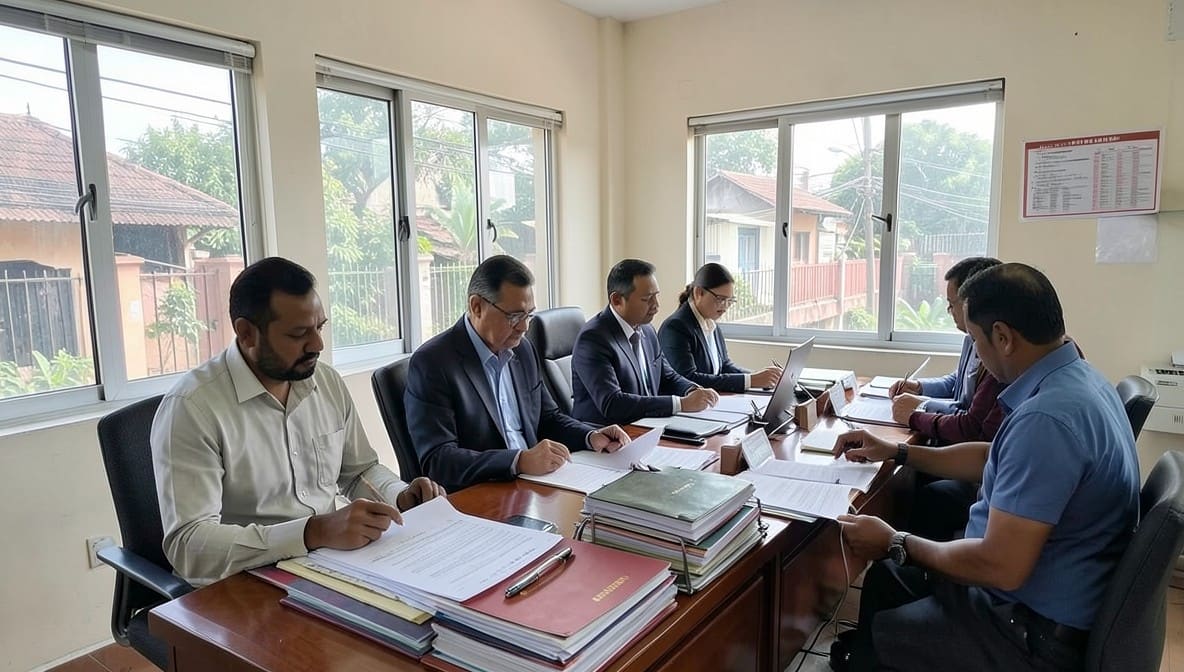
The Central Administrative Tribunal, Lucknow Bench, has affirmed a foundational principle of service jurisprudence: when a court or tribunal grants a benefit to a group of government employees under a uniform policy scheme, all similarly situated employees must receive the same benefit unless the judgment is expressly limited to the parties or the claimants have delayed unreasonably. This ruling reinforces constitutional equality under Article 14 and imposes a duty on administrative authorities to proactively extend lawful benefits.
Background & Facts
The Dispute
The applicants, all serving or retired employees of the Department of Posts and Department of Telecommunications, sought the extension of benefits under the Modified Assured Career Progression (MACP) Scheme, introduced by the 6th Central Pay Commission effective from 01.09.2008. They were denied the benefit of Grade Pay fixation at Rs. 5400/-, which had been granted to other similarly placed employees in a prior Tribunal order dated 20.04.2011 in OA No. 966 & 967 of 2009. The respondents, including the Union of India and various postal and communication authorities, refused to extend the benefit on the ground that the earlier judgment was not binding on non-parties and was not intended to be universally applicable.
Key Facts
- The MACP Scheme was implemented uniformly across all central government departments with effect from 01.09.2008
- The applicants are Assistant Account Officers and Account Officers holding identical posts and service conditions
- The Tribunal in OA No. 966 & 967 of 2009 granted MACP benefits (Grade Pay Rs. 5400/-) to applicants in that case, effective from the date the benefit was extended to their subordinates
- The impugned orders dated 20.04.2015 (Assistant Director General, Department of Posts) and 11.06.2015 (Deputy Controller of Communication Accounts, UP East Circle) denied the benefit to the present applicants
- The applicants had not filed individual applications for MACP prior to the 2009 judgment, relying instead on the principle of equal treatment
- The applicants’ service records, including ACRs, were found to be in order and met the eligibility criteria for MACP
Procedural History
- 01.09.2008: MACP Scheme implemented across central government departments
- 20.04.2011: Tribunal in OA No. 966 & 967 of 2009 granted MACP benefit to applicants in that case
- 20.04.2015: Respondent authority issued order denying MACP benefit to present applicants
- 11.06.2015: Second impugned order issued by Deputy Controller, UP East Circle, reaffirming denial
- 2015: Original Application No. 332/00225/2015 filed before CAT Lucknow seeking relief
- 23.03.2026: Judgment delivered by CAT Lucknow Bench
Relief Sought
The applicants sought:
- Quashing of the impugned orders dated 20.04.2015 and 11.06.2015
- Grant of revised pay with Grade Pay of Rs. 5400/- from the date the benefit was extended to their subordinates
- Payment of accrued arrears with all consequential benefits
- Costs of litigation
The Legal Issue
The central question was whether a judgment granting MACP benefits under a uniform central government scheme to a group of employees constitutes a judgment in rem, thereby obligating authorities to extend the same benefit to all similarly situated employees, even if they did not initiate litigation.
Arguments Presented
For the Appellant/Petitioner
The applicants’ counsel relied on Lt. Col. Suprita Chandel v. Union of India (2024) INSC 942 and State of Uttar Pradesh v. Arvind Kumar Srivastava (2015) 1 SCC 347 to argue that the MACP Scheme is a policy-driven, department-wide benefit applicable uniformly. Since the 2009 judgment did not expressly restrict its application to the parties before it, and since the scheme was implemented across all departments, the judgment was in rem. The applicants were similarly situated, met the eligibility criteria, and had not acquiesced to any discriminatory practice. Denial of benefit violated Article 14.
For the Respondent/State
The respondents contended that the MACP benefit is personal and discretionary, and the 2009 judgment was in personam, binding only on the parties to that case. They argued that extending the benefit to non-parties would amount to judicial overreach and undermine administrative discretion. They further claimed that the applicants had not pursued their claims earlier and could not now rely on the judgment of others.
The Court's Analysis
The Tribunal undertook a detailed analysis of the nature of the MACP Scheme and the legal character of the 2009 judgment. It observed that the MACP Scheme was introduced by the 6th Central Pay Commission as a uniform policy applicable to all central government employees, irrespective of department. The scheme was not discretionary but governed by objective criteria including ACRs and service duration.
"Normal rule is that when a particular set of employees is given relief by the Court, all other identically situated persons need to be treated alike by extending that benefit. Not doing so would amount to discrimination and would be violative of Article 14 of the Constitution of India."
The Court distinguished between judgments in personam and in rem, citing Arvind Kumar Srivastava (2015) 1 SCC 347. It held that the 2009 judgment did not contain any express limitation restricting its application to the parties. The Tribunal had not framed the order as a personal remedy but as a directive to implement a statutory scheme. The absence of any prohibition on extension to others rendered the judgment in rem.
The Court further rejected the argument that the applicants were fence-sitters. There was no evidence of delay or acquiescence on their part. They had not been informed of their rights under the scheme, nor had they been given an opportunity to apply individually before the 2009 judgment. The administrative failure to proactively implement the scheme across the board could not be used to penalize employees.
The Court emphasized that service jurisprudence demands uniformity in treatment of similarly placed employees. Administrative convenience cannot override constitutional equality.
The Verdict
The applicants succeeded. The Tribunal quashed the impugned orders dated 20.04.2015 and 11.06.2015. The respondents were directed to extend the benefit of the MACP Scheme (Grade Pay Rs. 5400/-) to all applicants who satisfy the eligibility criteria laid down in the scheme, as interpreted in OA No. 966 & 967 of 2009. The competent authorities were directed to conduct individual assessments within four months from the date of the certified copy of this order. Parties were directed to bear their own costs.
What This Means For Similar Cases
Judgment in Rem Obligates Proactive Implementation
- Government departments cannot refuse to extend benefits granted in a tribunal or court judgment to non-parties if the judgment pertains to a uniform policy scheme
- The burden shifts to the administration to identify and extend benefits to all similarly situated employees, not to the employees to litigate individually
- Any refusal must be grounded in a clear, express limitation in the judgment or proven laches/acquiescence
MACP and Similar Schemes Are Policy-Based, Not Discretionary
- Benefits under centrally mandated schemes like MACP, ACP, or pay revisions are not subject to administrative discretion once eligibility is met
- ACRs and service records are the sole determinants; personal favoritism or departmental bias is impermissible
- Employees who meet the criteria are entitled as of right, not by grace
Laches Must Be Proven, Not Assumed
- Delay alone is insufficient to deny a benefit; the administration must prove actual acquiescence or intentional non-action
- Silence or lack of litigation cannot be equated with waiver unless there is evidence of knowledge and intentional non-challenge
- Practitioners must argue that systemic failure, not individual negligence, caused the delay