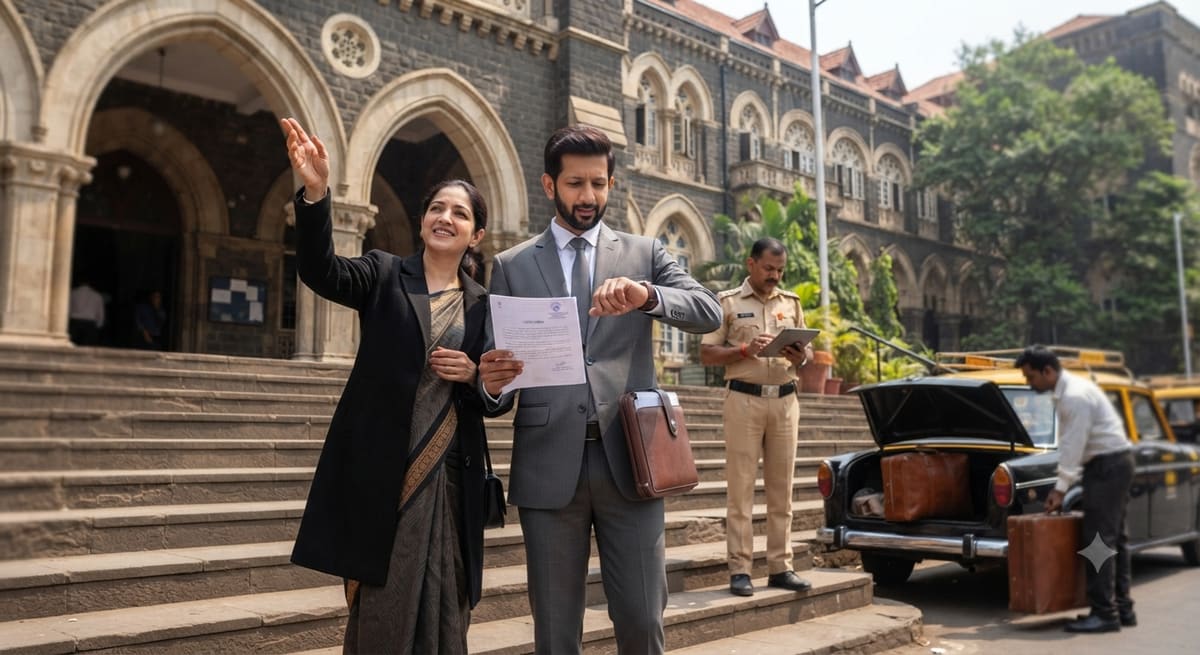
The Bombay High Court has affirmed that the right to travel abroad is not extinguished by the issuance of a Look-Out Circular, even in financial investigation cases, provided the travel is for a compelling personal reason and strict compliance conditions are met. This order reinforces the principle that procedural restrictions must yield to fundamental rights when proportionality and public interest are balanced.
Background & Facts
The Dispute
The applicant, Ritu Chhabria, is subject to a Look-Out Circular (LOC) issued by the Bureau of Immigration at the request of Respondent No. 2, Bank of Baroda, in connection with alleged financial irregularities. The LOC restricts her from leaving India without prior permission. She now seeks temporary suspension of the LOC to attend her son’s graduation ceremony in the United States of America.
Key Facts
- The applicant’s son, Vishwaroop Chhabria, is pursuing a Bachelor of Business Administration and Management at Babson College, USA.
- His graduation-cum-convocation ceremony is scheduled for May 2026.
- The applicant has no criminal record and is not accused of any offence.
- The LOC was initiated solely on the basis of a civil financial dispute with Bank of Baroda.
- The applicant previously traveled to Thailand between 19 November 2025 and 29 November 2025 under a similar interim order dated 10 October 2025, and returned to India as required.
- She complied fully with all conditions imposed during that trip, including submission of travel itinerary and return confirmation.
Procedural History
- 10 October 2025: Interim order passed in IA(L)/30535/2025 permitting travel to Thailand under strict conditions.
- 23 December 2025: Writ Petition (WP(C) No. 23121 of 2025) filed challenging the LOC.
- 5 April 2026: Interim Application (IA(L) No. 6566 of 2026) filed seeking permission to travel to the USA from 5 May 2026 to 25 May 2026.
- 9 April 2026: Hearing before the Division Bench of the Bombay High Court.
The Parties' Positions
Applicant (Ritu Chhabria): Argued that the LOC is disproportionate to the nature of the dispute, which is civil in character. Emphasized the emotional and familial importance of attending her son’s graduation, a once-in-a-lifetime event. Cited her prior compliance with travel conditions as proof of good faith.
Respondent No. 2 (Bank of Baroda): Did not oppose the travel request but insisted that the same conditions imposed in the October 2025 order be reapplied.
Respondents No. 1 and 3 (Bureau of Immigration and Ministry of Home Affairs): Took no independent stance, deferring to the Bank’s position.
Relief Sought
The applicant sought:
- Temporary suspension of the LOC for the period 5 May 2026 to 25 May 2026.
- Permission to travel to the United States of America to attend her son’s convocation.
- Clarification that immigration authorities must permit departure without requiring a certified copy of the order.
The Legal Issue
Can a Look-Out Circular be temporarily suspended to permit international travel for a compelling personal reason, even when a financial dispute is pending, provided the individual has demonstrated compliance with prior conditions and offers binding undertakings?
Arguments Presented
For the Appellant/Petitioner
Learned counsel for the applicant emphasized that the LOC is a coercive measure intended to prevent flight from criminal proceedings, not to penalize individuals in civil disputes. He relied on the principle of proportionality under Article 21 of the Constitution and cited K.S. Puttaswamy v. Union of India to underscore that restrictions on movement must be necessary and least restrictive. He highlighted the applicant’s clean compliance record during her prior trip to Thailand and submitted that the travel is for a legitimate, non-commercial, and emotionally significant purpose. He argued that the Bank’s objection was not substantive but procedural, and that the conditions previously imposed were sufficient to safeguard state interests.
For the Respondent/State
The Advocate for Respondent No. 2 (Bank of Baroda) did not oppose the travel request. The only condition raised was that the same terms from the October 2025 order be re-imposed. The Bureau of Immigration and Ministry of Home Affairs did not contest the application, indicating no institutional objection to the proposed relief.
The Court's Analysis
The Court observed that the LOC was not issued in connection with any criminal proceeding but in the context of a civil financial dispute. It noted that the applicant has not been charged with any offence, nor has any arrest warrant been issued. The Court emphasized that the right to travel abroad is an integral part of personal liberty under Article 21, and cannot be curtailed arbitrarily.
"The applicant has demonstrated a consistent record of compliance with court-imposed conditions. There is no material to suggest that she intends to evade legal process or abscond. The purpose of her travel is singular, genuine, and non-negotiable: to attend her son’s graduation."
The Court further held that the Bank’s lack of objection, coupled with the applicant’s voluntary submission to binding undertakings, rendered the LOC’s continued enforcement disproportionate. It rejected the notion that immigration authorities must have prior system-level notification or a certified copy of the order to permit departure, noting that such technicalities defeat the purpose of judicial orders.
The Court also clarified that the relief granted is strictly limited to the LOC issued by Respondent No. 1 at the instance of Respondent No. 2, and does not affect any other restraint imposed by any other authority.
The Verdict
The applicant succeeded. The Court permitted her to travel to the United States of America from 5 May 2026 to 25 May 2026, subject to the following conditions:
- She shall file an undertaking in court detailing her itinerary, flight tickets, hotel addresses, and contact information, and affirm her return to India on or before 25 May 2026.
- She shall file a second undertaking not to seek renewal or extension of this order until her return.
- Copies of both undertakings shall be served on the Bank of Baroda’s advocate before departure.
- Immigration authorities at all ports shall permit her departure upon presentation of an authenticated or digitally signed copy of this order, without requiring a certified copy.
- This order does not affect any other LOC or restraint issued by any other authority.
What This Means For Similar Cases
Travel Restrictions Must Be Proportionate
- Practitioners may now argue that LOCs issued in civil financial disputes cannot be used as blanket travel bans without evidence of flight risk.
- Courts are likely to permit temporary suspension where the travel is for a compelling personal reason (e.g., medical emergency, family event) and the individual has a clean compliance record.
Undertakings Are Sufficient Safeguards
- Courts will accept detailed, sworn undertakings regarding itinerary and return as adequate assurance against non-return.
- The burden shifts to the state or financial institution to demonstrate a real risk of evasion - not mere suspicion.
Immigration Authorities Must Implement Judicial Orders
-
Immigration checkpoints cannot refuse passage based on system delays or lack of certified copies.
-
Digitally signed or authenticated court orders are legally sufficient for enforcement.
-
Practitioners should always seek explicit directions in orders that immigration authorities act on the order without additional documentation.
-
This judgment provides a template for similar applications in cases involving LOCs arising from civil debt or banking disputes.