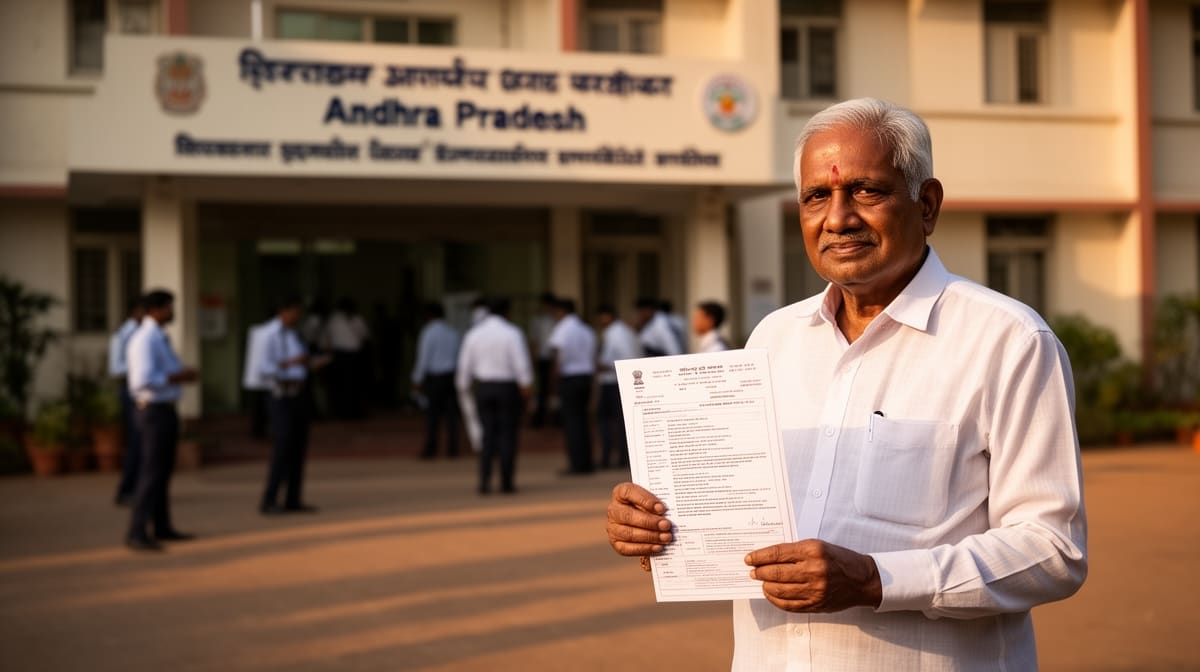
The Andhra Pradesh High Court has affirmed that once financial assistance is formally sanctioned under a state-sponsored scholarship scheme, the state cannot delay or withhold payment on procedural grounds. This judgment reinforces the principle that administrative convenience cannot override a beneficiary’s legitimate expectation of entitlement.
Background & Facts
The Dispute
The petitioner, Peravali Vinay Kumar, a student from Guntur District, applied for financial assistance under the NTR Videshi Vidya Deevana Scheme for the academic year 2018 - 2019 to pursue a Post Graduate degree in Computer Engineering at Arizona State University. His application was accepted and assigned Application ID No. OV2018120214. After due verification by the Economically Backward Classes Welfare Department, the Government sanctioned an amount of Rs.10,00,000 (Ten Lakhs) for his overseas education. Despite completing the course, the petitioner has not received the disbursed funds.
Key Facts
- The petitioner submitted his application for the NTR Videshi Vidya Deevana Scheme in 2018
- Application ID No. OV2018120214 was allotted on verification
- Sanction order for Rs.10,00,000 was issued under G.O. Ms. No. 29 dated 27.08.2016
- The petitioner successfully completed his Post Graduate program at Arizona State University
- No dispute exists regarding his eligibility or completion of course requirements
- The Respondent Department prepared a bill (No. 952/EBC-VVD/2024-5) on 14.11.2024 for disbursement
- The bill was approved on 29.11.2024 and assigned Bill No. 2024-1767449
- Due to year-end financial closure on 31.03.2025, the Finance Department returned the bill under Article 39 & 50 of the Andhra Pradesh Financial Code, Vol. I
- The payment status was marked as "Bill returned to DDO"
Procedural History
- 2018: Petitioner applied for scholarship under NTR Videshi Vidya Deevana Scheme
- 2018 - 2019: Academic year for which assistance was sanctioned
- 14.11.2024: Bill for disbursement prepared by EBC Welfare Department
- 29.11.2024: Bill approved by competent authority
- 31.03.2025: Finance Department closed the bill due to year-end financial freeze
- 03.01.2026: Written instructions issued by Managing Director, EBC Corporation, acknowledging delay and requesting 3-month extension
- 20.01.2026: Writ Petition No. 2017/2026 filed before the High Court of Andhra Pradesh
- 08.04.2026: Judgment delivered by Justice Nyapathy Vijay
Relief Sought
The petitioner sought a writ of mandamus directing the respondents to immediately disburse the sanctioned amount of Rs.10,00,000 under Application ID No. OV2018120214, declaring the non-release as illegal, arbitrary, and violative of natural justice.
The Legal Issue
The central question was whether the state can withhold a duly sanctioned financial assistance under a welfare scheme on grounds of administrative delay or year-end financial closure, despite the beneficiary having fulfilled all eligibility criteria.
Arguments Presented
For the Petitioner
The petitioner’s counsel argued that the sanction of funds under G.O. Ms. No. 29 dated 27.08.2016 created a legitimate expectation and a binding obligation on the state. The preparation and approval of the bill in November 2024 confirmed the finality of the decision. Delay caused by year-end financial procedures cannot override the beneficiary’s right to timely disbursement, especially when the course has been completed. Reliance was placed on the principle that welfare schemes are meant to empower beneficiaries, not burden them with bureaucratic inertia.
For the Respondent
The Standing Counsel for the respondents acknowledged the sanction and bill approval but contended that the payment could not be processed due to procedural constraints under the Andhra Pradesh Financial Code. The Finance Department had closed the bill on 31.03.2025 due to year-end financial freeze, and the matter was pending re-submission to the PFMS unit. The respondents requested three months to complete the process, submitting a written undertaking to that effect.
The Court's Analysis
The Court observed that there was no dispute regarding the petitioner’s eligibility, the sanction of funds, or the completion of the course. The bill had been prepared and approved by the competent authority, indicating finality of decision. The reason for non-payment - year-end financial closure - was purely administrative and could not override the state’s obligation under a welfare scheme designed to support meritorious students from economically backward classes.
"The state cannot use internal financial procedures as a shield to deny a beneficiary the benefit of a sanctioned grant, particularly when the beneficiary has fulfilled all conditions and the sanction has been formally approved."
The Court emphasized that the NTR Videshi Vidya Deevana Scheme is a welfare initiative intended to remove financial barriers to higher education abroad. Denial of payment after sanction, even for procedural reasons, amounts to arbitrary action and violates the principle of legitimate expectation. The written instructions dated 03.01.2026, wherein the Managing Director himself acknowledged the delay and sought time, confirmed the state’s admission of liability.
The Court further noted that the petitioner had already completed his studies and was not seeking interim relief but the fulfillment of a final entitlement. The delay of over a year since bill approval was unreasonable and unjustifiable.
The Verdict
The writ petition was disposed of with directions. The respondents are directed to disburse the amount of Rs.10,00,000 (Rupees Ten Lakhs only) to the petitioner within three months from the date of receipt of a copy of this order. There shall be no order as to costs. Pending applications are closed.
What This Means For Similar Cases
Sanction Equals Binding Obligation
- Once a scholarship or financial assistance is formally sanctioned under a welfare scheme, the state is legally bound to disburse the amount
- Administrative delays due to year-end closures or PFMS processing timelines cannot override a beneficiary’s right
- Practitioners may now cite this judgment to challenge delays in disbursement of state-funded scholarships, even if bills are pending in finance departments
Legitimate Expectation Applies to Welfare Schemes
- Beneficiaries who meet all eligibility criteria and receive formal sanction have a legitimate expectation of payment
- Courts will not permit the state to treat welfare commitments as discretionary after approval
- This principle extends beyond education schemes to housing, subsidies, pensions, and other welfare benefits where formal sanction has been granted
Procedural Compliance Cannot Override Substantive Rights
- Internal financial codes (e.g., AP Financial Code Articles 39 & 50) cannot be invoked to defeat statutory or policy-based entitlements
- Departments must plan disbursements within fiscal cycles, not shift burden to beneficiaries
- Legal notices demanding disbursement should now include reference to this judgment as binding precedent