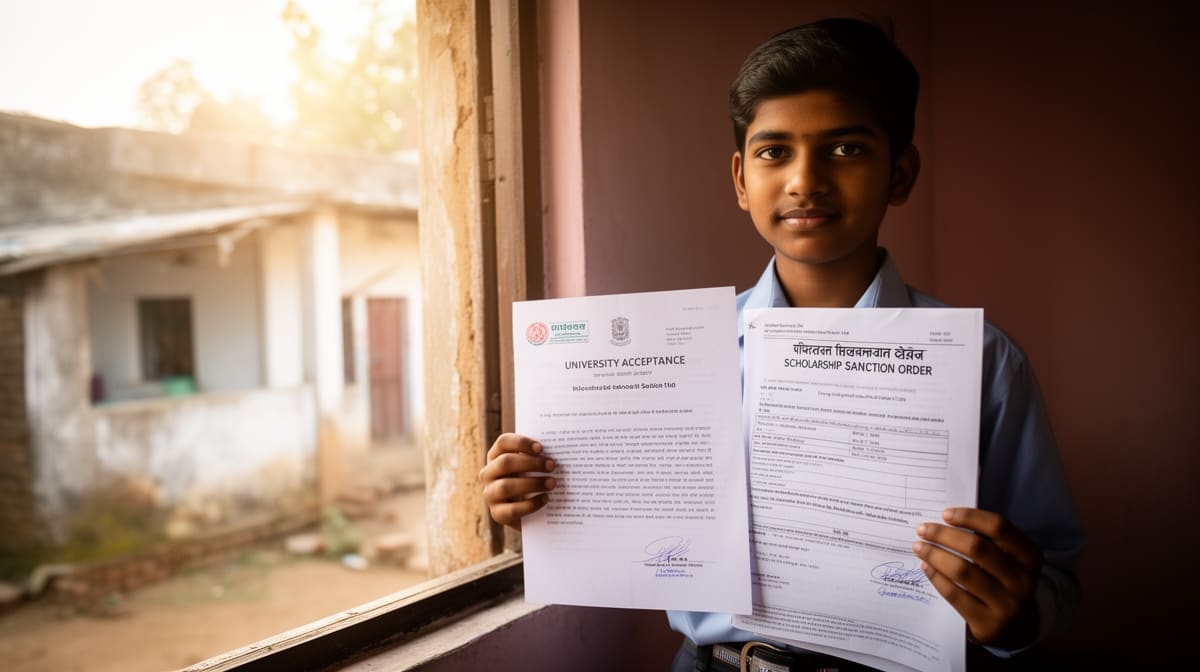
The Andhra Pradesh High Court has affirmed that the issuance of an e-pass under state-sponsored overseas scholarship schemes creates a legitimate expectation in favor of applicants, which cannot be nullified by subsequent policy revamps or administrative inaction. This judgment reinforces the doctrine of promissory estoppel against the state and mandates the reinstatement of procedural fairness for beneficiaries who acted in good faith.
Background & Facts
The Dispute
The petitioners, all belonging to Scheduled Castes (SC), Scheduled Tribes (ST), Backward Classes (BC), and Minority communities, applied for financial assistance under various state government scholarship schemes designed to enable meritorious students to pursue postgraduate and professional courses abroad. These schemes included the "Ambedkar Overseas Vidya Nidhi" (for SC/ST), "Overseas Education Scheme for Minority Students" (for minorities), "NTR Videshi Vidyadarana" (for BC), and "Economic Support Schemes" (for EBC). Each scheme was introduced through specific Government Orders (G.O.Ms.) issued between 2013 and 2018, detailing eligibility criteria, income limits, maximum financial assistance, and eligible countries.
Key Facts
- G.O.Ms. No. 54, Social Welfare (Edn.2), dated 28.06.2013: Introduced "Ambedkar Overseas Vidya Nidhi" for SC students to pursue PG/Ph.D in USA, UK, Australia, Canada, and Singapore. Eligibility: minimum 60% marks in PG and family income below Rs. 2.00 lakhs per annum.
- G.O.Ms. No. 33, Minorities Welfare (EDM), dated 29.09.2016: Introduced similar scheme for minority students with financial assistance up to Rs. 10 lakhs.
- G.O.Ms. No. 29, BC Welfare (B), dated 27.08.2016: Introduced "NTR Videshi Vidyadarana" for BC students for postgraduate studies abroad.
- G.O.Ms. No. 174, BC Welfare (B), dated 07.12.2017: Introduced "Economic Support Scheme" for Economically Backward Classes (EBC).
- Amendments: Subsequent G.Os enhanced income limits (up to Rs. 6.00 lakhs), increased financial assistance (up to Rs. 15 lakhs), and expanded eligible countries to include China, Philippines, and Kazakhstan.
- Application Process: Applicants applied online; upon meeting eligibility criteria, an "e-pass" was issued as proof of preliminary eligibility.
- e-pass Issuance Dates: Petitioners received e-passes between 2018 and 2023, with application dates ranging from 04.11.2019 to 28.02.2023.
- Course Details: Petitioners were admitted to institutions in the UK, USA, Australia, Philippines, Russia, Kazakhstan, China, and Germany for MBBS, M.Sc, Ph.D, and other postgraduate programs.
- G.O.Ms. No. 39, Social Welfare (EDN.), dated 11.07.2022: Revamped all existing schemes. Introduced new criteria: financial assistance limited to top 200 global universities (QS rankings), with 100% tuition coverage for top 100 and 50% or Rs. 50 lakhs (whichever is less) for 101 - 200. Income limit raised to Rs. 8.00 lakhs. The new scheme superseded all prior G.Os.
- State Level Screening Committee (SLSC): The SLSC, responsible for final sanction of funds, did not meet after 2019 due to the COVID-19 pandemic. No sanction orders were issued to any applicant after that date.
- No Denial Letters: Respondents did not issue formal rejection orders. Petitioners were led to believe their applications were under consideration.
Procedural History
- 2013 - 2018: Various G.Os issued establishing scholarship schemes.
- 2019 - 2022: Petitioners applied online and received e-passes.
- 2020 - 2023: SLSC meetings suspended indefinitely due to pandemic.
- 11.07.2022: G.O.Ms. No. 39 issued, superseding all prior schemes.
- 2022 - 2023: Petitioners filed 36 writ petitions (W.P. Nos. 36610/2022 to 28664/2023) before the High Court.
- 23.11.2023: Court ordered impleadment of additional respondents (Finance, Planning, SC/BC Corporations).
- 20.04.2026: Court delivered common order disposing of all 36 petitions.
The Parties' Positions
Petitioners contended that:
- The issuance of e-passes constituted a clear assurance of eligibility under the then-existing G.Os.
- The state’s failure to constitute the SLSC after 2019 was an administrative failure, not a ground to deny entitlement.
- G.O.Ms. No. 39 could not retrospectively nullify rights accrued under prior schemes.
- The doctrine of legitimate expectation and promissory estoppel bound the state to honor its assurances.
Respondents contended that:
- No final sanction orders were issued due to non-convening of SLSC.
- The schemes were subject to discretionary approval, and e-passes were merely preliminary.
- G.O.Ms. No. 39 replaced all prior schemes and applied prospectively.
- Petitioners had no vested right until final sanction.
Relief Sought
Petitioners sought:
- Declaration that the state’s failure to disburse funds violated Articles 14, 15, 16, 19, 21, and 300-A of the Constitution.
- Directions to constitute SLSC and process applications under the original G.Os.
- Disbursement of scholarship amounts as per the schemes in force at the time of application.
- Costs and injunction against further denial.
The Legal Issue
The central question was whether the issuance of an e-pass under a government scholarship scheme creates a legitimate expectation enforceable against the state, and whether a subsequent revamp of the scheme can lawfully extinguish rights accrued under prior schemes where applicants have acted in good faith and the state has failed to conduct mandatory screening.
Arguments Presented
For the Petitioner
Counsel for petitioners relied on Maneka Gandhi v. Union of India to argue that the state’s issuance of e-passes constituted a clear, unambiguous assurance of eligibility. They cited State of Haryana v. Bhagwan Das to assert that when the state creates a scheme and applicants comply with its terms, the state is estopped from denying benefits due to its own administrative lapses. They emphasized that the SLSC’s failure to meet after 2019 was a breach of procedural duty, not a valid reason to forfeit entitlement. The doctrine of promissory estoppel, as recognized in Union of India v. Ghanshyam Das, was invoked to bind the state to its conduct. Petitioners argued that G.O.Ms. No. 39, while prospective in nature, could not be applied retroactively to nullify rights already triggered by e-pass issuance.
For the Respondent
The Government Pleader argued that e-passes were merely eligibility confirmations, not final approvals. They contended that the SLSC’s non-convening was due to extraordinary circumstances (pandemic) and that no binding promise was made until sanction orders were issued. They relied on K. S. Puttaswamy v. Union of India to argue that policy revamps are permissible if they serve public interest. They maintained that since no funds were disbursed, no vested right had accrued, and petitioners had no enforceable claim under the old schemes.
The Court's Analysis
The Court rejected the state’s argument that e-passes were merely preliminary. It held that the issuance of an e-pass was not a mere administrative formality but a formal recognition of eligibility under the scheme’s criteria. The Court observed that applicants, relying on this assurance, incurred significant expenses to secure admissions abroad, including tuition deposits, visa fees, and travel arrangements.
"The e-pass was not a mere acknowledgment of application receipt; it was a formal intimation of eligibility under the scheme as it stood at the time of application. The State cannot, by its own inaction, deprive applicants of the very benefit it had affirmatively confirmed."
The Court emphasized that the doctrine of legitimate expectation arises when the state makes a clear, unambiguous representation upon which the applicant reasonably relies. The state’s failure to constitute the SLSC after 2019 was not the applicant’s fault. To deny benefits on this ground would amount to punishing the applicant for the state’s administrative failure.
The Court further held that G.O.Ms. No. 39, while introducing a comprehensive and improved scheme, did not expressly repeal or extinguish rights accrued under prior schemes. The new scheme applied prospectively to future applicants, not retroactively to those who had already met the conditions of the old schemes. The Court noted that the state’s own counter-affidavits did not allege any fraud, misrepresentation, or disqualification on the part of petitioners.
The Court distinguished Union of India v. Ghanshyam Das by noting that in that case, the promise was conditional and revocable. Here, the promise was fulfilled by the issuance of the e-pass, which triggered a duty to process the application. The state’s failure to act could not be used as a shield to avoid liability.
The Verdict
The petitioners succeeded. The Court directed the State of Andhra Pradesh to:
- Constitute State Level Screening Committees under the original G.Os in force at the time of each petitioner’s application.
- Examine all pending applications post facto and determine eligibility under the schemes as they existed when the e-passes were issued.
- Complete this review within four months from the date of receipt of the order.
- Disburse the scholarship amounts within two months of determining eligibility.
- Pay the full amount as per the original G.Os (e.g., Rs. 10 - 15 lakhs as applicable), not under the revised G.O.Ms. No. 39.
- No costs awarded.
The Court explicitly held that the financial assistance must be calculated based on the scheme in force at the time of e-pass issuance, not the revised scheme.
What This Means For Similar Cases
Legitimate Expectation Arises Upon Formal Eligibility Confirmation
- Practitioners must now argue that any formal issuance of eligibility confirmation (e-pass, pre-approval letter, provisional sanction) under a welfare scheme creates a binding legitimate expectation.
- Administrative delays or non-convening of screening bodies cannot be used to deny benefits where applicants have acted in reliance.
- This principle applies to scholarships, subsidies, housing schemes, and other welfare benefits where the state issues preliminary approvals.
Policy Revamps Cannot Erase Accrued Rights
- New schemes cannot retrospectively nullify rights triggered under prior schemes unless expressly stated.
- If a scheme has a clear eligibility criterion and the applicant satisfies it, the state must honor the promise even if the scheme is later amended.
- Courts will apply promissory estoppel against the state when applicants have incurred expenses or made irreversible decisions based on official assurances.
Procedural Compliance Is Non-Negotiable
-
Mandatory procedural steps (e.g., SLSC review) are not optional. Failure to conduct them is a breach of duty, not a justification for denial.
-
Petitioners in similar cases should immediately seek mandamus to compel constitution of statutory bodies if they are not convened.
-
Courts will not allow the state to benefit from its own inaction.
-
The judgment sets a precedent for over 10,000 pending scholarship applications across India under similar schemes.
-
State governments must now ensure timely constitution of screening committees or risk judicial intervention.
-
Legal advisors should advise clients to retain all e-passes, application receipts, and official communications as conclusive evidence of legitimate expectation.
-
This ruling strengthens the constitutional right to education under Article 21 and reinforces the state’s duty to act fairly under Article 14.