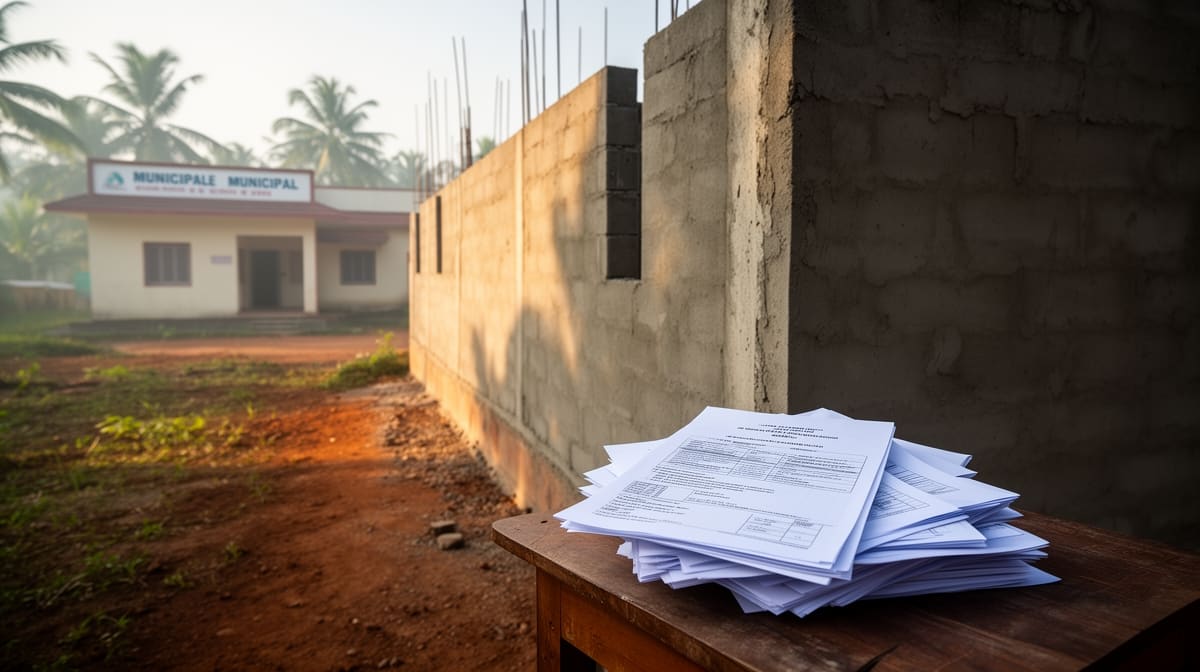
The Kerala High Court has clarified that administrative bodies cannot deny building permits solely on the basis of a land classification as 'plantation' when the property otherwise complies with statutory requirements. This judgment reinforces the principle that decisions must be grounded in substantive legal criteria, not arbitrary or superficial labels.
Background & Facts
The Dispute
The petitioner, Vagamon Happy Valley Adventures and Estates Pvt. Ltd., applied for a building permit to construct a commercial building on its property in Elappara, Idukki district. The application was rejected by the Secretary of Elappara Grama Panchayat through Ext.P5 order dated 31.03.2026, on the ground that the land was classified as a 'plantation'. The petitioner challenged this order as arbitrary and contrary to prior judicial precedents.
Key Facts
- The petitioner holds lawful possession of the land, evidenced by a Possession Certificate dated 06.03.2026 (Exhibit P2)
- Land tax receipts for the property were issued as of 19.07.2025 (Exhibit P1)
- The building permit application was submitted and acknowledged by the Panchayat on 31.03.2026 (Exhibit P3)
- The application fee was paid on 30.03.2026 (Exhibit P4)
- The rejection order (Ext.P5) was issued on the same day as the acknowledgment, 31.03.2026
- The petitioner relied on three prior judgments of the Kerala High Court: WPC No. 2689 of 2026 (23.01.2026), WPC No. 40967 of 2025 (04.11.2025), and WPC No. 11 of 2026 (06.01.2026) - collectively Exhibits P6 to P8
Procedural History
- 30.03.2026: Petitioner paid building permit application fee
- 31.03.2026: Application acknowledged by Respondent No.1; same day, rejection order (Ext.P5) issued by Respondent No.2
- 08.04.2026: Writ Petition (WP(C) No. 13543 of 2026) filed before the High Court of Kerala at Ernakulam
- 08.04.2026: Court heard arguments and delivered judgment on the same day
Relief Sought
The petitioner sought:
- Quashing of Ext.P5 order
- A writ of mandamus directing the Panchayat to grant the building permit
- Dispensation from the requirement to translate vernacular documents
The Legal Issue
The central question was whether a local body may lawfully reject a building permit application solely on the ground that the land is classified as a 'plantation', when the applicant has lawful possession, pays land tax, and the proposed construction complies with all other statutory and zoning norms.
Arguments Presented
For the Petitioner
The petitioner’s counsel argued that the rejection order was based on an irrelevant and legally unsustainable ground. The classification of land as 'plantation' under revenue records does not, by itself, prohibit commercial construction. The petitioner relied on three recent judgments of the same court - WPC No. 2689 of 2026, WPC No. 40967 of 2025, and WPC No. 11 of 2026 - which held that such classifications cannot override compliance with building regulations. The counsel emphasized that the Panchayat had not demonstrated any violation of building bylaws, environmental norms, or land use zoning.
For the Respondent
The Standing Counsel for the Panchayat did not contest the applicability of the cited precedents. No independent legal argument was advanced to justify the rejection on the basis of 'plantation' status. The respondent did not dispute that the petitioner had submitted all requisite documents or that the property was otherwise eligible for construction.
The Court's Analysis
The Court observed that the rejection order (Ext.P5) was issued without any reference to specific violations of the Kerala Municipal Building Rules or the Panchayat Building Regulations. The sole ground cited - that the land is a 'plantation' - was held to be legally insufficient. The Court noted that land classification under revenue records is distinct from land use zoning under building regulations. A property may be recorded as 'plantation' for tax purposes while still being permissible for commercial development under local building norms.
"If the application is otherwise in order, the reason mentioned in Ext.P5 cannot be a valid ground for rejection."
The Court emphasized that administrative decisions must be reasoned, relevant, and consistent with judicial precedent. The prior judgments cited by the petitioner (Exhibits P6 to P8) were binding on the same court and directly addressed identical factual and legal issues. The Court held that the Panchayat’s refusal to reconsider the application in light of these precedents amounted to an abuse of discretion.
The Verdict
The writ petition was allowed. The Court set aside Ext.P5 order dated 31.03.2026. The 2nd respondent, Secretary, Elappara Grama Panchayat, was directed to reconsider the building permit application dehors the 'plantation' classification, provided the application otherwise complies with applicable building rules. The reconsideration must be completed within 30 days of receipt of a certified copy of this judgment. The request to dispense with translation of vernacular documents was granted as unnecessary in light of the relief granted.
What This Means For Similar Cases
Land Classification Cannot Override Building Regulations
- Practitioners must challenge permit rejections based solely on revenue classification (e.g., 'plantation', 'forest', 'wasteland') if the applicant has valid possession and complies with building bylaws
- Revenue records are not determinative of permissible land use under municipal or panchayat building codes
Precedent Binding on Administrative Bodies
- Local authorities are bound by High Court judgments on identical issues, even if not formally cited in the application
- Failure to apply binding precedent constitutes arbitrariness under Article 14 of the Constitution
Procedural Compliance Must Be the Focus
-
Authorities must assess applications on the basis of statutory compliance - not subjective or extraneous labels
-
Rejection orders must specify exact violations of rules; generic grounds like 'plantation' are legally invalid
-
Always verify land use zoning under local building regulations, not just revenue records
-
If a prior judgment exists on the same issue, cite it explicitly in applications and appeals
-
Demand reasoned orders; unreasoned rejections are liable to be quashed under Article 226