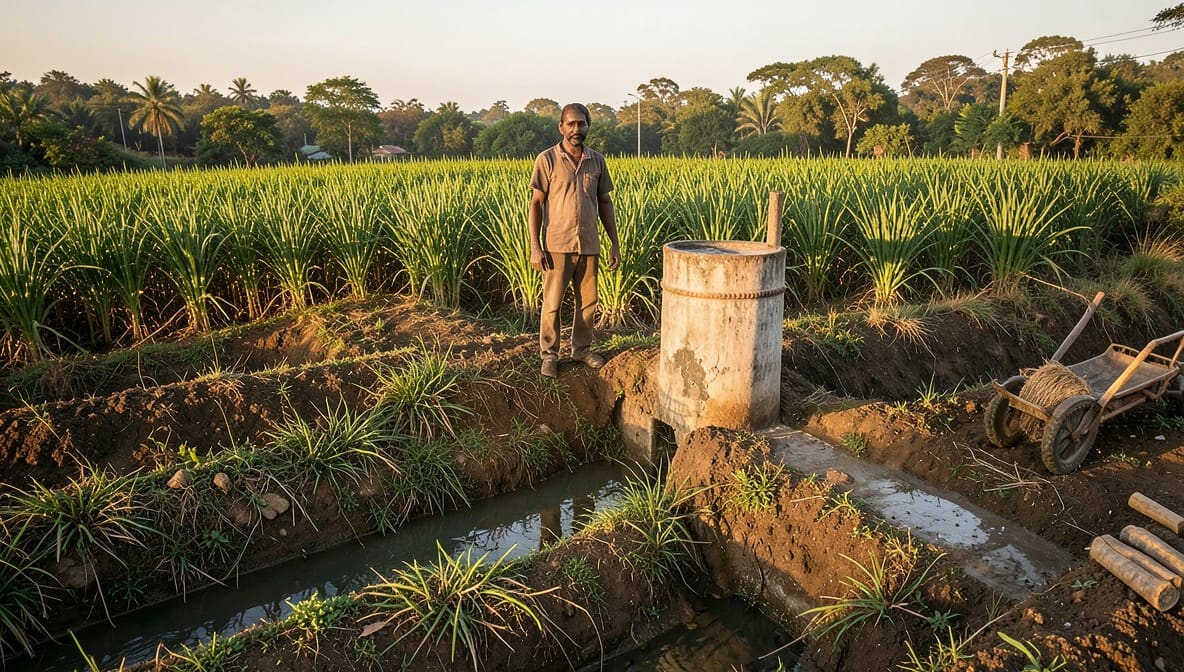
The Madhya Pradesh High Court has clarified that land classification for compensation purposes under the Land Acquisition Act, 1894 must be grounded in documented revenue records and tangible evidence, not arbitrary division. Where Khasra entries, electricity bills, and witness testimony uniformly establish that acquired land is irrigated, authorities cannot reduce compensation by splitting the land into irrigated and unirrigated categories without justification.
Background & Facts
The Dispute
The appellant, Mayaram, was the owner of agricultural land bearing Survey No. 38/2 in Village Khadki, Tehsil Rajpur, District Barwani, with a total area of 3.476 hectares. The State Government initiated acquisition of 1.160 hectares of this land for the construction of a canal under the Goi Project. The Land Acquisition Officer (LAO) determined compensation based on a classification that treated only 0.500 hectares as irrigated land, 0.660 hectares as unirrigated land, and 0.016 hectares as fallow land, resulting in a total compensation of Rs. 7,47,000 plus 12% statutory interest.
Key Facts
- The appellant’s land was acquired under a preliminary notification issued on 05.12.2011 under Section 4 of the Land Acquisition Act, 1894.
- A final declaration under Section 6 was issued on 27.07.2012.
- Claims for compensation were invited via Section 9 notification on 15.04.2013.
- The LAO passed the initial award on 30.09.2013.
- The appellant filed a reference under Section 18 before the District Judge, Barwani, in Reference Case No. 364/2014, challenging the classification and market value.
- The reference court dismissed the reference by award dated 30.07.2016.
- The appellant appealed to the High Court, which allowed the appeal on 20.07.2017 and remanded the matter for fresh determination under the Right to Fair Compensation and Transparency in Land Acquisition, Rehabilitation and Resettlement Act, 2013.
- On remand, the reference court passed the impugned award on 12.12.2017, maintaining the same classification and rejecting enhancement of market value.
- The appellant filed the present first appeal under Section 54 of the Land Acquisition Act, 1894.
Procedural History
- 05.12.2011: Preliminary notification under Section 4 issued.
- 27.07.2012: Declaration under Section 6 issued.
- 15.04.2013: Section 9 notification inviting claims.
- 30.09.2013: LAO’s initial award.
- 2014: Reference Case No. 364/2014 filed before District Judge, Barwani.
- 30.07.2016: Reference Court dismissed the reference.
- 20.07.2017: High Court allowed first appeal and remanded the matter.
- 12.12.2017: Reference Court passed impugned award on remand.
- 15.06.2026: Judgment delivered by High Court.
The Underlying Transaction
The appellant produced the following evidence to prove the land was entirely irrigated:
- Ex. P-4: Khasra record for 2007-08 showing total area 3.476 hectares, with 3.460 hectares encircled (indicating irrigated land), and 0.016 hectares marked as fallow land (पड़त भूिम).
- Exs. P-5 to P-8: Electricity bills for a 3HP pump connected to a well on the land, under agricultural tariff category LB 5.1.
- Exs. P-9 to P-12: Photographs showing standing crops and irrigation pipelines.
- Testimony of Patwari Sunil (PW-4): Confirmed that revenue records from 2007-08 to 2011-12 consistently classified the land as irrigated.
- Ex. P-21: Five-yearly Khasra (2006-07 to 2010-11) relied upon by the LAO, which also showed encircled areas for cotton and chilly crops - indicating irrigated land - and a well with 3HP pump.
Procedural History (Continued)
- The LAO (PW-4) admitted using Ex. P-21 to classify the land.
- The State’s witness Ratanlal (DW-1) failed to explain why half the land was classified as unirrigated despite revenue records showing otherwise.
- The appellant did not produce sale deeds of nearby plots to prove higher market value.
- The appellant admitted no documentary proof of the PVC pipeline’s existence.
Relief Sought
The appellant sought:
- Reclassification of the entire 1.160 hectares as irrigated land.
- Enhancement of market value based on comparable sales in nearby villages (Bilwani and Rajpur Halka).
- Compensation for the PVC pipeline laid on the land.
- Higher compensation for three trees on the land.
- Rejection of the 0.016 hectares fallow land classification as unsupported.
The Legal Issue
The central questions were: (1) whether the market value of the acquired land was correctly determined in absence of comparable sale evidence; and (2) whether the Land Acquisition Officer was justified in bifurcating the acquired land into irrigated and unirrigated portions despite revenue records and documentary evidence establishing the entire land as irrigated.
Arguments Presented
For the Appellant
The appellant’s counsel argued that:
- The Khasra entries (Ex. P-4 and Ex. P-21) clearly showed the entire land as irrigated, with encircled crop areas and a well with a 3HP pump.
- Electricity bills (Exs. P-5 to P-8) corroborated active irrigation through electric pumps.
- Photographs (Exs. P-9 to P-12) visually confirmed irrigation infrastructure and standing crops.
- The Patwari’s testimony was unchallenged and consistent with revenue records.
- The LAO’s arbitrary division of the land into 0.500 hectares irrigated and 0.660 hectares unirrigated lacked any evidentiary basis.
- The 0.016 hectares classified as fallow land was not even part of the acquired area (1.160 hectares), and its category was never established.
- The reference court failed to consider this evidence, rendering its finding in para 42 legally unsustainable.
For the Respondent/State
The State’s counsel contended that:
- No specific document proved the entire land was irrigated.
- No geo-tagging or survey maps were produced to substantiate the claim.
- The classification followed the Revenue Department’s circular dated 29.01.2014.
- The appellant failed to produce sale deeds of comparable land to justify higher market value.
- The reference court’s findings were based on available evidence and should not be disturbed.
The Court's Analysis
The Court undertook a meticulous review of the evidence, particularly the Khasra records and testimonial corroboration. It emphasized that revenue records are the primary source for determining land classification in acquisition proceedings.
"It is clear from the Khasra for the year 2007-08 that almost the entire land of the appellant is shown as irrigated land and that the well attached with 3HP electric pump is situated on the said land. Hence, immediate presumption comes in the mind that the land was being irrigated through the said well."
The Court noted that the appellant discharged the initial burden of proving the land was irrigated through documentary and testimonial evidence. The burden then shifted to the State to justify the bifurcation - a burden it entirely failed to discharge.
"There is complete absence of any explanation in this behalf in the evidence led by the respondents before the reference Court."
The Court rejected the State’s reliance on the Revenue circular, observing that circulars cannot override clear revenue records. The LAO’s decision to treat half the land as unirrigated was arbitrary and unsupported. The Court further held that the 0.016 hectares classified as fallow land was not part of the acquired area and its classification was irrelevant and unproven.
Regarding market value, the Court found no error. The appellant admitted he did not produce any sale deeds of comparable land, and the reference court’s valuation was not shown to be manifestly incorrect.
The Court also dismissed claims for pipeline and tree compensation, noting the absence of documentary proof.
The Verdict
The appeal was allowed in part. The Court held that the entire 1.160 hectares of acquired land must be treated as irrigated land. The respondents are directed to recalculate compensation at the rate applicable to irrigated land, pay the differential amount, and include statutory interest at 12% per annum from the date of possession until payment. The authorities must comply within three months from the date of receipt of this order. Claims for enhanced market value, pipeline compensation, and increased tree compensation were rejected.
What This Means For Similar Cases
Revenue Records Are Conclusive in Land Classification
- Practitioners must prioritize obtaining and submitting Khasra records, Jamabandi entries, and land revenue maps as primary evidence in acquisition disputes.
- Any deviation from revenue records by the LAO must be justified with specific, documented reasons - mere administrative convenience is insufficient.
Burden of Proof Shifts After Initial Showing
- Once the landowner produces credible revenue records and corroborative evidence (electricity bills, photographs, Patwari testimony), the burden shifts to the acquiring authority to prove why the classification should differ.
- Failure to rebut such evidence renders the LAO’s classification legally unsustainable.
Fallow Land Classification Requires Specific Determination
- Fallow land must be categorized (current, old, uncultivable) and proven to be part of the acquired area.
- Arbitrary inclusion of fallow land in acquisition without evidence is impermissible and invalidates compensation calculations.
Market Value Claims Require Comparable Evidence
- To challenge market value, landowners must produce sale deeds of similar plots in nearby areas within a reasonable time frame.
- Absence of such evidence precludes enhancement, even if the valuation appears low.
No Compensation for Unproven Infrastructure
- Claims for compensation for pipelines, wells, or trees require documentary proof of ownership, cost, and existence.
- Oral testimony or photographs alone, without supporting documents, are insufficient.