The Bombay High Court has clarified a critical principle in land acquisition jurisprudence: irrigated land must be compensated at double the rate of dry land when market value is determined by reference to comparable sales. This ruling resolves longstanding ambiguity in valuation methodology and provides binding guidance for claimants and acquiring authorities alike.
Background & Facts
The Dispute
The appellant, Vilas Malharrao Mahulkar, an agriculturist from Tembhurkheda, Amravati, challenged the compensation awarded for 57 Ropani of his land acquired for the widening of the Tembhurkheda-Insambri road. The Land Acquisition Officer (L.A.O.) determined compensation at Rs.1,90,000 per hectare, based on a sale instance dated 17.04.1996 (Exhibit-22), which the Reference Court treated as representative of dry crop land. The appellant contended that his land was partially irrigated and thus entitled to higher valuation.
Key Facts
- The acquired land comprised 57 Ropani (approximately 1.425 hectares), divided into 29 Ropani of irrigated land and 28 Ropani of potkharab (uncultivable) land.
- The L.A.O. awarded Rs.55,100 for the 29 Ropani irrigated portion and Rs.13,300 for the 28 Ropani potkharab land.
- The sale instance (Exhibit-22) involved a transaction of dry land dated 17.04.1996, with a rate of Rs.57,142 per hectare.
- The Reference Court applied a 10% annual increase over 13 years (from 17.04.1996 to 19.05.2009, date of Section 4 notification), arriving at Rs.1,31,427 per hectare for dry land.
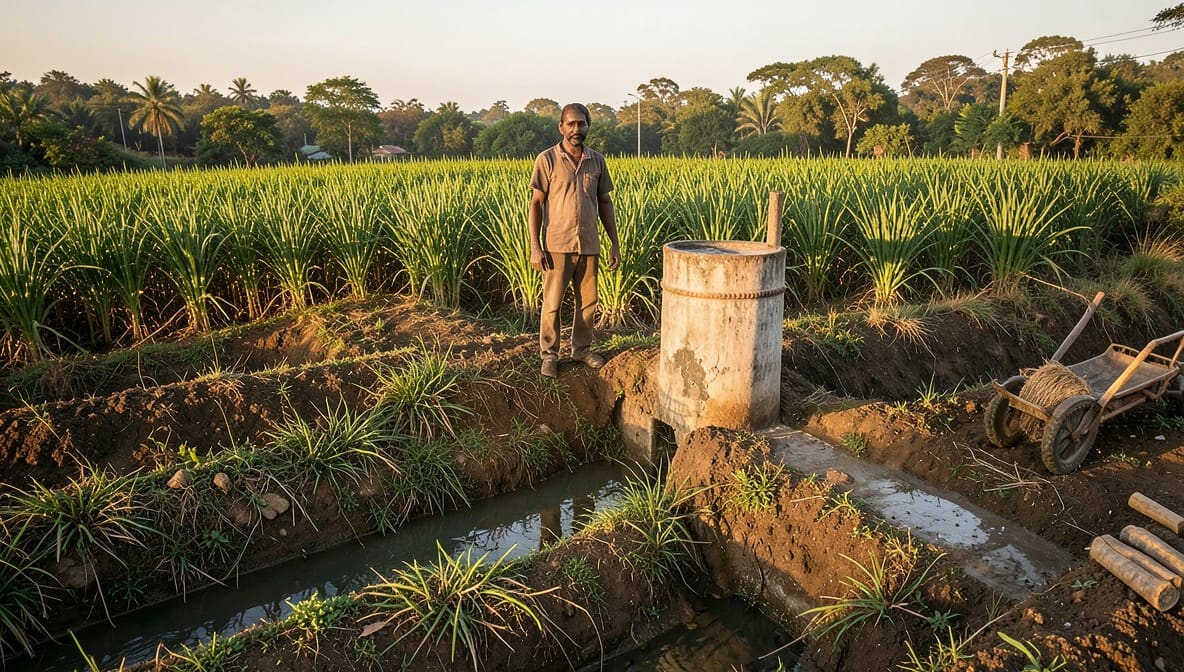
- The appellant produced evidence of a well and motor pump on the acquired land, and crop records (Extract 12) showing cultivation of Kharif crops in 2007-08, 2008-09, and 2009-10.
- No cross-examination was conducted on the existence or functionality of the well or irrigation infrastructure.
- The Reference Court dismissed the claim for higher compensation, holding that the absence of evidence on well depth, diameter, and consistent irrigation rendered the land dry.
Procedural History
- 17.04.1996: Sale deed (Exhibit-22) executed for dry land in same village.
- 19.05.2009: Section 4 notification published for acquisition.
- 31.03.2010: L.A.O. issued award of Rs.1,90,000 per hectare.
- 2011: Appellant filed Reference Application No.99 of 2011 before the Joint Civil Judge, Senior Division, Amravati.
- 07.02.2015: Reference Court dismissed the application, upholding L.A.O.’s award.
- 2015: First Appeal No.676 of 2015 filed before the Bombay High Court, Nagpur Bench.
Relief Sought
The appellant sought enhancement of compensation: (1) double the rate for 29 Ropani of irrigated land; (2) half the rate for 28 Ropani of potkharab land; and (3) statutory interest and costs.
The Legal Issue
The central question was whether irrigated land in a land acquisition proceeding is entitled to double the market value assigned to dry land under the Land Acquisition Act, 1894, when evidence confirms the presence of irrigation infrastructure and consistent cultivation, even in the absence of technical data on well capacity.
Arguments Presented
For the Appellant
The appellant’s counsel argued that the Reference Court erred in disregarding the physical evidence of irrigation. He relied on settled precedent that where land is shown to be irrigated by a well or canal, and crops are cultivated annually, it must be classified as irrigated land. He cited State of Maharashtra v. Rameshwar and Kishanlal v. Land Acquisition Officer to assert that the burden of disproving irrigation lies with the acquiring authority, which failed to cross-examine on the well or pump. He emphasized that the canal adjacent to the land and the crop records were sufficient to establish irrigation status.
For the Respondent
The State’s counsel contended that the sale instance (Exhibit-22) was for dry land and that the appellant failed to prove the irrigation capacity of the well. He argued that without evidence of well depth, diameter, or water yield, the land could not be classified as irrigated. He relied on the Reference Court’s observation that the 7/12 extract showed only one well and no evidence of consistent irrigation, and that dry crops were cultivated for three consecutive years.
The Court's Analysis
The Court undertook a meticulous review of the evidence and found the Reference Court’s reasoning flawed. It noted that while the sale instance (Exhibit-22) was for dry land, the acquired land was part of the same parcel and bore physical indicators of irrigation: a well, a motor pump, and proximity to a canal. The Court emphasized that the absence of technical data on well capacity does not negate the reality of irrigation, particularly where the land has been cultivated annually with Kharif crops.
"The fact that the Appellant reaped Kharif crops for three consecutive years prior to acquisition, coupled with the presence of a well and motor pump, is conclusive evidence of irrigation, irrespective of the absence of measurements of the well’s depth or diameter."
The Court held that the principle of double compensation for irrigated land, as established in State of Maharashtra v. Rameshwar, is not contingent on exhaustive hydrological data but on observable and documented agricultural use. It further noted that the L.A.O. and Reference Court failed to apply the settled legal standard: where land is irrigated, its value must be doubled compared to dry land in the same locality.
The Court also accepted the appellant’s submission regarding potkharab land, affirming that such land is entitled to half the rate of dry land. The Reference Court’s failure to apply these differential rates was therefore legally untenable.
The Verdict
The appeal was allowed. The Court modified the Reference Court’s order dated 07.02.2015 and directed enhanced compensation as follows: Rs.21,127 for the 29 Ropani of irrigated land and Rs.18,399 for the 28 Ropani of potkharab land, along with statutory benefits. The enhanced amount of Rs.39,526 must be deposited in the Court’s office within four months. Court fees on the enhanced amount must be paid before withdrawal. The record is to be sent back to the Tribunal.
What This Means For Similar Cases
Irrigation Status Is Determined by Use, Not Just Technical Data
- Practitioners must now argue that continuous cultivation of water-intensive crops (e.g., Kharif) combined with visible irrigation infrastructure (well, pump, canal proximity) is sufficient to establish irrigated status.
- Acquiring authorities cannot demand hydrological reports as a precondition for higher valuation; the burden shifts to them to disprove irrigation through cross-examination or contrary evidence.
Double Rate Is Mandatory, Not Discretionary
- The double rate for irrigated land is not a discretionary enhancement but a mandatory legal principle under the Land Acquisition Act.
- Courts must apply this rule automatically when evidence supports irrigation, regardless of whether the comparable sale instance was for irrigated or dry land.
Potkharab Land Entitles to Half-Rate Compensation
- The Court reaffirmed that potkharab land (uncultivable, rocky, or barren) is entitled to half the rate of dry land, not nil compensation.
- This prevents arbitrary undervaluation of marginal land parcels and ensures equitable compensation across all land types.
Documenting Agricultural Use Is Critical
- Claimants should routinely collect and submit: crop records (7/12 extracts), photographs of irrigation structures, and witness statements on cultivation patterns.
- Legal notices and claims must explicitly request application of the double rate and half-rate rules, citing State of Maharashtra v. Rameshwar and similar precedents.