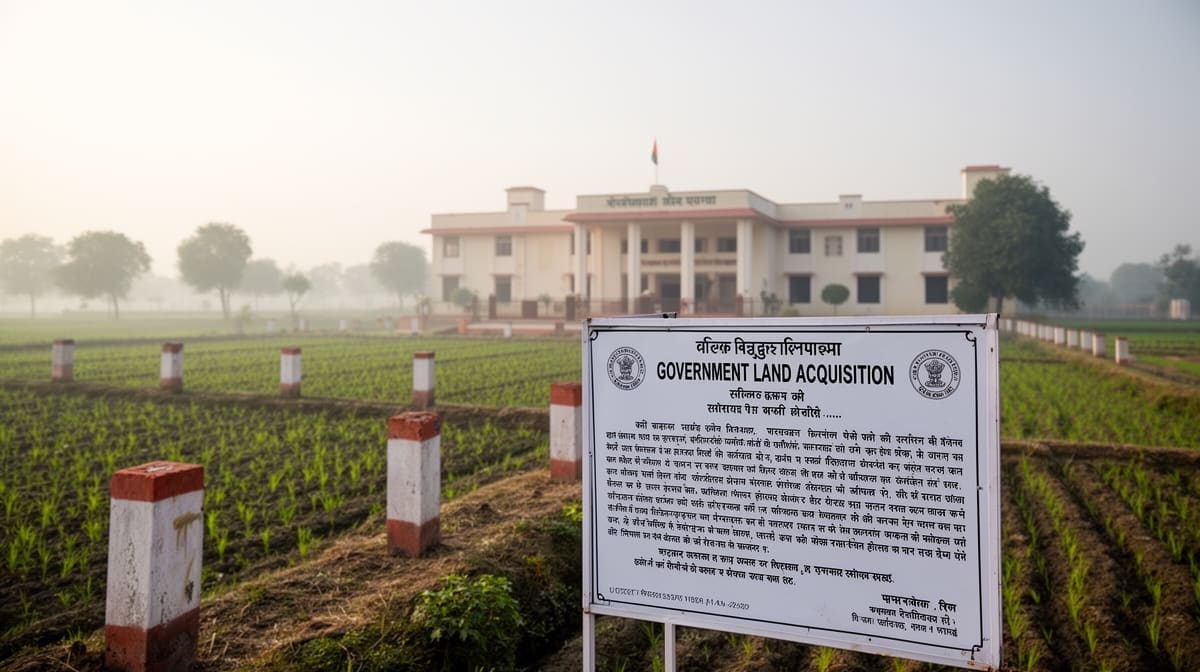
The Bombay High Court has reaffirmed that uniform compensation must be granted to landowners whose properties are acquired under the same notification for the same public purpose, establishing parity as a non-negotiable principle under the Land Acquisition Act, 1894. This ruling resolves conflicting awards arising from identical circumstances and reinforces the constitutional mandate of just compensation.
Background & Facts
The Dispute
The dispute arose from the acquisition of agricultural lands in village Makani, Taluka Omerga, District Osmanabad, under Section 4 of the Land Acquisition Act, 1894, for the rehabilitation of earthquake-affected persons. The notification was issued on 29 September 1994, and the Land Acquisition Officer (LAO) passed an award on 21 October 1997, fixing compensation at Rs.25,400 per hectare. The claimants, Shankar and Sharad Ambadas Jadhav, challenged this award, seeking enhancement to Rs.60 per square foot, arguing that their land had NA potential and was adjacent to a state highway, thereby commanding a higher market value.
Procedural History
- 1997: LAO awarded Rs.25,400 per hectare (approx. Rs.2.50 per sq.ft.)
- 2007: Reference Court enhanced compensation to Rs.13 per sq.ft. but deducted 30% for development charges
- 2019: In a collateral proceeding (LAR No.738/2009), the Reference Court awarded Rs.22 per sq.ft. to adjacent landowners; the State did not appeal
- 2023: Single Judge Bench of Bombay High Court granted Rs.22 per sq.ft. in Pandit Bhimrao Shirke v. State of Maharashtra
- 2025: Single Judge Bench in Manohar Kedari Sawant v. State of Maharashtra upheld parity in compensation for similar lands
Relief Sought
The claimants sought enhancement of compensation to Rs.22 per sq.ft. without deduction of development charges, invoking the doctrine of parity. The State sought to set aside the Reference Court’s enhancement, arguing that development charges were mandatory and that parity could not override individual assessment.
The Legal Issue
The central question was whether compensation for lands acquired under the same notification and for the same public purpose must be uniform when adjacent properties have comparable potential, or whether each claimant must independently prove market value irrespective of prior awards.
Arguments Presented
For the Petitioner
The claimants relied on Nanak (Deceased) Through LRS v. New Okhla Industrial Development Authority and Krishan Kumar v. State of Haryana, arguing that parity in compensation is a settled legal principle when lands are acquired under the same notification and share identical characteristics. They highlighted that the State had accepted Rs.22 per sq.ft. in LAR No.738/2009 and did not challenge it, thereby rendering that award final. They further cited Pandit Bhimrao Shirke and Manohar Kedari Sawant as binding precedents from the same Bench.
For the Respondent
The State contended that development charges are mandatory under Section 23(1A) and that each claimant must independently establish market value. It argued that the Reference Court’s award of Rs.13 per sq.ft. was based on evidence and that granting Rs.22 per sq.ft. would set a precedent undermining the statutory framework. It further claimed that parity cannot override the requirement of individualized assessment under Section 23.
The Court's Analysis
The Court examined the doctrine of parity as a corollary to the constitutional guarantee of just compensation under Article 300A and Section 23 of the Land Acquisition Act. It held that when multiple parcels of land are acquired under the same notification, for the same purpose, and with comparable location and potential, differential compensation without objective justification violates the principle of equality.
"It would be unjustified to award different compensation amount for the acquired land for the same purpose in same village."
The Court emphasized that the State’s own conduct - accepting Rs.22 per sq.ft. in LAR No.738/2009 and declining to appeal - constituted an admission of market value. The Court distinguished Krishan Kumar and Nanak as directly on point, noting that the Supreme Court has repeatedly held that parity is not discretionary but mandatory in such circumstances.
The Court rejected the State’s argument that development charges must be deducted uniformly, finding no statutory mandate requiring such deduction where the land has NA potential and is adjacent to a highway. The Reference Court’s deduction of 30% was deemed arbitrary in light of the established market rate.
The Court also clarified that while interest under Sections 28 and 34 is payable, statutory benefits under Section 23(1A) for delayed payment are not applicable where the delay stems from the claimants’ own delay in filing LARs, not from State inaction.
The Verdict
The claimants won. The Court held that compensation must be uniform for lands acquired under the same notification with comparable potential, and granted Rs.22 per sq.ft. without deduction of development charges. The State’s appeals were dismissed. Interest was awarded as per State of Maharashtra v. Kailash Shiva Rangari, but statutory benefits under Section 23(1A) were denied.
What This Means For Similar Cases
Parity Overrides Individual Assessment
- Practitioners must now argue parity as a substantive right, not merely a persuasive factor
- Where multiple claimants are affected by the same acquisition notification, failure to grant uniform compensation invites reversal on appeal
- Evidence of prior awards to adjacent landowners must be treated as prima facie proof of market value
Development Charges Cannot Be Automatically Deducted
- Deductions for development charges are not mandatory where land has NA potential or is adjacent to infrastructure
- The burden shifts to the State to prove that such deductions are justified by actual development costs
- Courts will scrutinize arbitrary deductions that reduce compensation below established market rates
State’s Silence Can Constitute Acceptance
- If the State does not appeal an award granting higher compensation to similarly situated claimants, that award becomes binding on subsequent claims
- Practitioners should cite non-appeal as evidence of the State’s tacit admission of market value
- This creates a strategic advantage in consolidated acquisition cases where one claimant’s success can benefit others