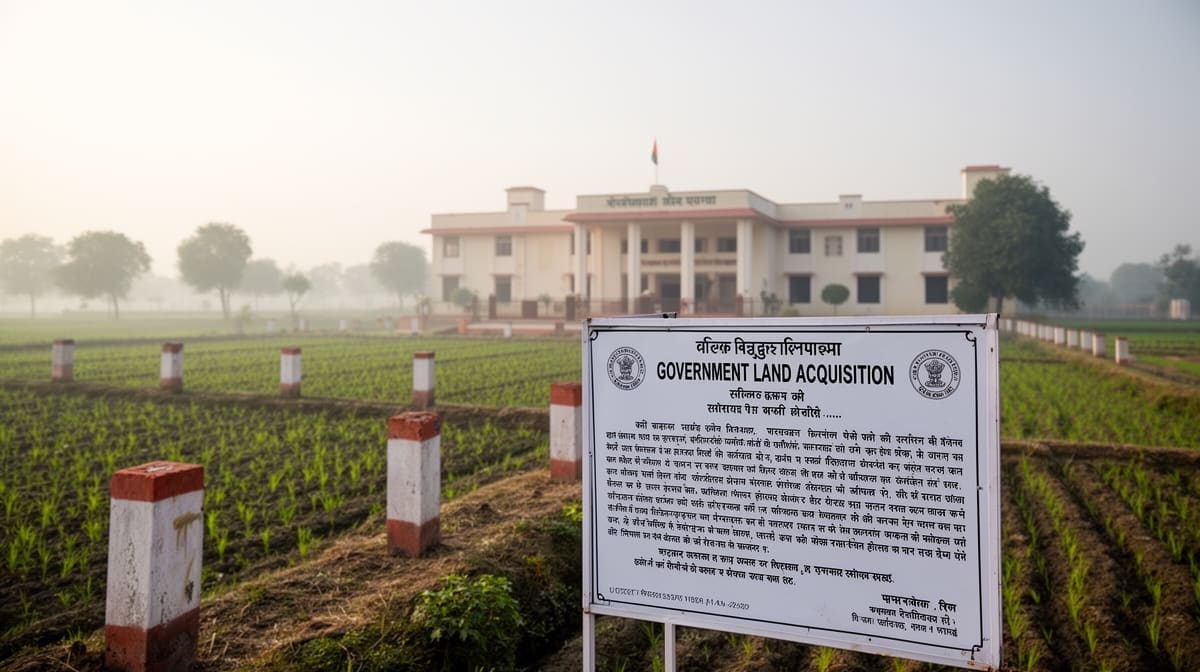
The Punjab & Haryana High Court has affirmed a foundational principle in land acquisition law: co-sharers in acquired land are entitled to the same compensation awarded to other co-owners, regardless of whether they personally filed objections under Section 18 or 28-A of the Land Acquisition Act, 1894. This ruling resolves a recurring procedural dispute and reinforces equitable treatment among landowners in state acquisition proceedings.
Background & Facts
The Dispute
The petitioners, co-sharers in land acquired by the State of Haryana for industrial development, sought execution of an award passed in favor of their co-sharers under Section 18 of the Land Acquisition Act, 1894. They were not parties to the original reference proceedings but claimed entitlement to the same compensation amount awarded to their co-owners. The executing court dismissed their petition on the ground that they had not filed objections under Section 18 or 28-A, thereby treating them as having waived their right to claim compensation.
Procedural History
- 2023: Land acquired by Haryana State Industrial and Infrastructure Development Corporation for industrial sites
- 2024: Compensation award passed in favor of certain co-sharers under Section 18
- 2025: Petitioners filed execution application seeking identical compensation
- 18.04.2025: Additional District Judge, Gurugram, dismissed execution petition for lack of prior objection
- 19.02.2026: Revision petition filed before Punjab & Haryana High Court
Relief Sought
The petitioners sought direction to the executing court to enforce the compensation award granted to their co-sharers, arguing that as co-owners of the same parcel, they were entitled to equal benefit under the principle of equitable distribution.
The Legal Issue
The central question was whether a co-sharer in acquired land, who did not file an objection under Section 18 or Section 28-A of the Land Acquisition Act, 1894, is barred from claiming the same compensation awarded to other co-sharers through execution of their award.
Arguments Presented
For the Petitioner
Learned counsel relied on the Supreme Court’s recent decision in Ramphal & Ors. v. Haryana State Industrial and Infrastructure Development Corporation Ltd. & Ors., arguing that the Court had explicitly held that co-sharers are entitled to all consequential benefits flowing from the award, including the same compensation amount, irrespective of their participation in the reference proceedings. The petitioner contended that the executing court’s dismissal was contrary to the settled law laid down by the Apex Court.
For the Respondent
The State, through the Deputy Advocate General, argued that execution of an award is a statutory remedy available only to parties who had actively participated in the reference proceedings under Section 18 or 28-A. Non-participating co-sharers, it was submitted, could not be allowed to piggyback on awards obtained by others without fulfilling procedural prerequisites.
The Court's Analysis
The Court examined the Supreme Court’s judgment in Ramphal & Ors. and found it directly applicable. The Apex Court had clarified that the acquiring authority, being an instrumentality of the State, must ensure equitable treatment among all co-sharers. The Court emphasized that compensation under the Land Acquisition Act is not a reward for procedural diligence but a constitutional obligation under Article 300A to provide just compensation.
"The appellants would be entitled to all other consequential benefits which flow from award of compensation and the respondent(s) authorities shall compute the compensation as has been determined by the award passed under Section 18 of the Act..."
The High Court held that the executing court erred in treating non-filing of objections as a waiver of substantive rights. The right to equal compensation is inherent in co-ownership and cannot be extinguished by procedural omission. The Court distinguished between the right to challenge the award (which requires objection under Section 18) and the right to benefit from an award already passed in favor of co-owners (which is automatic). The latter flows from the nature of joint ownership and the State’s duty to treat all landowners fairly.
The Verdict
The petitioners succeeded. The High Court set aside the executing court’s order and held that co-sharers are entitled to the same compensation awarded to other co-owners, even without filing objections under Section 18 or Section 28-A. The matter was remanded to the executing court to compute and disburse the compensation within the timelines prescribed in Ramphal’s case.
What This Means For Similar Cases
Compensation Rights Are Inherent, Not Procedural
- Practitioners must now argue that co-ownership creates an automatic entitlement to compensation awarded to other co-sharers
- Execution petitions by non-objecting co-sharers cannot be dismissed on procedural grounds alone
- The burden shifts to the State to prove that the petitioner is not a co-sharer, not on the petitioner to prove procedural compliance
Execution Courts Must Apply Supreme Court Precedents
- Executing courts are bound by the Supreme Court’s directive in Ramphal’s case to treat co-sharers equally
- Any refusal to execute compensation on grounds of non-participation in reference proceedings is now legally untenable
- Practitioners should cite Ramphal as binding precedent in all pending execution matters involving co-sharers
Statutory Benefits Extend to All Co-Sharers
- Interest, solatium, and other statutory benefits awarded to one co-sharer must be extended to all
- The three-month timeline for computation and disbursement under Ramphal applies uniformly
- Delay in payment triggers 9% interest from the date of determination, regardless of who filed the original objection