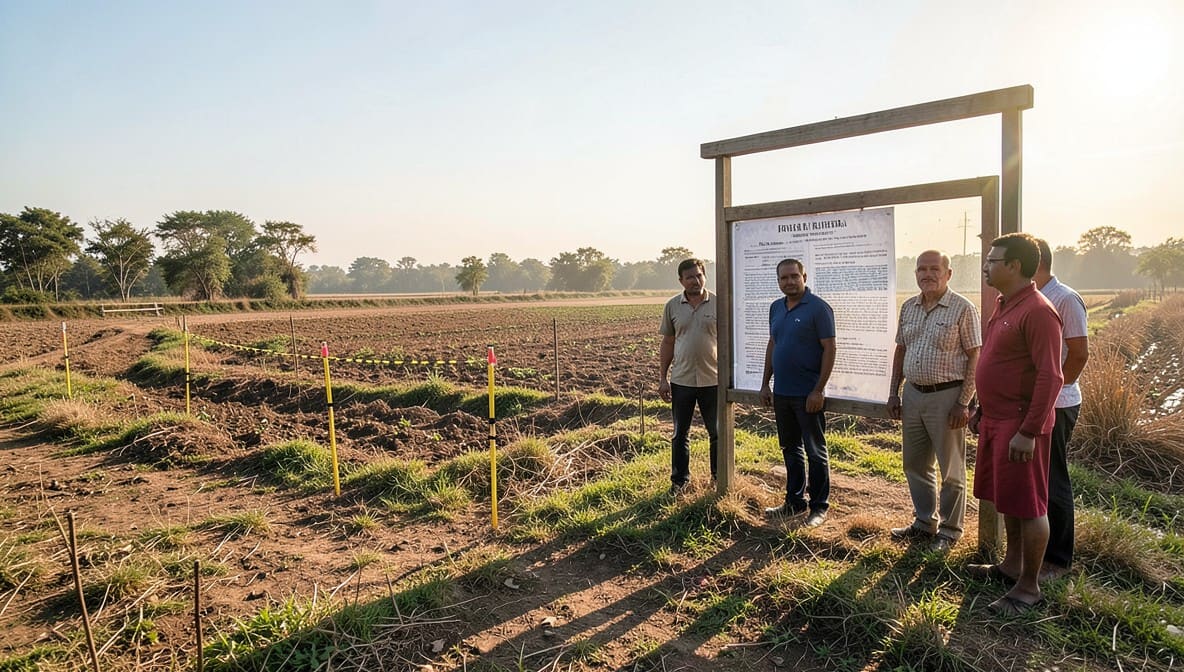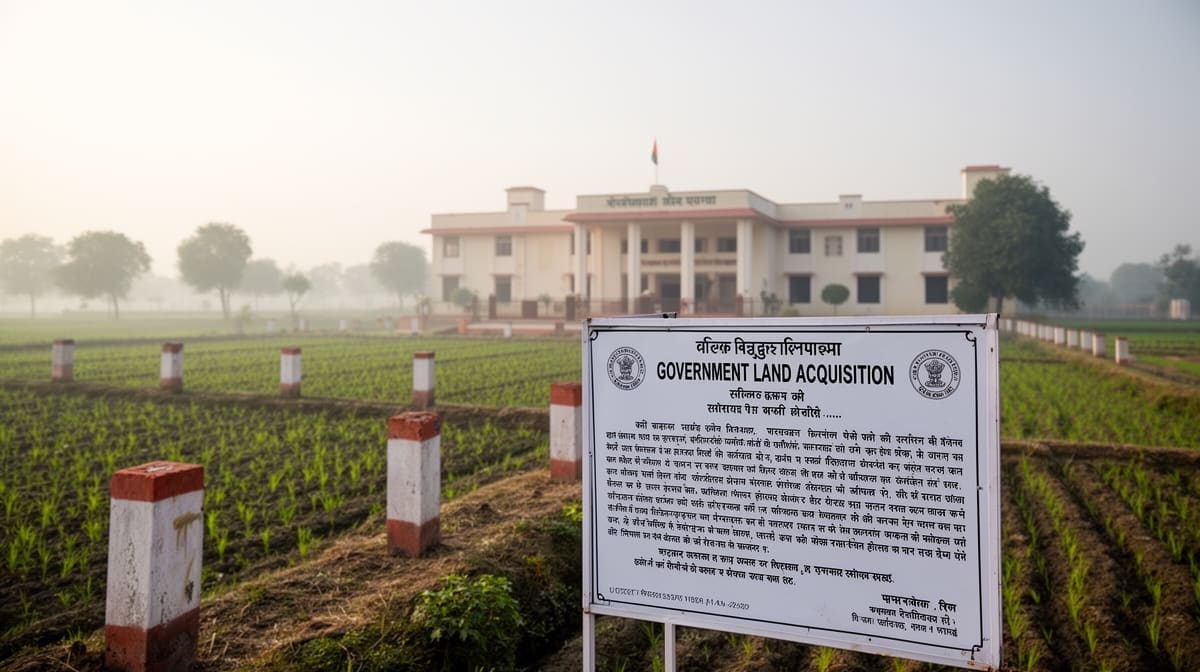
A significant clarification has emerged on the rights of co-sharers in land acquisition proceedings, affirming that entitlement to equal compensation does not hinge on prior objection under Section 18 of the Land Acquisition Act. The Punjab and Haryana High Court, relying on a recent Supreme Court precedent, has restored the petitioner’s right to claim the same enhanced compensation awarded to his co-sharers, reinforcing equitable treatment in state acquisitions.
Background & Facts
The Dispute
The petitioner, a landowner in Sonipat, Haryana, owned a share in agricultural land acquired by the Haryana State Industrial and Infrastructure Development Corporation Limited for industrial development. While several co-sharers filed objections under Section 18 of the Land Acquisition Act, 1894, leading to an enhanced compensation award, the petitioner did not file any such objection or reference. Despite this, he later filed an execution application seeking payment of the same enhanced compensation awarded to his co-sharers.
Key Facts
- The acquired land was utilized for forming industrial sites and allotted to private entities under applicable rules
- Multiple co-sharers filed references under Section 18 of the Land Acquisition Act, 1894
- An enhanced compensation award was passed in favor of those co-sharers on 15.08.2023
- The petitioner, though a co-sharer, did not file any objection or reference under Section 18 or Section 28-A
- On 20.09.2024, the petitioner filed an execution application before the Additional District Judge, Sonipat, seeking payment of the enhanced compensation
- The executing court dismissed the application on 29.11.2025, holding that absence of a Section 18 objection disqualified the petitioner from claiming the enhanced award
Procedural History
- 15.08.2023: Enhanced compensation award passed in favor of co-sharers who filed Section 18 references
- 20.09.2024: Petitioner files execution application before Additional District Judge, Sonipat
- 29.11.2025: Executing Court dismisses application on ground of non-filing of Section 18 objection
- 02.01.2026: Civil Appeals No. 391-398 of 2026 decided by Supreme Court in Ramphal & Ors. v. Haryana SIDC (reported at 2026 SCC Online SC 123)
- 28.02.2026: Petitioner files revision petition (CR-2861-2026) before Punjab & Haryana High Court
- 02.04.2026: High Court hears arguments and delivers judgment
Relief Sought
The petitioner sought setting aside of the executing court’s order dated 29.11.2025 and direction to the respondents to pay him the same enhanced compensation awarded to his co-sharers, along with statutory interest and consequential benefits as per the Supreme Court’s ruling in Ramphal.
The Legal Issue
The central question was whether a co-sharer in acquired land, who did not file an objection under Section 18 of the Land Acquisition Act, 1894, is nonetheless entitled to the same enhanced compensation awarded to other co-sharers who did file such objections.
Arguments Presented
For the Petitioner
Learned counsel for the petitioner relied on the Supreme Court’s judgment in Ramphal & Ors. v. Haryana SIDC dated 13.01.2026, which held that co-sharers are entitled to equal compensation irrespective of whether they filed objections under Section 18. He argued that the principle of equity and non-discrimination under Article 14 of the Constitution mandates uniform treatment among co-owners. He further submitted that the executing court’s refusal to enforce the award violated the binding precedent of the Apex Court.
For the Respondent
The Additional Advocate General for Haryana conceded that the Supreme Court had laid down the law in Ramphal but contended that the petitioner’s failure to invoke the statutory remedy under Section 18 rendered his claim non-maintainable. The State argued that execution cannot be granted on the basis of another’s statutory proceeding, and that the petitioner must have exhausted his own remedies before seeking enforcement.
The Court's Analysis
The Court observed that the executing court’s dismissal of the petition was based on a misreading of the law. It emphasized that the Supreme Court in Ramphal & Ors. v. Haryana SIDC had squarely addressed this issue and held that co-sharers are entitled to equal compensation as a matter of substantive right, not procedural compliance.
"The appellants would be entitled to all other consequential benefits which flow from award of compensation and the respondent(s) authorities shall compute the compensation as has been determined by the award passed under Section 18 of the Act and/or modified by the High Court or this Court in exercise of appellate jurisdiction."
The Court noted that the State, as an instrumentality, had benefited from the acquisition and that denying equal compensation to a co-sharer who did not file a Section 18 objection would amount to arbitrary discrimination. It held that the right to equal compensation arises from the nature of co-ownership and the uniformity of the acquisition process, not from the procedural choice of one co-sharer.
The Court further clarified that the Ramphal judgment’s directives on interest and timelines were binding on all co-sharers, regardless of their participation in the Section 18 process. The executing court’s role, therefore, was not to re-examine entitlement but to implement the award uniformly.
The Verdict
The petitioner succeeded. The High Court set aside the order dated 29.11.2025 and remitted the matter to the executing court for fresh adjudication. The petitioner is entitled to receive the same enhanced compensation awarded to his co-sharers, along with statutory interest and consequential benefits as determined in Ramphal & Ors. v. Haryana SIDC. The compensation shall be computed and disbursed within three months of the executing court’s determination, and if delayed, interest at 9% per annum shall accrue from the date of determination.
What This Means For Similar Cases
Equal Compensation Is a Substantive Right
- Practitioners must now argue that co-sharers are entitled to equal compensation as a matter of substantive equity, not procedural compliance
- Failure to file a Section 18 objection does not extinguish the right to equal award
- Execution applications based on co-sharer awards are maintainable even without prior statutory challenge
Execution Courts Must Implement, Not Reassess
- Executing courts are bound to enforce awards granted to co-sharers without reopening the question of entitlement
- The only permissible inquiry is whether the applicant is a verified co-sharer in the acquired land
- Any attempt to deny execution on grounds of non-filing of Section 18 objection is legally untenable
State Accountability Is Non-Negotiable
- State agencies cannot exploit procedural gaps to deny equitable relief to landowners
- The Ramphal precedent now binds all executing authorities across India in land acquisition matters
- Delays in disbursement attract 9% interest from the date of determination, as per Supreme Court directive