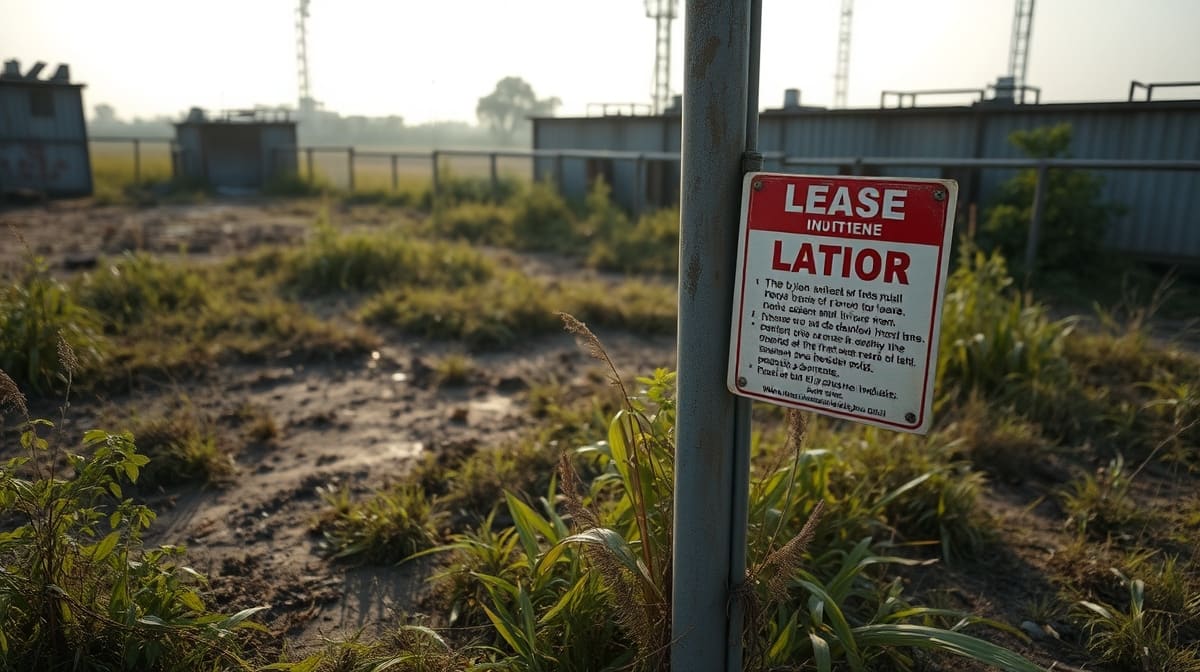
The Karnataka High Court has clarified that statutory notice under Section 34-B of the Karnataka Industrial Areas Development Act, 1966 is not a precondition for cancellation of industrial land allotment when the lessee fails to execute the lease-cum-sale agreement within the stipulated time. This ruling reinforces the principle that allotment is conditional and revocable until formal contractual obligations are fulfilled.
Background & Facts
The Dispute
The appellant, IDBI Bank Limited, sought to develop a Regional Processing Unit, Currency Chest Training Centre, Call Centre, and Staff Quarters on a 4.5-acre plot in Bengaluru Hardware Park. The Karnataka Industrial Areas Development Board (KIADB) allotted the land vide letter dated 15.02.2013 on a lease-cum-sale basis. The terms required the appellant to pay 20% of the tentative cost (Rs. 1.80 crores) within 30 days of allotment and the remaining 80% (Rs. 6.30 crores) within 180 days, i.e., by 13.08.2013. The appellant made full payment by 27.09.2013. The KIADB issued a confirmatory allotment letter on 12.08.2014 and a Possession Certificate on 27.12.2014. The appellant was required to execute the lease-cum-sale agreement within 30 days of receiving the Possession Certificate and commence production within 24 months of taking possession.
Key Facts
- Allotment letter issued: 15.02.2013
- Tentative cost: Rs. 1.80 crores per acre (total Rs. 8.10 crores for 4.5 acres)
- 20% payment made: 26.07.2012
- 80% payment made: 27.09.2013
- Confirmatory allotment letter issued: 12.08.2014
- Possession Certificate issued: 27.12.2014
- Draft lease-cum-sale agreement sent by KIADB: 23.03.2016
- Appellant requested modifications to draft: 27.06.2016
- KIADB rejected all proposed modifications: 27.01.2018
- Appellant sought 3-year extension: 17.05.2022
- KIADB cancelled allotment: 20.12.2022
- Writ Petition filed: 2023
- Single Judge dismissed petition: 06.03.2024
- Writ Appeal filed: 2024
- Judgment delivered: 28.04.2026
The appellant’s proposed modifications to the draft agreement included extending the production commencement period from 24 to 60 months, reducing investment thresholds for extensions from 25% to 15%, extending the maximum extension period from 4 to 8 years, and removing clauses on local employment and shareholding requirements. The KIADB consistently rejected these changes. Additionally, the Reserve Bank of India placed IDBI Bank under the Prompt Corrective Action Framework from 05.05.2017 to 10.03.2021, freezing capital expenditure. Despite multiple communications from KIADB urging compliance and directing the appellant to approach the State Level Single Window Clearance Committee (SLSWCC) for extension, no formal request was made.
Procedural History
- 15.02.2013: KIADB issued allotment letter for 4.5 acres
- 26.07.2012: Appellant paid 20% of tentative cost (Rs. 1.80 crores)
- 27.09.2013: Appellant paid 80% balance (Rs. 6.30 crores)
- 12.08.2014: Confirmatory allotment letter issued
- 27.12.2014: Possession Certificate issued
- 23.03.2016: KIADB sent draft lease-cum-sale agreement
- 27.06.2016: Appellant submitted proposed modifications
- 27.01.2018: KIADB rejected modifications
- 18.08.2018: KIADB Board meeting decided appellant must approach SLSWCC for extension
- 03/04.09.2018: KIADB communicated Board’s decision to appellant
- 14.06.2019: Appellant sought clarification on extension costs and land sale
- 07.05.2020: KIADB responded, citing draft agreement clauses
- 28/31.12.2021: KIADB reiterated need to approach SLSWCC
- 20.12.2022: KIADB cancelled allotment for non-compliance
- 2023: Writ Petition No. 29319/2023 filed before Single Judge
- 06.03.2024: Single Judge dismissed writ petition
- 2024: Writ Appeal No. 499/2024 filed
- 28.04.2026: Division Bench dismissed appeal
Relief Sought
The appellant sought quashing of the KIADB’s cancellation order dated 20.12.2022 and a direction to execute the lease-cum-sale agreement as per the original allotment terms.
The Legal Issue
The central question was whether Section 34-B of the Karnataka Industrial Areas Development Act, 1966 mandates issuance of a notice and opportunity to cure before cancellation of an industrial land allotment where the lease-cum-sale agreement has not been executed within the stipulated time.
Arguments Presented
For the Appellant
The appellant contended that cancellation of the allotment without issuing notice under Section 34-B of the KIAD Act violated principles of natural justice. It argued that since possession had been granted, the appellant was a licensee or lessee entitled to procedural safeguards. Reliance was placed on Electromobiles (I) Ltd. to assert that possession conferred rights requiring notice before cancellation. It further argued that delays were due to external factors including RBI’s PCA framework and that the KIADB had not acted in good faith by rejecting reasonable modifications.
For the Respondent
The KIADB countered that Section 34-B applies only after execution of a lease or lease-cum-sale agreement, not during the pre-contractual phase. It emphasized that Regulation 10(d) of the Karnataka Industrial Areas Development Board Regulations, 1969 explicitly states that failure to execute the agreement within the stipulated time renders the allottee deemed to have declined the allotment. The appellant had been given over a decade to comply, multiple opportunities to negotiate, and clear directives to seek extension via SLSWCC - all of which were ignored. The KIADB’s action was not arbitrary but a lawful consequence of non-performance.
The Court's Analysis
The Court undertook a detailed textual and contextual analysis of the KIAD Act and the Regulations. It observed that Regulation 10(d) unambiguously provides: "Failure to execute the agreement or to pay the sums demanded... will render the allottee to have deemed to have declined the allotment." This provision operates as a self-executing condition precedent. The Court held that the appellant’s possession was strictly limited to the purpose of commencing construction under Regulation 15, which explicitly states that until the agreement is executed, the allottee is a mere licensee with no right to alienate or hold the land as a lessee.
"The relationship of lessee and lessor never came into being, in the absence of execution of lease deed. The execution of lease deed was necessary as the State Government had only accorded in principle approval and advised IDCO to allot the land that could only be done by execution of lease deed."
The Court relied on Orissa Industrial Infrastructure Development Corporation v. Mesco Kalinga Steel Ltd. to affirm that statutory authorities cannot be bound by informal possession when a formal document is mandated as a condition precedent. The Court distinguished Electromobiles (I) Ltd. on the grounds that in that case, the documents establishing the terms of allotment were not on record, whereas here, the allotment letter, possession certificate, and Regulation 10(d) were clear and binding.
The Court further held that Section 34-B applies only to resumption of possession after a lease has been executed or where possession is held without authority. Since no lease was executed, the appellant never became a lessee, and thus the statutory notice mechanism under Section 34-B was inapplicable. The Court noted that the appellant had been given ample opportunity to respond to the draft agreement, propose changes, and seek extensions - all of which were exhausted without action. The cancellation after nearly a decade of inaction was not abrupt but a lawful consequence of non-compliance.
The Verdict
The writ appeal was dismissed. The Court upheld the cancellation of the land allotment dated 20.12.2022, confirming that the appellant’s failure to execute the lease-cum-sale agreement within the stipulated time rendered the allotment deemed declined under Regulation 10(d). No notice under Section 34-B of the KIAD Act was required. The appellant’s claim for execution of the lease-cum-sale agreement was rejected.
What This Means For Similar Cases
Non-Execution of Lease Deed Automatically Terminates Allotment
- Practitioners must advise clients that possession of industrial land under an allotment letter does not confer any proprietary or leasehold rights until the lease-cum-sale agreement is executed
- Failure to execute the agreement within the stipulated time, even if possession is granted, triggers automatic deemed decline under Regulation 10(d)
- No statutory notice under Section 34-B is required prior to cancellation in such cases
Procedural Compliance Is Non-Negotiable
- Statutory authorities are entitled to enforce strict timelines for industrial development
- Requests for modification must be submitted promptly; prolonged negotiation without formal extension applications will be viewed as inaction
- Parties must proactively approach designated bodies (e.g., SLSWCC) for extensions; passive waiting for authority to act is insufficient
Draft Agreements Are Binding Frameworks
- Rejection of proposed modifications to a draft agreement does not invalidate the original terms
- The original conditions of allotment remain enforceable unless formally amended by mutual consent
- Courts will not permit parties to evade contractual obligations by delaying execution under the guise of negotiation