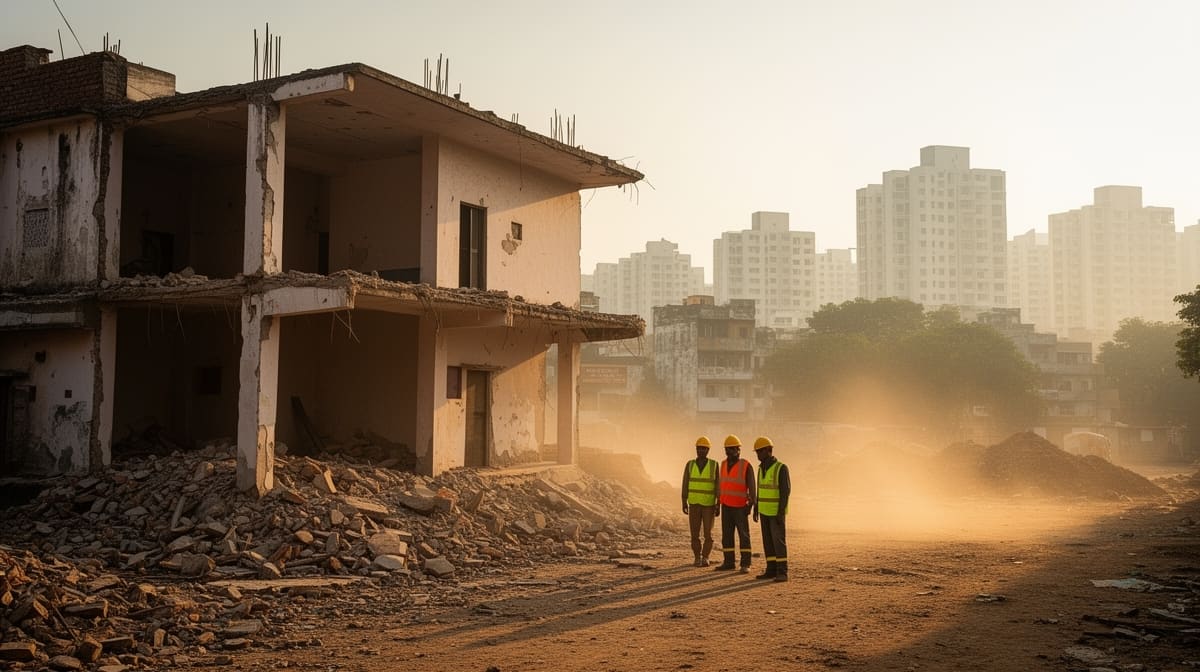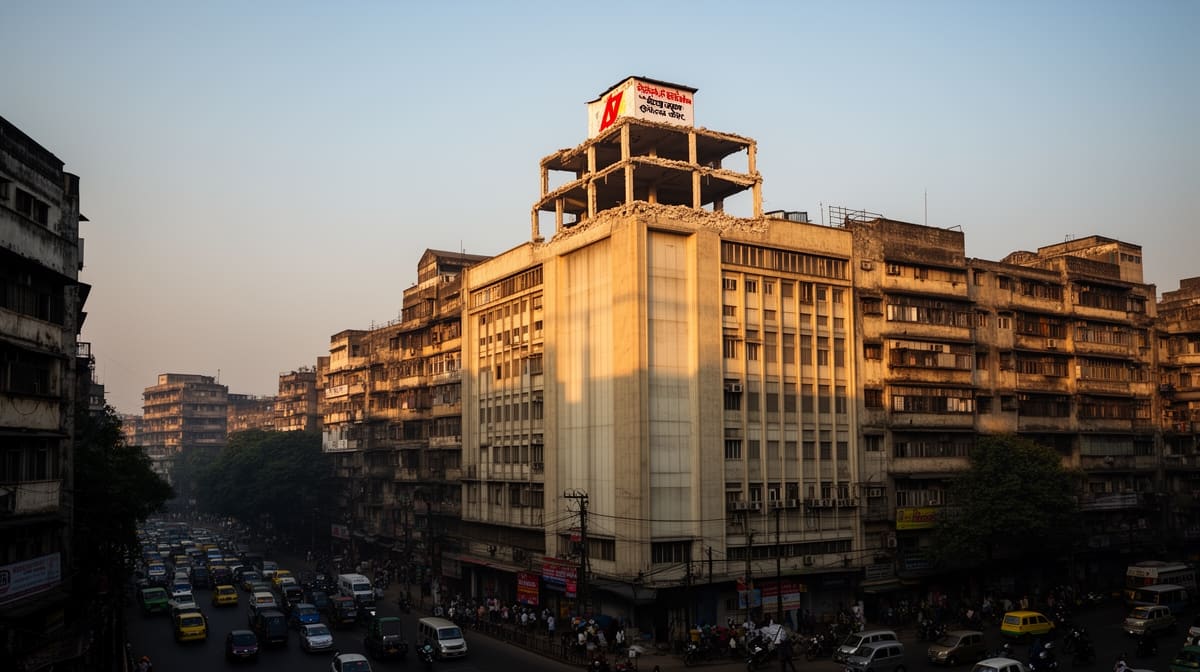
The Bombay High Court has established a novel equitable framework for granting interim relief against demolition orders under the Maharashtra Regional Town Planning Act, 1966. By conditioning stay on mandatory retroactive financial deposits, the Court has redefined the balance between preserving property rights and enforcing urban planning compliance.
Background & Facts
The Dispute
The appellant, Geeta Mahesh Dhanani, owns commercial premises in Colaba, Mumbai, where a 100 sq.ft. loft structure was erected without statutory approval. The Municipal Corporation of Greater Mumbai issued a notice under Section 53(1) of the Maharashtra Regional Town Planning Act, 1966, directing demolition of the unauthorized construction. The appellant challenged the notice before the City Civil Court, which, on 14 August 2012, dismissed the suit after a detailed examination of evidence and submissions.
Procedural History
- 2005: Unauthorized loft constructed in commercial premises
- 16 August 2005: Demolition notice issued under Section 53(1)
- 14 August 2012: City Civil Court dismissed challenge to notice with costs
- 2013: First Appeal filed before Bombay High Court
- 2026: Interim Application filed seeking restoration of appeal and continuation of status-quo
- 11 February 2026: Appeal restored; interim relief granted with conditions
Relief Sought
The appellant sought continuation of status-quo orders allegedly passed in 2012 and 2015, and a stay on demolition pending disposal of the appeal. The appellant argued that demolition would cause irreversible harm, while the Corporation maintained that the structure remained illegal and unchallenged for over two decades.
The Legal Issue
The central question was whether a court may grant interim stay against a demolition order under Section 53(1) of the MRTPL, and if so, whether such relief can be conditioned on the appellant depositing monthly sums retroactively from the date of illegal construction.
Arguments Presented
For the Appellant
The appellant’s counsel contended that the structure had existed since before 2005 and that demolition would cause irreparable loss. He argued that the City Civil Court’s 2012 order was not final and that the appeal raised substantial questions of law. He relied on equitable principles to justify stay, asserting that the Corporation had delayed enforcement for over a decade.
For the Respondent
The Municipal Corporation argued that the structure was clearly unauthorized and that the 2012 order had conclusively determined its illegality. Counsel emphasized that prolonged non-enforcement does not confer legitimacy, and that allowing continued use of illegal structures undermines urban planning. No prior stay order was produced by the appellant.
The Court's Analysis
The Court acknowledged that no prior interim order had been recorded, and that the appellant had failed to establish a prima facie case on the merits. However, recognizing the potential for irreversible harm if demolition proceeded before appellate adjudication, the Court invoked equitable jurisdiction to craft a balanced remedy.
"To balance the equity, I pass the following order: the impugned notice... is stayed subject to the applicant/appellant to deposit in this Court Rs.5,000/- per month from August 2005 till 31 March 2026."
The Court rejected the notion that delay by authorities automatically validates illegality. Instead, it imposed a financial mechanism to neutralize the economic benefit derived from unlawful use. The monthly deposit of Rs.5,000 was calculated to reflect the commercial value of the unauthorized space over time. The Court directed that the aggregate sum be deposited within 12 weeks, with no extensions permitted, and that future deposits be made monthly until final disposal.
The Court further mandated that the deposited amounts be invested in fixed deposits, with proceeds to be returned to the appellant if the appeal succeeds, or forfeited to the Corporation or a charitable cause if dismissed. This structure ensures that the state is not deprived of the economic value of compliance, while preserving the appellant’s right to appellate redress.
The Verdict
The appellant prevailed on the interim relief. The Court held that interim stay against demolition under Section 53(1) may be granted conditionally upon retroactive financial deposit, reflecting the value of unauthorized use. The stay remains operative only if monthly deposits are made without default.
What This Means For Similar Cases
Retroactive Financial Conditioning Is Now a Viable Equitable Tool
- Practitioners must now anticipate that courts may require deposit of monthly sums dating back to the date of unauthorized construction
- The amount must be rationally linked to the economic benefit derived from the illegal structure
- Failure to deposit even one installment will result in automatic vacation of stay
Burden of Proof Shifts to the Unlawful Occupant
- The onus is on the appellant to prove the existence and duration of the structure
- Courts will not presume legitimacy due to administrative delay
- Oral assertions without documentary support will not suffice to justify stay
Deposit Mechanism as a Deterrent and Compensation Tool
- The fixed deposit mechanism ensures funds are preserved and earn interest
- The dual outcome - refund or forfeiture - creates a strong incentive for timely appellate resolution
- This model may be replicated in cases involving illegal encroachments, unauthorized floor space index violations, and non-compliant commercial use