The National Company Law Appellate Tribunal has clarified that a corporate debtor’s admission of partial liability for wage arrears does not override a genuine, pre-existing dispute over quantum when parallel labour proceedings are pending. This ruling reinforces the Insolvency and Bankruptcy Code’s intent to prevent misuse of CIRP as a debt recovery tool.
Background & Facts
The Dispute
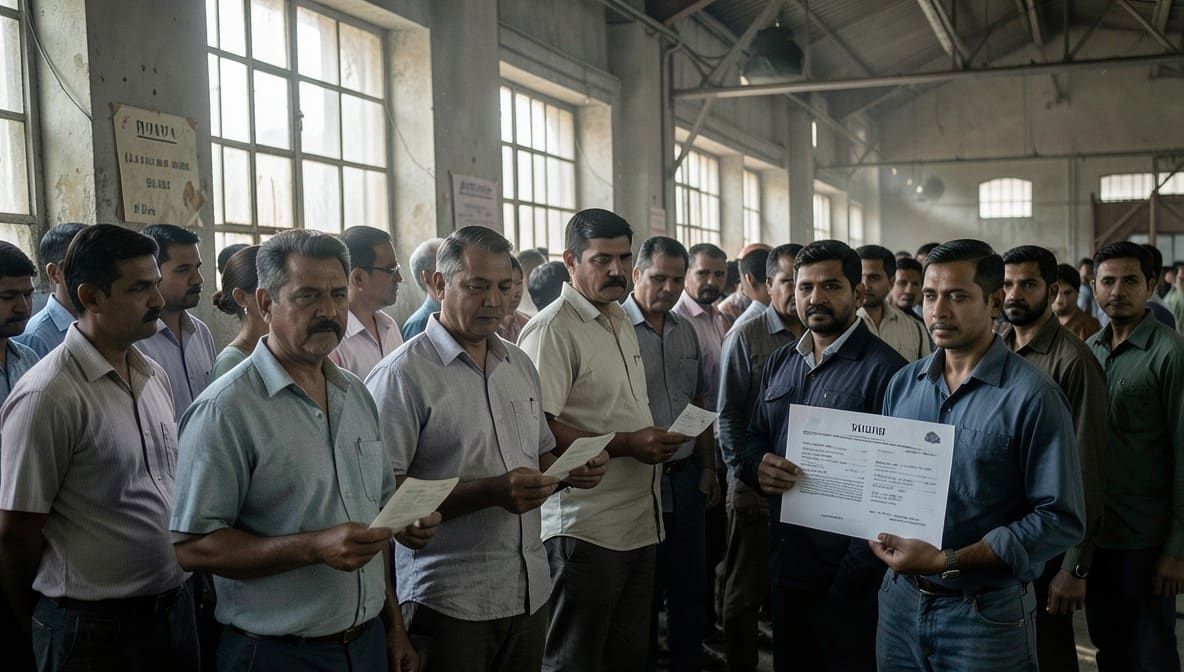
The Appellant, Rashtriya Mill Mazdoor Sangh (RMMS), a registered trade union representing workmen of three mills under the Corporate Debtor, National Textile Corporation Limited (NTC), sought initiation of Corporate Insolvency Resolution Process (CIRP) under Section 9 of the Insolvency and Bankruptcy Code, 2016 (IBC). The dispute arose from non-payment of full wages, gratuity, bonus, and other statutory dues to approximately 12,000 workmen across NTC’s 26 mills, following the shutdown of operations due to the COVID-19 pandemic.
Key Facts
- NTC suspended full operations across all mills from 25.03.2020 due to nationwide lockdowns.
- From 18.05.2020, NTC paid 50% wages to workers not engaged in essential services, while paying 100% to those working.
- RMMS and NTC exchanged correspondence in June 2020, with RMMS accepting the 50% wage arrangement conditionally.
- On 18.05.2023, NTC acknowledged an aggregate liability of Rs. 66.88 crore towards workmen’s dues.
- By 31.07.2023, NTC had paid approximately Rs. 20 crore, leaving an outstanding balance of Rs. 46.88 crore.
- On 31.07.2023, RMMS issued a Section 8 Demand Notice claiming Rs. 44.96 crore as unpaid operational debt.
- NTC did not respond to the Section 8 Demand Notice within the statutory 10-day period.
- On 25.08.2023, RMMS filed a Section 9 application before the National Company Law Tribunal (NCLT), New Delhi, seeking initiation of CIRP.
- NTC filed its reply affidavit on 09.12.2023, asserting that the claimed amount was inflated due to mismatches in employee data, inclusion of already-paid workers, and category errors.
- NTC admitted that a reconciled balance of Rs. 4.25 crore remained under dispute, but maintained that this was subject to verification against actual payroll records.
- RMMS had previously filed Complaint No. 160 of 2020 before the Industrial Court, Mumbai, seeking full wage payment and cessation of unfair labour practices.
- The Industrial Court passed an order on 30.10.2021 directing NTC to pay wages monthly and comply with existing settlements.
- RMMS filed Writ Petition No. 252 of 2022 before the Bombay High Court, seeking enforcement of the Industrial Court’s order.
- The Bombay High Court, on 26.06.2023, directed the Industrial Court to expedite disposal of Complaint No. 160 of 2020.
- The NCLT, by its Impugned Order dated 12.09.2025, dismissed the Section 9 application on grounds of pre-existing dispute.
Procedural History
- 18.05.2020: NTC reduces wages to 50% for non-essential workers.
- 24.06.2020: NTC writes to RMMS proposing 50% wage structure.
- 25.06.2020: RMMS accepts the arrangement conditionally.
- 30.10.2021: Industrial Court, Mumbai, passes order in Complaint No. 160 of 2020.
- 18.05.2023: NTC admits total liability of Rs. 66.88 crore.
- 31.07.2023: Section 8 Demand Notice issued by RMMS for Rs. 44.96 crore.
- 09.12.2023: NTC files reply affidavit to Section 9 application, raising dispute over quantum and reconciliation.
- 25.08.2023: Section 9 application filed before NCLT, New Delhi.
- 12.09.2025: NCLT dismisses Section 9 application citing pre-existing dispute.
- 17.04.2026: NCLAT dismisses appeal.
The Parties' Positions
Appellant (RMMS): Argued that NTC admitted liability exceeding Rs. 1 crore, failed to respond to Section 8 notice, and that pending labour proceedings concerned unfair labour practices and revival of mills - not the quantification of admitted dues. Contended that reconciliation is merely an accounting exercise and does not constitute a dispute over existence of debt.
Respondent (NTC): Asserted that the wage claim was inherently disputed due to data inconsistencies, inclusion of non-entitled workers, and ongoing reconciliation. Emphasized that the same issues were sub judice before the Industrial Court and Bombay High Court, and that IBC cannot be used as a substitute for labour adjudication.
Relief Sought
RMMS sought: (1) Setting aside of the Impugned Order dated 12.09.2025; (2) Admission of the Section 9 application; (3) Initiation of CIRP against NTC; (4) Appointment of an Interim Resolution Professional.
The Legal Issue
The central question was whether the existence of a pre-existing dispute over the quantum of operational debt - raised for the first time in the reply to a Section 9 application and supported by pending labour proceedings - justifies rejection of a Section 9 application under the IBC, even when the corporate debtor has admitted a liability exceeding the statutory threshold and failed to respond to the Section 8 demand notice.
Arguments Presented
For the Appellant
The Appellant relied on Mobilox Innovations Pvt. Ltd. v. Kirusa Software Pvt. Ltd. (2018) 1 SCC 353 to argue that a dispute must be real, substantial, and bona fide, not spurious or illusory. It contended that reconciliation of accounts presupposes admitted liability and cannot constitute a dispute over existence of debt. It further cited Narayan Singh Pathania v. Valuelabs LLP (CA(AT)(Ins) No. 1415 of 2019) to assert that mere pendency of reconciliation does not amount to a pre-existing dispute. The Appellant emphasized that the labour proceedings before the Industrial Court and Bombay High Court concerned unfair labour practices and revival of operations, not the calculation of wage arrears. It argued that Section 238 of the IBC overrides other laws, and that the Adjudicating Authority exceeded its limited jurisdiction by examining the quantum of debt.
For the Respondent
The Respondent relied on Mobilox and S.S. Engineers v. Hindustan Petroleum Corporation Ltd. (Civil Appeal No. 4583 of 2022) to argue that IBC is not a debt recovery mechanism and cannot be invoked where claims are disputed. It submitted that the wage dispute was not merely about reconciliation but involved fundamental disagreements over employee classification, payment eligibility, and entitlement under past settlements. It highlighted that the Appellant had already pursued the same claims before the Industrial Court and Bombay High Court, and that the NCLT’s rejection of the Section 9 application was consistent with the principle that insolvency proceedings must not be used for forum shopping. The Respondent also relied on Brand Realty Services Ltd. v. Sir John Bakeries India Pvt. Ltd. (CA(AT)(Ins) No. 958 of 2020) to establish that failure to reply to a Section 8 notice does not preclude raising a dispute at the Section 9 stage.
The Court's Analysis
The NCLAT undertook a detailed examination of the statutory framework under Sections 8 and 9 of the IBC, and the jurisprudence developed by the Supreme Court and this Tribunal. The Court emphasized that the Adjudicating Authority’s role at the admission stage is not to adjudicate the merits of the dispute but to determine whether a plausible dispute exists.
"The threshold for determining a dispute is whether there is a plausible contention requiring investigation and not a sham defense."
The Court noted that the Corporate Debtor, despite not replying to the Section 8 notice, was entitled to raise a dispute in its reply to the Section 9 application, as held in Brand Realty. The reply affidavit contained specific allegations of data mismatches, inclusion of already-paid employees, and discrepancies in wage categorization - all of which went to the heart of the quantum of the claimed debt.
The Court further observed that the labour proceedings initiated by RMMS before the Industrial Court and Bombay High Court were not collateral but directly concerned the very same wage entitlements and payment structures that formed the basis of the Section 9 application. The Industrial Court’s order dated 30.10.2021 had already directed NTC to pay wages in accordance with existing settlements, indicating that the dispute over calculation and entitlement was not only pre-existing but actively adjudicated.
The Court distinguished between admission of liability and admission of quantum. While NTC had acknowledged a total liability of Rs. 66.88 crore, it had consistently maintained that the amount claimed by RMMS was inflated. The Court held that such a discrepancy, especially when coupled with ongoing litigation, satisfies the Mobilox test of a plausible dispute.
The Court also invoked Swiss Ribbons Pvt. Ltd. v. Union of India (2019) 4 SCC 17 and Hindustan Construction Company Ltd. v. Union of India (2020) 17 SCC 324 to reaffirm that the IBC is not a debt recovery statute but a mechanism for corporate revival. The Appellant’s attempt to bypass the labour forum and invoke CIRP was viewed as forum shopping, contrary to the legislative intent.
The NCLAT concluded that the Adjudicating Authority did not err in rejecting the Section 9 application. The dispute was neither illusory nor spurious; it was rooted in factual disagreements over wage calculation, substantiated by contemporaneous correspondence and pending adjudication.
The Verdict
The appeal was dismissed. The NCLAT upheld the Impugned Order dated 12.09.2025, confirming that the Section 9 application was rightly rejected on grounds of pre-existing dispute. The Court held that the operational debt claimed by RMMS was not undisputed, as the quantum remained subject to reconciliation and was the subject of ongoing proceedings before the Industrial Court and Bombay High Court. No costs were awarded.
What This Means For Similar Cases
Pre-Existing Dispute Includes Quantification Disagreements
- Practitioners must now recognize that disputes over calculation, classification, or eligibility of wage components - such as overtime, allowances, or category-based entitlements - constitute valid pre-existing disputes under Section 9.
- A corporate debtor’s failure to respond to a Section 8 notice does not waive its right to raise a dispute at the Section 9 stage, as confirmed by Brand Realty.
- Reconciliation efforts, when accompanied by specific allegations of data errors, are sufficient to meet the Mobilox threshold for plausible dispute.
Labour Forum Proceedings Preclude IBC Initiation for Wage Claims
- Where wage disputes are already sub judice before labour courts or industrial tribunals, Section 9 applications based on the same claims will be rejected.
- The pendency of such proceedings is not merely a procedural bar but a substantive indicator that the debt’s existence and quantum are contested.
- Creditors, including trade unions, must exhaust labour remedies before invoking IBC for wage recovery.
IBC Is Not a Debt Recovery Tool for Disputed Claims
- The judgment reinforces that IBC’s primary objective is corporate revival, not creditor enforcement.
- Operational creditors must ensure claims are undisputed and quantified before filing Section 9 applications.
- Any attempt to use CIRP as leverage in wage negotiations will be viewed as forum shopping and dismissed.