Topic

Insolvency and Bankruptcy

Insolvency and Bankruptcy in India refers to the legal framework under the Insolvency and Bankruptcy Code, 2016, for resolving corporate defaults and protecting creditors' rights, including homebuyers and operational creditors.

60 articlesLatest September 2026
Operational Debt Under IBC | Advance Payment Under Consortium Agreement Constitutes Operational Debt: NCLAT
Case Law Analysis
|National Company Law Appellate Tribunal

Operational Debt Under IBC | Advance Payment Under Consortium Agreement Constitutes Operational Debt: NCLAT

The NCLAT has ruled that advance payments made under a consortium agreement for goods supply qualify as operational debt under Section 5(21) of the IBC, even when payment obligations are structured between consortium members rather than directly with a corporate debtor. This expands the scope of operational creditors in complex supply chains and clarifies that inter-se financial arrangements do not negate the existence of a debt arising from a transaction in the ordinary course of business.

Section 121(2) IBC | Three-Month Deadline for Personal Guarantor Bankruptcy Applications is Directory, Not Mandatory : NCLAT
Case Law Analysis
|National Company Law Appellate Tribunal

Section 121(2) IBC | Three-Month Deadline for Personal Guarantor Bankruptcy Applications is Directory, Not Mandatory : NCLAT

NCLAT rules that the three-month timeline under Section 121(2) of the IBC for filing bankruptcy applications against personal guarantors is directory, not mandatory, allowing condonation of delay under the Limitation Act. This decision clarifies that financial creditors can proceed with insolvency applications even beyond the prescribed period, ensuring flexibility in personal guarantor insolvency proceedings.

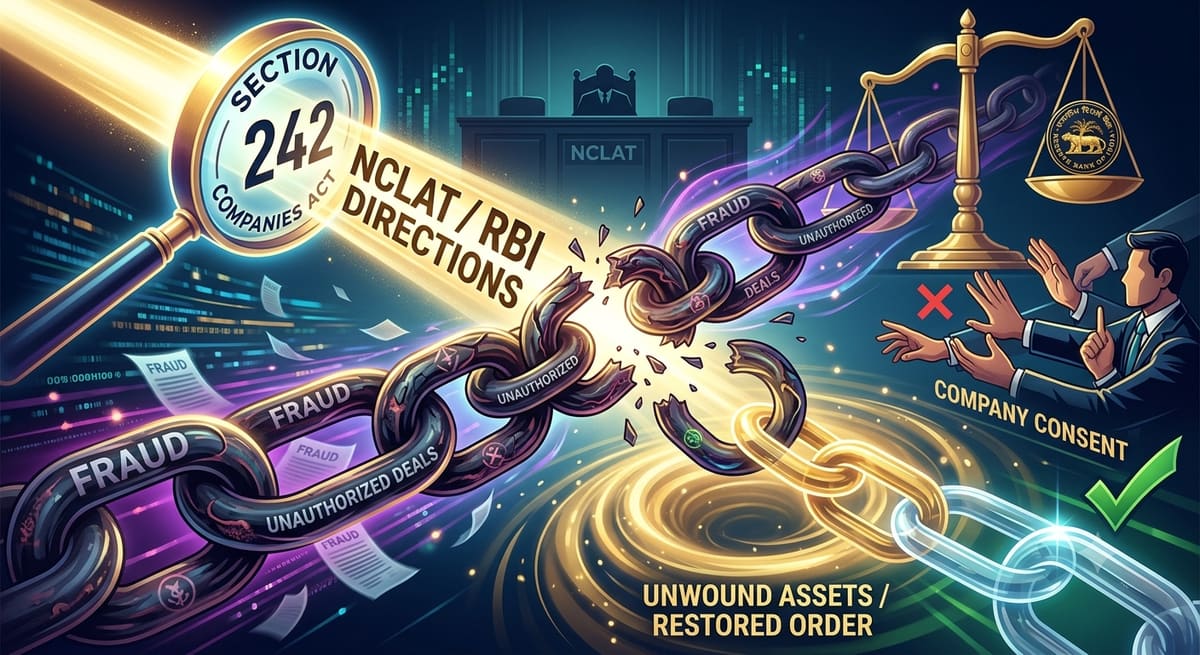
Section 242 Companies Act | Fraudulent Transactions Can Be Unwound Without Consent: NCLAT Upholds RBI Directions as Binding
Case Law Analysis
|National Company Law Appellate Tribunal

Section 242 Companies Act | Fraudulent Transactions Can Be Unwound Without Consent: NCLAT Upholds RBI Directions as Binding

NCLAT ruled that fraudulent transactions under Section 242 of the Companies Act can be set aside without the consent of involved parties, reinforcing RBI directions as legally binding. The judgment impacts insolvency proceedings and corporate governance, particularly for NBFCs and group companies engaged in sham lending arrangements.

Section 65 IBC | Malicious Refusal by Single Creditor to Accept Repayment Justifies CIRP Termination : NCLAT
Case Law Analysis
|National Company Law Appellate Tribunal

Section 65 IBC | Malicious Refusal by Single Creditor to Accept Repayment Justifies CIRP Termination : NCLAT

NCLAT rules that a single creditor’s unjustified refusal to accept repayment of an admitted debt during CIRP constitutes abuse of process under Section 65 IBC, warranting termination of insolvency proceedings. The ruling protects corporate debtors from frivolous or malicious creditor actions that undermine the IBC’s objectives.

Section 18 IBC | Unlawful Possession Post-Eviction Decree Cannot Be Included in CIRP Assets: NCLAT
Case Law Analysis
|National Company Law Appellate Tribunal

Section 18 IBC | Unlawful Possession Post-Eviction Decree Cannot Be Included in CIRP Assets: NCLAT

NCLAT rules that assets under unlawful possession of a corporate debtor, even after a Supreme Court-affirmed eviction decree, cannot form part of the Corporate Insolvency Resolution Process (CIRP). The ruling reinforces that legal ownership, not physical possession, determines asset inclusion under the IBC, impacting insolvency proceedings where disputed assets are involved.

Section 95 IBC | Contractual Notice Suffices for Personal Guarantee Invocation Even Without Postal Proof: NCLAT
Case Law Analysis
|National Company Law Appellate Tribunal

Section 95 IBC | Contractual Notice Suffices for Personal Guarantee Invocation Even Without Postal Proof: NCLAT

NCLAT rules that a personal guarantor's insolvency can be initiated under the IBC based on contractual notice and cumulative evidence, even if postal receipts are absent. The ruling clarifies that strict proof of service is not mandatory if the guarantee deed authorizes alternative invocation methods, impacting lenders and guarantors in insolvency proceedings.

IBC Section 30(5) | Financial Creditor as Resolution Applicant Permitted to Vote on Own Plan : NCLAT Overrules NCLT Conflict of Interest Bar
Case Law Analysis
|National Company Law Appellate Tribunal

IBC Section 30(5) | Financial Creditor as Resolution Applicant Permitted to Vote on Own Plan : NCLAT Overrules NCLT Conflict of Interest Bar

NCLAT clarifies that a financial creditor submitting a resolution plan under the IBC is not barred from voting on its own plan, rejecting the NCLT's conflict of interest rationale. The ruling reinforces the commercial wisdom of the Committee of Creditors (CoC) and expands the scope of eligible resolution applicants, impacting insolvency proceedings where creditors seek to revive distressed companies.

Section 53A TPA Possessory Rights Prevail Over IBC Claims: NCLAT Shields Consent Decree from RP Override
|National Company Law Appellate Tribunal

Section 53A TPA Possessory Rights Prevail Over IBC Claims: NCLAT Shields Consent Decree from RP Override

NCLAT rules that possessory rights under Section 53A of the Transfer of Property Act, when affirmed by a consent decree, cannot be disturbed by a Resolution Professional under the Insolvency and Bankruptcy Code. The ruling clarifies that IBC proceedings do not automatically extinguish pre-existing property rights established through judicial decrees, offering critical protection to parties with settled possessory claims.