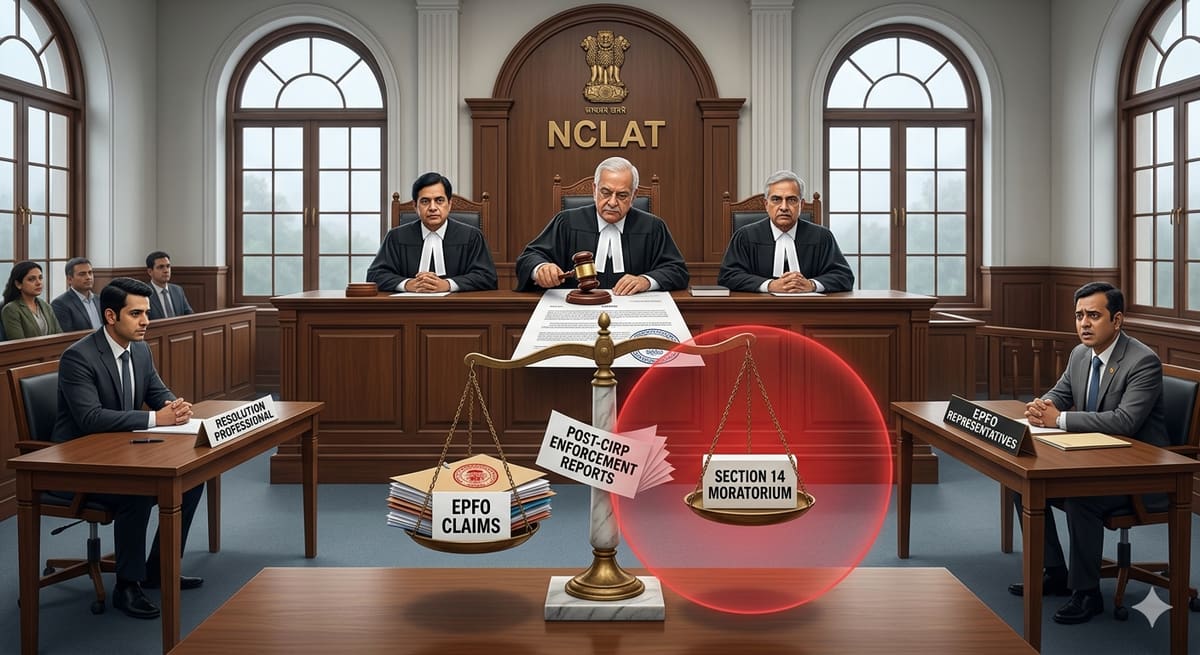
The Bombay High Court has held that the moratorium under Section 14(1)(a) of the Insolvency and Bankruptcy Code, 2016 prohibits only proceedings instituted or continued against a corporate debtor, not proceedings initiated by the corporate debtor, including a counter claim in arbitration. The Court dismissed a Section 37 challenge to an arbitral order vacating a status quo arrangement, ruling that the arbitral tribunal retained jurisdiction to adjudicate the counter claim and modify interim measures accordingly. The judgment clarifies that a terminated development agreement does not constitute an asset of the corporate debtor for purposes of Section 14(1)(d), and that the Adjudicating Authority's residuary jurisdiction under Section 60(5)(c) is not attracted where termination precedes and is unrelated to insolvency.
Background & Facts
The Dispute
The petitioner, A A Estates Pvt. Ltd. ("AA Estates"), a real estate developer undergoing its second Corporate Insolvency Resolution Process ("CIRP"), challenged an arbitral order dated January 16, 2025 ("Impugned Order") that vacated a status quo order and permitted the respondent, Govind Niwas Co-operative Housing Society Ltd. ("Society"), to appoint a new developer for redevelopment of its property. The dispute arose from a Development Agreement ("DA") dated April 16, 2010, under which AA Estates undertook to redevelop the Society's property at no cost to members in exchange for development rights to the balance area.
Key Facts
- April 16, 2010: Development Agreement executed between AA Estates and the Society.
- 2010-2011: Society members vacated their flats pursuant to the DA.
- 2011-2016: AA Estates carried out only excavation and piling work; no further redevelopment occurred.
- October 10, 2016: Society wrote to AA Estates recording lack of progress and non-payment of transit rent since January 2016.
- October 12, 2017: Society's General Body resolved to terminate the DA for persistent defaults.
- December 7, 2017: Society issued notice of termination, revoking all powers granted to AA Estates with immediate effect.
- January 10, 2018: AA Estates replied, contending termination was illegal.
- April 27, 2018: Order appointing Sole Arbitrator passed, converting Society's Section 9 petition into a Section 17 application (First Interim Application).
- May 2, 2018: Status Quo Order passed by Arbitrator recording undertakings from both parties to maintain status quo; expressly noted as a pro tem measure without going into merits.
- June 21, 2018: Society filed Statement of Claim seeking declaration that DA stood cancelled.
- August 23, 2018: AA Estates filed Counter Claim seeking declaration setting aside termination and specific performance of DA, alternatively damages.
- October 4, 2018: Arbitrator framed issues; AA Estates contended certain issues intertwined with final reliefs.
- November 14, 2019: First CIRP admitted against AA Estates ("First CIRP Order").
- March 9, 2020: Section 29A Court refused extension of tribunal's mandate due to moratorium under Section 14 IBC.
- June 12, 2020: First CIRP Order set aside under Section 12A IBC.
- September 27, 2021: Section 29A Court extended tribunal's mandate until September 27, 2022.
- December 6, 2022: Second CIRP admitted against AA Estates ("Second CIRP Order"), still pending; Society filed claim before Resolution Professional.
- January 17, 2024: Section 29A Court extended tribunal's mandate by one year ("Section 29A Order"), holding Counter Claim could proceed as proceedings by corporate debtor not barred by moratorium.
- May 17, 2024: Society filed Second Interim Application under Section 17 seeking to vacate Status Quo Order and appoint new developer.
- September 16, 2024: AA Estates objected, citing IBC bar on proceedings.
- January 16, 2025: Impugned Order passed allowing Second Interim Application.
- April 24, 2025: Present Section 37 Petition filed.
- April 30, 2025: Stay on arbitral proceedings granted.
- July 1, 2025: Society stated no further steps would be taken towards appointing new developer.
Procedural History
- April 24, 2025: Commercial Arbitration Petition (L) No. 12886 of 2025 filed before Bombay High Court.
- April 30, 2025: Interim stay on arbitration proceedings granted.
- October 19, 2026: Matter reserved for judgment after refresher hearing.
- October 26, 2026: Judgment pronounced.
Relief Sought
AA Estates sought setting aside of the Impugned Order on jurisdictional grounds, contending that the Second Interim Application and resultant proceedings were barred by the moratorium under Section 14(1)(a) and (d) of the IBC, and that exclusive jurisdiction vested in the Adjudicating Authority under Sections 60(5)(c) and 63 of the IBC.
The Legal Issue
The central questions were: (i) whether the Learned Arbitral Tribunal had jurisdiction to entertain the Second Interim Application and pass the Impugned Order modifying the Status Quo Order while a CIRP was pending against AA Estates, having regard to Sections 14(1)(a) and 14(1)(d) of the IBC and the pending Counter Claim; (ii) whether the Adjudicating Authority under the IBC was the only forum with jurisdiction by virtue of Sections 60(5)(c) and 63; and (iii) whether the Impugned Order's mischaracterisation of the Section 29A Order rendered it invalid.
Arguments Presented
For the Petitioner (AA Estates)
Mr. Shadab Jan contended that the Second Interim Application, filed on May 17, 2024 during the pendency of the Second CIRP, was a proceeding against the corporate debtor explicitly prohibited under Section 14(1)(a) of the IBC. Relying on Alchemist Asset Reconstruction Co. Ltd. v. Hotel Gaudavan (P) Ltd., he argued the bar is absolute and any step taken in breach is non est and void ab initio. He further submitted that the reliefs sought in the Second Interim Application were in aid of the Society's Statement of Claim, not the Counter Claim. Additionally, he invoked Sections 60(5)(c) and 63 of the IBC to argue that the Adjudicating Authority had exclusive jurisdiction over all matters relating to the CIRP, ousting the arbitral tribunal. He also relied on Section 60(6) IBC, contending that the suspension of limitation for claims "by or against" a corporate debtor indicated legislative intent to bar both categories of proceedings during moratorium.
For the Respondent (Society)
Mr. Naushad Engineer argued that Section 14(1)(a) only prohibits proceedings against the corporate debtor, not by it. The Society's undertaking in the Status Quo Order was a protection granted in aid of AA Estates' Counter Claim, and the Second Interim Application merely sought release from that undertaking to pursue the Counter Claim. The Section 29A Order, unchallenged and final, had expressly permitted continuation of the Counter Claim. On Section 14(1)(d), he relied on A.A. Estates (P) Ltd. v. Kher Nagar Sukhsadan Co-operative Housing Society Ltd. to submit that a DA terminated before CIRP commencement does not constitute an asset of the corporate debtor. On jurisdiction, he cited Tata Consultancy Services Ltd. v. Vishal Ghisulal Jain and Kher Nagar to argue that Section 60(5)(c) is a limited residuary jurisdiction attracted only where termination arises from insolvency, which was not the case here.
The Court's Analysis
The Court, per Somasekhar Sundaresan J., began by noting the unequivocal language of Section 14(1)(a) IBC: it prohibits "the institution of suits or continuation of pending suits or proceedings against the corporate debtor." The phrase "against the corporate debtor" is deliberate and excludes proceedings initiated by the corporate debtor. The Supreme Court in Alchemist addressed arbitration instituted after moratorium against the corporate debtor, not a counter claim by the corporate debtor. P. Mohanraj v. Shah Brothers Ispat (P) Ltd. clarified that Section 14 shields the corporate debtor from "pecuniary attacks against it"; a counter claim, if allowed, adds to the estate, and if disallowed, imposes no pecuniary liability.
The Court examined New Delhi Municipal Council v. Minosha India Ltd., where the Supreme Court held that proceedings by the corporate debtor, including a Section 11 application, are not tabooed. The suspension of limitation under Section 60(6) for suits "by or against" a corporate debtor addresses displacement of management, not a bar on proceedings by the debtor. The legislature's use of "by or against" in Section 60(6) but only "against" in Section 14(1)(a) is a conscious textual distinction that courts cannot judicially rewrite.
On the Section 29A Order, the Court found it had attained finality without challenge. The Impugned Order erroneously stated twice that the Section 29A Order permitted pursuit of both the Claim and the Counter Claim. However, this error was not fatal because the Second Interim Application was referable to the Counter Claim, which the Section 29A Order had clearly permitted. The tribunal, having jurisdiction over the Counter Claim, necessarily had jurisdiction to decide appropriate interlocutory measures for its preservation.
On Section 14(1)(d), the Court applied Kher Nagar, which held that only property forming part of the corporate debtor's estate on the insolvency commencement date is protected. A development agreement lawfully terminated before CIRP commencement ceases to exist and cannot be an "asset." Here, the Society's termination notices (October 2017, December 2017) preceded both CIRPs (November 2019, December 2022). Moreover, under Clause 43 of the DA, possession was to be handed over only after building plans were sanctioned and IOD obtained - milestones never achieved. The Status Quo Order was a pro tem arrangement volunteered by parties, not a reasoned interlocutory order. With only the Counter Claim proceeding, the tribunal was entitled to revisit interim measures.
On Sections 60(5)(c) and 63, the Court followed Tata Consultancy and Kher Nagar: the residuary jurisdiction is limited to disputes arising solely from or relating to the insolvency. Where termination is based on grounds unrelated to insolvency and precedes CIRP, the Adjudicating Authority lacks jurisdiction. Here, the Society's default notices and termination preceded the CIRP and arose from AA Estates' non-performance, not insolvency. AA Estates was engaged in multiple projects; the DA was not its sole or life-sustaining contract. Section 63 ouster therefore did not arise.
Finally, the Court emphasised that a Section 37 court should not substitute its view for the tribunal's on interlocutory measures so long as the tribunal's view is reasonable. Since only the jurisdictional challenge was pressed and rejected, the merits of the interlocutory arrangement needed no pronouncement.
"Section 14(1)(a) of the IBC interdicts the institution and continuation of proceedings against the corporate debtor. It does not bar proceedings initiated by the corporate debtor, including a Counter Claim."
"The terminated DA is not an asset of AA Estates. The termination preceded both CIRPs. In light of Kher Nagar, Section 14(1)(d) of the IBC is not attracted."
"Section 60(5)(c) of the IBC confers a limited residuary jurisdiction. As held in Tata Consultancy and Kher Nagar, it is not attracted where the termination is unrelated to insolvency."
The Verdict
The petition was dismissed. The Court held that: (1) Section 14(1)(a) IBC bars only proceedings against the corporate debtor, not by it; the Counter Claim and related Second Interim Application could proceed; (2) the Section 29A Order attained finality and permitted the Counter Claim; (3) the terminated DA is not an asset under Section 14(1)(d) per Kher Nagar; (4) Section 60(5)(c) jurisdiction is not attracted where termination precedes and is unrelated to CIRP; (5) the arbitral tribunal had jurisdiction to modify the pro tem Status Quo Order. The stay on arbitration proceedings imposed on April 30, 2025 was vacated. Parties were directed to appear before the Learned Arbitral Tribunal within two weeks of judgment upload, with the tribunal to fix next steps for any date after six weeks from upload.
What This Means For Similar Cases
Counter Claims by Corporate Debtors Survive Moratorium
- Section 14(1)(a) IBC uses the phrase "against the corporate debtor" deliberately; proceedings initiated by the corporate debtor, including counter claims in arbitration, are not barred.
- Alchemist is confined to proceedings instituted against the corporate debtor after moratorium; it does not govern counter claims.
- Practitioners should frame counter claims distinctly and seek tribunal directions on interim measures referable solely to the counter claim.
Terminated Development Agreements Are Not Assets Under Section 14(1)(d)
- Kher Nagar establishes that a development agreement lawfully terminated before insolvency commencement date is not an "asset" of the corporate debtor.
- Mere expectant, contingent, or uncrystallised contractual rights do not qualify for moratorium protection.
- Possession milestones under the agreement (plan sanction, IOD, commencement certificate) must be examined; if unmet, Section 14(1)(d) has no application.
- The moratorium does not revive terminated contracts or resurrect extinguished interests.
Adjudicating Authority Jurisdiction Is Narrow, Not All-Consuming
- Section 60(5)(c) IBC is a limited residuary jurisdiction attracted only where the dispute arises solely from or relates to the insolvency.
- Termination for pre-insolvency defaults (non-performance, delay) does not invoke this jurisdiction, even if the corporate debtor is in CIRP.
- The contract must be central to the success of the CIRP and its termination must threaten corporate death for the NCLT to intervene.
- Arbitration clauses are not ousted by Section 60(5)(c), but the nexus with insolvency must exist as a jurisdictional fact.
Section 29A Extension Orders Attain Finality If Unchallenged
- An unchallenged Section 29A order extending the arbitral tribunal's mandate on the basis that the counter claim can proceed becomes final and binding.
- Subsequent mischaracterisation of that order by the tribunal or parties does not nullify the jurisdiction it conferred.
- The Section 37 court will not second-guess a coordinate bench's unchallenged jurisdictional determination.
Pro Tem Status Quo Orders Are Revisitable
- A status quo order entered by consent as a pro tem measure without merits adjudication can be revisited when the procedural landscape changes (e.g., only counter claim survives).
- The tribunal has discretion to fashion appropriate interlocutory measures for the best preservation of the subject matter of the arbitration agreement under Section 17.
- Section 37 appellate courts should not interfere with reasonable interlocutory decisions merely because an alternative view is possible.