The National Company Law Appellate Tribunal has affirmed that development rights granted to a Corporate Debtor under a Development Agreement constitute actionable assets under the Insolvency and Bankruptcy Code, even where the landowner claims termination prior to insolvency. The judgment underscores that alleged terminations, unsupported by conduct or contemporaneous evidence, cannot override the statutory framework of the IBC.
Background & Facts
The Dispute
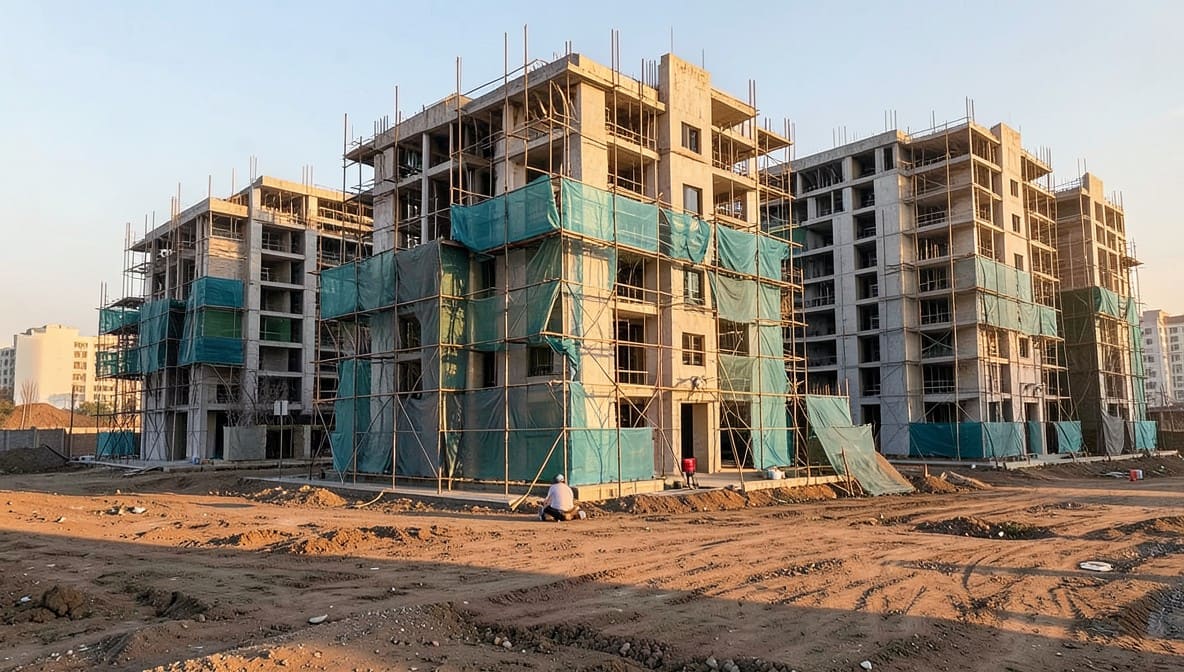
The dispute centers on 7.2431 acres of land in Sector-89, Faridabad, originally licensed under Haryana’s Town and Country Planning Act. M/s Triveni Ferrous Infrastructure Pvt. Ltd. (later renamed Maximal Infrastructure Pvt. Ltd.), along with co-owners, granted development rights over this land to M/s PAL Infrastructure & Developer Pvt. Ltd. (the Corporate Debtor) via a Development Agreement dated 15.01.2008. The agreement stipulated a total consideration of Rs. 51.89 crores, payable in installments via post-dated cheques. The Corporate Debtor paid Rs. 41.77 crores and executed 664 Builder-Buyer Agreements with homebuyers.
Key Facts
- The Development Agreement dated 15.01.2008 granted the Corporate Debtor exclusive rights to construct and sell units on 7.2431 acres.
- The agreement’s Clause 5.2 provided that if any post-dated cheque was dishonoured, the Agreement would automatically terminate, with the owner liable to refund 90% of the amount received after forfeiting 10%.
- Several cheques issued by the Corporate Debtor were dishonoured, triggering proceedings under Section 138 of the Negotiable Instruments Act.
- On 17.06.2009, the owners issued a letter claiming termination of the Development Agreement and cancellation of the Power of Attorney, but no refund of Rs. 36.58 crores was made.
- The Corporate Debtor continued construction activities post-2009, evidenced by procurement orders for steel, cement, bricks, and machinery dated between 2010 and 2014.
- On 05.09.2019, the National Company Law Tribunal admitted a Section 7 petition against the Corporate Debtor, initiating the Corporate Insolvency Resolution Process (CIRP).
- The Resolution Professional included the project land as an asset in the Information Memorandum and issued an Expression of Interest (EoI).
- The Appellant (Maximal Infrastructure) filed IA No. 2729/2021 seeking exclusion of the land from CIRP, claiming the Development Agreement was terminated in 2009.
- The Appellant, for the first time, produced the 17.06.2009 termination letter in an affidavit dated 19.07.2024, claiming it was "untraceable" until then.
- The Appellant transferred the same development rights to Parcela Real Estate Pvt. Ltd. on 26.11.2022, during the pendency of CIRP.
- The Directorate of Town and Country Planning (DTCP) granted change of beneficial interest to Parcela on 16.11.2023.
- The Haryana RERA and DTCP, in multiple orders between 2019 and 2022, consistently recognized the Corporate Debtor as a developer with vested rights.
- The Supreme Court, in its order dated 05.05.2015 and contempt order dated 24.04.2020, treated the Corporate Debtor’s development rights as continuing and referenced the Agreement in the Memorandum of Settlement.
Procedural History
- 15.01.2008: Development Agreement executed between owners and Corporate Debtor.
- 17.06.2009: Owners claim termination of Agreement and cancellation of Power of Attorney; no refund made.
- 05.05.2015: Supreme Court issues order in Writ Petition (Criminal) No. 5 of 2015, recognizing development rights granted to five companies including the Corporate Debtor.
- 24.04.2020: Supreme Court passes contempt order, noting the Corporate Debtor’s development rights over 10.48 acres.
- 01.10.2019: Haryana RERA orders bifurcation of license among five developers, including the Corporate Debtor.
- 05.09.2019: NCLT admits Section 7 petition against Corporate Debtor; CIRP initiated.
- 24.08.2020: Resolution Professional writes to owners to file claims.
- 21.06.2021: Appellant files IA No. 2729/2021 seeking exclusion of land from CIRP.
- 15.12.2020: NCLT directs Resolution Professional not to proceed with Resolution Plan pending resolution of IA.
- 16.11.2023: DTCP grants beneficial interest to Parcela Real Estate Pvt. Ltd.
- 05.06.2025: NCLT (Adjudicating Authority) rejects IA No. 2729/2021, upholding inclusion of land as asset.
- 28.03.2025: Appellant files Company Appeal (AT) Nos. 987 & 988 of 2025.
- 20.04.2026: NCLAT delivers judgment.
The Parties' Positions
Appellant (Maximal Infrastructure): Claims the Development Agreement was automatically terminated on 17.06.2009 due to dishonoured cheques. Argues that since the Agreement ceased to exist, the land and development rights cannot be part of the Corporate Debtor’s assets. Asserts that the 2009 letter was merely "untraceable" until 2024.
Resolution Professional: Contends that the Development Agreement remained in force. Highlights that the Corporate Debtor continued construction, paid no refund, and the Appellant never raised termination before RERA, DTCP, or the Supreme Court until CIRP began. Argues that the 2022 transfer to Parcela is void under Section 14 of the IBC.
Intervenors (Parcela Real Estate): Claims it acquired development rights from the Appellant on 26.11.2022 and obtained DTCP approval on 16.11.2023.
Intervenors (PAL Garden Allottee Welfare Association): Represents 664 homebuyers who paid substantial amounts to the Corporate Debtor. Argues that exclusion of the asset would jeopardize delivery of homes after 15 years.
Relief Sought
The Appellant sought exclusion of the 7.2431-acre project land from the Corporate Debtor’s assets, deletion of the land from the EoI, and recall of the EoI. The Resolution Professional sought direction to remove unauthorized control over the land. The Appellant also sought to validate the 2022 transfer to Parcela. The homebuyers sought continuation of CIRP to ensure delivery of units.
The Legal Issue
The central question was whether development rights granted to a Corporate Debtor under a Development Agreement continue to constitute an asset under the Insolvency and Bankruptcy Code, 2016, despite the landowner’s claim of termination prior to the commencement of CIRP, and whether such rights can be transferred by the landowner during the moratorium period.
Arguments Presented
For the Appellant
The Appellant relied on Clause 5.2 of the Development Agreement, arguing that dishonour of cheques automatically terminated the Agreement on 17.06.2009. It contended that since the Agreement ceased to exist, the development rights reverted to the owners, and the land could not be part of the Corporate Debtor’s estate. It cited AA Estates Pvt. Ltd. v. Kher Nagar Sukhsadan Co-operative Housing to argue that pre-CIRP termination of agreements is valid. It further argued that the Adjudicating Authority lacked jurisdiction to adjudicate contractual disputes.
For the Respondent
The Resolution Professional argued that the termination letter dated 17.06.2009 was never served, never acted upon, and was produced only in 2024 after five years of CIRP. It highlighted that the Appellant had consistently represented before RERA, DTCP, and the Supreme Court that development rights were transferred to five developers, including the Corporate Debtor. It relied on Victory Iron Works Ltd. v. Jitendra Lohia to establish that development rights are "property" under Section 3(27) of the IBC. It emphasized that the transfer to Parcela during moratorium violated Section 14(1)(b) of the IBC, which prohibits disposal of assets.
The Court's Analysis
The NCLAT undertook a rigorous examination of the Appellant’s conduct across multiple forums. It found that the Appellant’s claim of termination was inconsistent with its own representations before the Supreme Court, Haryana RERA, and DTCP. In the Memorandum of Settlement dated 04.05.2015, the Appellant’s group undertook to pay license fees on behalf of the Corporate Debtor, clearly recognizing the continuation of the Development Agreement. The Supreme Court’s 2020 contempt order further noted the Corporate Debtor’s development rights over 10.48 acres.
"The Appellant cannot take contradictory and dishonest plea before the Adjudicating Authority that the Corporate Debtor does not possess the development rights."
The Court rejected the Appellant’s excuse that the 2009 letter was "untraceable," noting that the letter was never produced in any proceeding prior to 2024, despite multiple opportunities. The Appellant’s failure to refund the 90% amount after termination, as required under Clause 5.2, further undermined its claim.
The Court affirmed that development rights are "property" under Section 3(27) of the IBC, citing Victory Iron Works Ltd. The rights are not merely contractual but constitute a bundle of interests arising from the immovable property, qualifying as an asset under Section 18(1)(f). The Adjudicating Authority, therefore, had jurisdiction to determine the nature and status of these rights.
The Court also held that the transfer of development rights to Parcela on 26.11.2022 was void. Section 14(1)(b) of the IBC prohibits the Corporate Debtor from alienating its assets during moratorium. Since the Appellant had no legal right to transfer rights that belonged to the Corporate Debtor, the transfer was non-est. The DTCP’s order granting beneficial interest to Parcela was rendered legally ineffective.
The Verdict
The Appellant’s appeals were dismissed. The NCLAT held that the development rights over the 7.2431-acre land remain the asset of the Corporate Debtor. The Resolution Professional is directed to take control and protect the asset. The period from 15.12.2020 to the date of judgment (20.04.2026) is excluded from the CIRP timeline. The Resolution Professional must publish Form G and complete the Resolution Plan within 90 days. The Appellant is directed to pay costs of Rs. 25 lakhs to the CIRP account within 30 days.
What This Means For Similar Cases
Development Rights Are Assets Under IBC
- Practitioners must treat development rights granted under joint development agreements as "property" under Section 3(27) IBC, even if the landowner claims termination.
- The existence of a termination clause does not automatically extinguish rights if the termination is not acted upon or communicated.
- Evidence of continued construction, payments, or representations before regulatory bodies will override post-CIRP claims of termination.
Moratorium Bars Unauthorized Transfers
- Any transfer of development rights by a landowner during CIRP, even if approved by a state authority, is void if the rights belong to the Corporate Debtor.
- State authorities (like DTCP or RERA) cannot override the moratorium under Section 14 IBC.
- Resolution Professionals must challenge such transfers as void ab initio under Section 14(1)(b).
Conduct Before Regulatory Forums Is Binding
- A party’s consistent representations before RERA, DTCP, or courts prior to CIRP will be treated as estoppel in insolvency proceedings.
- Attempts to reverse positions during CIRP to exclude assets will be viewed as mala fide and attract costs.
- Practitioners must review all prior regulatory filings before asserting asset exclusion claims.