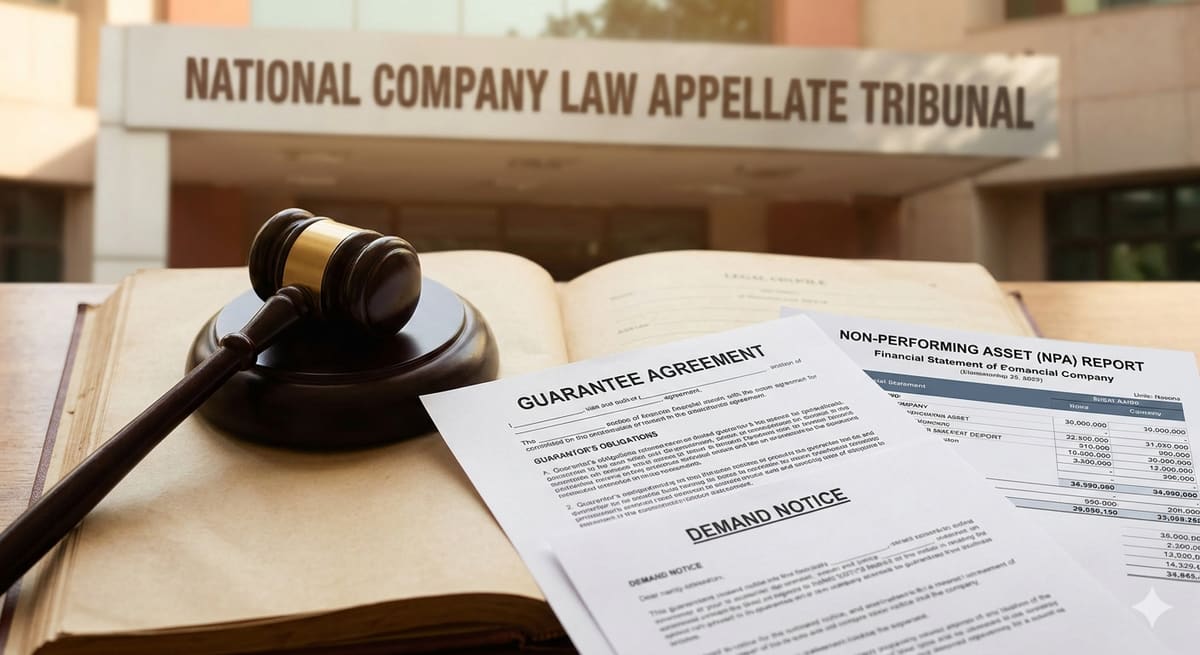
The National Company Law Appellate Tribunal has affirmed that simultaneous Corporate Insolvency Resolution Processes against a principal borrower and its corporate guarantor are legally permissible under the Insolvency and Bankruptcy Code, 2016. This ruling resolves a critical ambiguity in creditor enforcement strategy and clarifies the inapplicability of settlement mechanisms under Section 12A once liquidation has commenced.
Background & Facts
The Dispute
The dispute arises from the insolvency proceedings of Chamber Constructions Private Limited (the Corporate Debtor), which had provided a corporate guarantee to secure a loan extended by Bank of India to its holding company, RNA Corp Pvt. Ltd. (the Principal Borrower). Both entities were subjected to parallel CIRP proceedings initiated by different financial creditors. The Corporate Debtor’s CIRP was admitted on 16.07.2019, while RNA Corp’s CIRP was admitted on 26.11.2019. The Appellant, Mr. Gokul Aggarwal, a promoter and suspended director of RNA Corp, challenged the initiation of CIRP against RNA Corp before the Supreme Court, seeking a stay on proceedings on the ground that a single financial creditor cannot initiate parallel proceedings against both borrower and guarantor.
Key Facts
- The Corporate Debtor, Chamber Constructions Private Limited, guaranteed a loan of Rs. 81,58,50,645.75/- extended by Bank of India to RNA Corp.
- Bank of India filed a claim in the Corporate Debtor’s CIRP on this guarantee amount, which was admitted by the Resolution Professional.
- Bank of Baroda (Respondent No. 2) and India Resurgence ARC Pvt Ltd (Respondent No. 3) are other financial creditors of the Corporate Debtor.
- The Committee of Creditors (CoC) of the Corporate Debtor, comprising these three creditors holding 68.79%, 25.02%, and 6.19% of claims respectively, unanimously resolved on 31.08.2020 to liquidate the Corporate Debtor due to absence of viable resolution plans.
- The Resolution Professional filed IA No. 2471/2020 on 19.09.2020 seeking liquidation under Section 33(2) of the IBC.
- The Appellant filed Civil Appeal Nos. 827-828/2021 before the Supreme Court challenging the parallel CIRP against RNA Corp, seeking a stay.
- The Supreme Court granted an interim status quo order on 12.04.2021, restraining proceedings against RNA Corp pending final adjudication.
- On 26.02.2026, the Supreme Court dismissed Civil Appeal Nos. 827-828 of 2021, 4018 of 2023, and 7231 of 2024, holding that simultaneous CIRP against principal borrower and corporate guarantor is permissible under the IBC.
- The Appellant filed IA No. 41/2024 before the NCLT seeking stay on liquidation proceedings pending the Supreme Court’s final decision.
- The NCLT dismissed IA No. 41/2024 on 21.02.2024, holding that the Supreme Court’s interim order did not bar proceedings against the guarantor.
- On 28.05.2024, the NCLAT issued an interim order restraining the liquidator from auctioning assets, based on the Appellant’s representation that a settlement under Section 12A was being explored.
- On 01.10.2024, the NCLAT stayed the handover of secured assets to the liquidator, pending resolution of the settlement proposal.
- On 01.10.2024, the NCLAT also held in Asha Chopra v. Hind Motors India Ltd. that Section 12A is inapplicable during liquidation.
Procedural History
- 16.07.2019: CIRP admitted against Corporate Debtor (Chamber Constructions Pvt. Ltd.) under Section 7 of IBC.
- 26.11.2019: CIRP admitted against Principal Borrower (RNA Corp Pvt. Ltd.) under Section 7 of IBC.
- 19.09.2020: Resolution Professional filed IA No. 2471/2020 seeking liquidation of Corporate Debtor.
- 12.04.2021: Supreme Court granted interim status quo in Civil Appeal Nos. 827-828/2021 against RNA Corp.
- 31.08.2020: CoC unanimously resolved to liquidate Corporate Debtor.
- 21.02.2024: NCLT (Mumbai) dismissed IA No. 41/2024 and allowed liquidation to proceed.
- 28.05.2024: NCLAT issued interim order restraining auction of assets pending settlement under Section 12A.
- 01.10.2024: NCLAT stayed handover of secured assets to liquidator.
- 24.08.2024: NCLAT held in Asha Chopra that Section 12A inapplicable during liquidation.
- 26.02.2026: Supreme Court dismissed appeals, holding parallel CIRP permissible.
- 04.09.2025: NCLAT noted that Section 12A cannot be invoked post-liquidation.
- 19.09.2025: CA (AT) Ins. No. 2118/2024 withdrawn.
- 10.12.2025: NCLAT directed continuation of hearing despite pending Supreme Court judgment.
- 11.05.2026: NCLAT delivered final judgment.
The Parties' Positions
Appellant (Mr. Gokul Aggarwal): Argued that the Supreme Court’s interim order in the RNA Corp matter barred proceedings against the Corporate Debtor, as both were linked by the same debt. Claimed that settlement under Section 12A was feasible and that liquidation should be stayed pending resolution. Asserted that the NCLT erred in dismissing IA No. 41/2024 without considering the pendency of the Supreme Court matter.
Respondents (Bank of India, Bank of Baroda, India Resurgence ARC, Resolution Professional, Liquidator): Contended that the CIRP against the Corporate Debtor was initiated by Bank of India, while the CIRP against RNA Corp was initiated by Bank of Baroda - two distinct financial creditors. Emphasized that the Supreme Court’s order pertained only to RNA Corp and did not extend to the Corporate Debtor. Argued that Section 12A is statutorily barred during liquidation and that the CoC’s unanimous decision to liquidate must be respected.
Relief Sought
The Appellant sought: (1) stay of liquidation proceedings against Chamber Constructions Private Limited; (2) setting aside of the NCLT’s order dated 21.02.2024 dismissing IA No. 41/2024; (3) restoration of the interim order dated 28.05.2024 permitting settlement under Section 12A; and (4) direction to the liquidator to refrain from auctioning assets.
The Legal Issue
Can a financial creditor initiate parallel CIRP proceedings against both a principal borrower and its corporate guarantor under the IBC? And is an application under Section 12A permissible after the admission of liquidation?
Arguments Presented
For the Appellant
The Appellant relied on the Supreme Court’s interim status quo order dated 12.04.2021, arguing that it implicitly barred all proceedings related to the same debt, including against the guarantor. He contended that the NCLT’s dismissal of IA No. 41/2024 was premature and violated principles of natural justice, as he was not personally present during the hearing. He further argued that Section 12A remained a viable route for settlement, and that the liquidation order should be stayed to allow for negotiation.
For the Respondent
The Respondents emphasized that the CIRP against RNA Corp was initiated by Bank of Baroda, while the CIRP against the Corporate Debtor was initiated by Bank of India - two separate financial creditors. They cited ICICI Bank Ltd. v. Era Infrastructure (India) Ltd. (2026 SCC Online SC 314), wherein the Supreme Court held that parallel CIRP against borrower and guarantor is lawful under the IBC. They also relied on Asha Chopra v. Hind Motors India Ltd., which held that Section 12A is inapplicable during liquidation, and that settlement post-liquidation must follow Section 230 of the Companies Act, 2013. They argued that the Appellant had ample opportunity to propose a resolution plan but failed to do so over four years.
The Court's Analysis
The NCLAT undertook a detailed statutory and precedential analysis. It first examined the nature of the Supreme Court’s interim order dated 12.04.2021, concluding that it applied only to the CIRP against RNA Corp and did not extend to the Corporate Debtor, which was subject to a separate proceeding initiated by a different creditor. The Tribunal noted that the Supreme Court’s final judgment dated 26.02.2026 explicitly upheld the maintainability of parallel proceedings, thereby removing the foundational ground for the Appellant’s stay request.
"The issue before the Hon'ble Supreme Court in the case filed by Principal Borrower is whether a financial creditor can claim amounts simultaneously from Principal Borrower and the Guarantor. Having held that the proceeding further in this matter are not barred by the Hon'ble Supreme Court's order in the case of RNA Corp, we do not find any reason not to allow the Insolvency Resolution process to move forward in case of guarantor."
The Tribunal then turned to the applicability of Section 12A. It reaffirmed its earlier holding in Asha Chopra, emphasizing that the statutory scheme under Section 12A, Section 33, and Regulation 2B of the Liquidation Regulations clearly delineates that withdrawal of CIRP is permissible only during the resolution phase, not after liquidation has commenced. The Tribunal held that the Appellant’s reliance on Section 12A was legally untenable once the liquidation order was passed on 21.02.2024.
The NCLAT further observed that the CoC had unanimously resolved to liquidate the Corporate Debtor on 31.08.2020, a decision taken after the failure of all resolution attempts. The Appellant, who was present at the CoC meeting, did not raise any settlement proposal at that time. The Resolution Professional’s communication on 12.02.2024 that no out-of-court settlement had occurred remained unchallenged. The Tribunal held that the Adjudicating Authority acted within its statutory mandate under Section 33(2) in approving liquidation.
The Appellant’s non-appearance before the NCLT during IA No. 41/2024 was also examined under Rule 48 of the NCLT Rules. The Tribunal found no procedural illegality in the dismissal of the application, as the Adjudicating Authority had the discretion to decide on merits despite non-appearance.
The Verdict
The NCLAT dismissed the appeal and upheld the liquidation order dated 21.02.2024. The Tribunal held that simultaneous CIRP against a principal borrower and corporate guarantor is lawful under the IBC, as confirmed by the Supreme Court in ICICI Bank Ltd. v. Era Infrastructure (India) Ltd. (2026 SCC Online SC 314). Section 12A is inapplicable during liquidation, and any settlement must now be pursued under Section 230 of the Companies Act, 2013. The liquidator is directed to proceed with the liquidation process without delay, including the sale of assets, and all interim orders restraining auction or handover of secured assets are vacated. No costs are awarded.
What This Means For Similar Cases
Parallel CIRP Is Legally Valid
- Practitioners must now treat corporate guarantors and principal borrowers as independent entities for CIRP purposes, even when the debt is identical.
- Financial creditors may initiate separate proceedings against both parties without violating the IBC’s framework.
- Applications seeking stay on guarantor proceedings on grounds of parallel borrower proceedings will be dismissed unless the same creditor is involved and the matter is directly linked.
Section 12A Is Not a Post-Liquidation Escape Hatch
- Resolution applicants and promoters cannot invoke Section 12A after liquidation has been ordered.
- Any attempt to settle post-liquidation must follow the scheme under Section 230 of the Companies Act, 2013, and require approval of the NCLT.
- Liquidators must reject any application under Section 12A filed after the liquidation order, citing Asha Chopra as binding precedent.
Procedural Non-Appearance Does Not Invalidate Orders
- Tribunals may proceed to decide applications on merits even if the applicant is absent, under Rule 48 of NCLT Rules.
- Parties must ensure representation at all hearings; failure to appear does not automatically entitle them to restoration.
- Delay tactics based on non-appearance or pending Supreme Court matters will not be tolerated if the legal issue has been resolved.