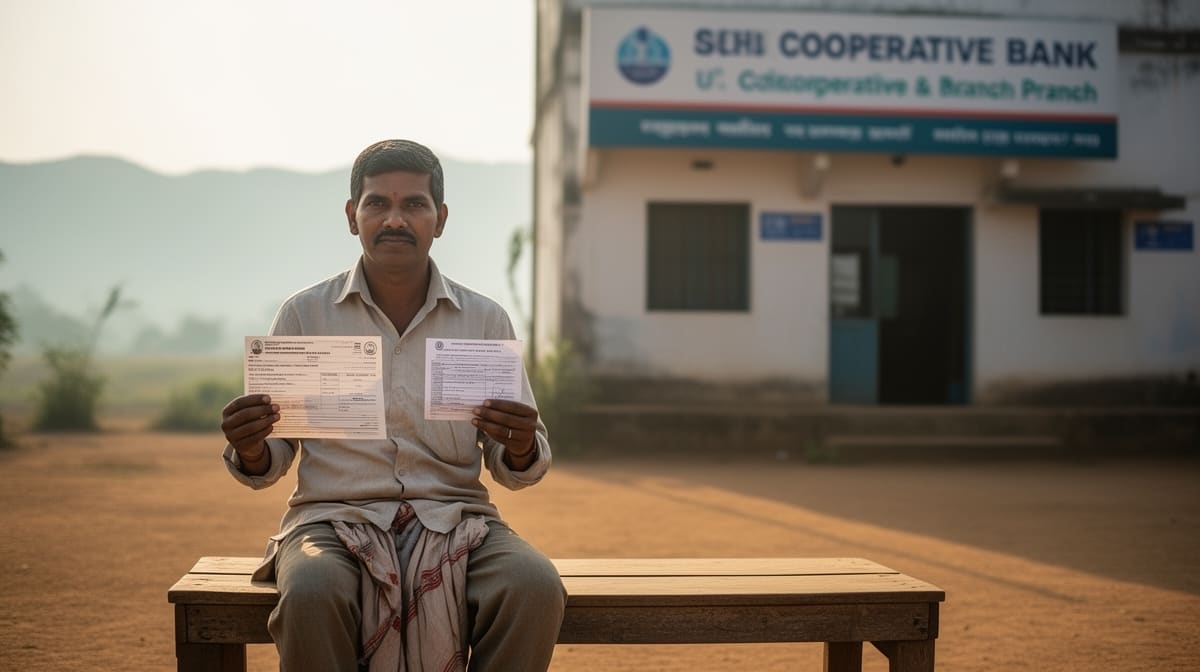
A 72-year-old widow challenges the mutation of her deceased husband’s hypothecated land to a co-operative bank after years of compounded interest, raising critical questions about statutory debt caps and procedural fairness. The Himachal Pradesh High Court, while declining to adjudicate the merits, has directed the bank to consider her representation under prescribed rules, reinforcing that financial institutions cannot unilaterally enforce property transfers without due process.
Background & Facts
The Dispute
The petitioner, Krishni Devi, is the widow of late Sh. Babu Ram, who availed a loan of ₹4.50 lakhs from the Kangra Co-operative Agriculture Primary Rural Development Bank in 1998. The loan was secured by hypothecation of agricultural land described in Khata Khatoni No. 86/201 and 84/199, situated at Mohal Sour, Hadbast No. 41/26, Sub-Tehsil Bhota, District Hamirpur, Himachal Pradesh. The petitioner alleges that her husband made partial repayments before his death in 2003. Thereafter, the bank allegedly ceased accepting payments and instead allowed interest to compound annually, inflating the outstanding amount to ₹36,62,431 as of 09.01.2026.
In 2011, the bank purchased the hypothecated land at an auction for ₹9,79,849 and obtained mutation of the land in its name. The petitioner contends that this transaction was neither lawful nor transparent, and that the bank violated the provisions of the Himachal Pradesh Debt Reduction Act, 1976, which caps interest and mandates recalibration of debts owed by small farmers and rural borrowers.
Key Facts
- Loan disbursed: 1998, amount ₹4.50 lakhs
- Borrower (husband) died: 2003
- Partial repayments made prior to death
- Loan account balance as of 09.01.2026: ₹36,62,431
- Bank purchased land at auction: 2011
- Auction price: ₹9,79,849
- Mutation of land in bank’s name: completed post-2011
- Petitioner never received notice of auction or opportunity to redeem
- Land remains in possession of petitioner despite mutation
Procedural History
- 2011: Bank conducts auction and purchases hypothecated land
- Post-2011: Mutation of land recorded in bank’s name without petitioner’s consent or notice
- 2026: Petitioner files Writ Petition (CWP No. 3699/2026) before the High Court of Himachal Pradesh seeking:
- Quashing of mutation
- Recalculation of debt under H.P. Debt Reduction Act, 1976
- Injunction against further auction
- Keeping open the one-time settlement offer
- 24.04.2026: Respondent bank submits instructions affirming strict adherence to financial norms and Rule 82 of the Himachal Pradesh Co-operative Societies Rules, 1971
- 05.05.2026: Court disposes of writ petition without deciding merits, granting liberty to file representation
The Parties' Positions
Petitioner’s Position: The bank’s conduct violates the H.P. Debt Reduction Act, 1976, which prohibits exorbitant interest accumulation and mandates debt restructuring for rural borrowers. The auction and mutation were illegal, as no statutory notice or opportunity to pay was given. The bank’s acquisition of land at a fraction of its market value constitutes unconscionable enrichment.
Respondent Bank’s Position: The bank acted within its rights under the Himachal Pradesh Co-operative Agriculture and Rural Development Banks Act, 1979. The auction was conducted lawfully. Any relaxation of debt terms requires explicit policy authorization from the Regional Co-operative Society (RCS), HP, and cannot be granted by field officials. The petitioner must approach the Competent Authority under Rule 82 of the Co-operative Societies Rules, 1971.
Relief Sought
The petitioner sought:
- Quashing of mutation in favour of the bank
- Recalculation of debt under the H.P. Debt Reduction Act, 1976
- Injunction against auction until lawful debt is determined
- Continuation of the one-time settlement offer pending judicial decision
The Legal Issue
Whether a co-operative bank can unilaterally acquire hypothecated agricultural land through auction and mutation after the borrower’s death, without recalibrating the debt under the H.P. Debt Reduction Act, 1976, and without affording the legal heir an opportunity to redeem or settle the debt?
Arguments Presented
For the Petitioner
The petitioner’s counsel argued that the H.P. Debt Reduction Act, 1976, applies to all loans extended by co-operative banks to rural borrowers, including those secured by land. The Act mandates that interest cannot be compounded beyond statutory limits and requires the bank to recalculate the principal and interest owed. The bank’s failure to do so renders the entire debt amount illegal. Further, the auction and mutation were conducted without notice to the legal heir, violating principles of natural justice. The bank’s acquisition of land at ₹9.8 lakhs against a liability of over ₹36 lakhs is grossly inequitable and amounts to exploitation under Section 27 of the Co-operative Banks Act, 1979.
For the Respondent
The bank’s counsel contended that the bank is a custodian of public funds and bound by strict financial discipline under the Himachal Pradesh Co-operative Societies Rules, 1971. Rule 82 provides the exclusive mechanism for considering concessions or settlements. Field officials lack authority to grant any relaxation without approval from the RCS, HP. The bank has not denied the petitioner’s right to seek relief; it has merely stated that the proper forum is the Competent Authority under Rule 82. The auction was conducted in accordance with the Co-operative Banks Act, and the mutation is legally valid.
The Court's Analysis
The Court declined to examine the substantive legality of the auction, mutation, or the quantum of interest. It noted that the bank, in its instructions dated 24.04.2026, had explicitly acknowledged that the petitioner may submit a representation to the Managing Committee or Competent Authority under Rule 82 of the Himachal Pradesh Co-operative Societies Rules, 1971. The bank further undertook to process such representation in accordance with law and issue a speaking order.
"That the Bank, being custodian of public funds, is bound to strictly adhere to financial norms; and any deviation from applicable regulations would be deemed unacceptable in the eyes of the law."
The Court observed that while the bank’s stance was procedurally correct, the petitioner’s vulnerability as a 72-year-old widow, who had no opportunity to contest the auction or seek debt relief, warranted a humane and expedited remedy. The Court emphasized that the statutory framework under the H.P. Debt Reduction Act, 1976, and Rule 82 are not mutually exclusive but complementary. The bank’s internal policy cannot override statutory protections meant for rural debtors.
The Court held that the petitioner’s right to be heard and to have her debt recalibrated under the Debt Reduction Act must be given effect through the internal mechanism the bank itself acknowledged. To deny her this avenue would render the statutory protections illusory.
The Verdict
The writ petition is disposed of with liberty to the petitioner to submit a comprehensive representation to the Managing Committee/Competent Authority of the Kangra Co-operative Bank within two weeks. The bank shall consider the representation strictly in accordance with the H.P. Debt Reduction Act, 1976, and Rule 82 of the Himachal Pradesh Co-operative Societies Rules, 1971, and pass a reasoned, speaking order within six weeks of receipt. The decision shall be communicated in writing to the petitioner. All pending applications are disposed of as infructuous.
What This Means For Similar Cases
Debt Recalibration Is Mandatory Before Auction
- Practitioners must now argue that any auction of agricultural land by a co-operative bank must be preceded by a statutory recalibration under the H.P. Debt Reduction Act, 1976
- Failure to recalculate interest renders the debt amount illegal and the auction voidable
- Legal heirs of deceased borrowers are entitled to notice and opportunity to redeem before any enforcement action
Rule 82 Is a Gateway, Not a Barrier
- Rule 82 of the Co-operative Societies Rules, 1971, is not a procedural trap but a statutory mechanism to enforce substantive rights
- Banks cannot use internal policy to delay or deny access to statutory relief
- Courts will treat representations under Rule 82 as mandatory pre-litigation remedies, but will enforce strict timelines for disposal
Judicial Intervention Preserves Statutory Rights
- Courts will not adjudicate merits prematurely but will ensure statutory rights are not extinguished by bureaucratic inaction
- A 6-week deadline for decision is now a binding norm for co-operative banks facing similar representations
- Any delay beyond six weeks may invite contempt proceedings or writs for enforcement