The Telangana High Court has underscored the critical importance of procedural compliance in administrative actions, particularly in land use variations. In a recent order, the Court set aside a Draft Variation Notification issued by the Hyderabad Metropolitan Development Authority (HMDA) for failing to adhere to the prescribed timeline for public objections, thereby violating the principles of natural justice and statutory provisions under the HMDA Act, 2008 and the Right to Fair Compensation and Transparency in Land Acquisition, Rehabilitation and Resettlement Act, 2013. The judgment reaffirms that administrative bodies cannot bypass procedural safeguards, even in matters of public infrastructure development.
Background & Facts
The Dispute
The petitioners, residents and plot owners in Green Valley Layout, Manchirevula Village, Gandipet Mandal, Ranga Reddy District, challenged the legality of a Draft Variation Notification issued by the HMDA vide Letter No. 3098/RDPs/Plg/HMDA/2025/P dated 07.01.2026. The notification proposed a missing link road from Biragiguda to Narsingi (Shankerpalli-Hyderabad Road) connecting to Manchirevula (Corridor No. 131), which was published in the Telangana Gazette No. 19-A on 07.01.2026. The petitioners contended that the notification was issued arbitrarily, without following due procedure, and adversely affected their property rights.
Key Facts
- 15.12.2025: HMDA issued a preliminary notification under Section 15(3) of the HMDA Act, 2008, calling for objections and suggestions from the public regarding the proposed road widening and missing link road construction. The notification specified a 15-day period for submissions.
- 02.02.2022: The petitioners’ plots were granted building permission by the respondent authorities.
- 11.12.2024: An occupancy certificate was issued in the name of SRRR Projects, from whom the petitioners purchased their plots.
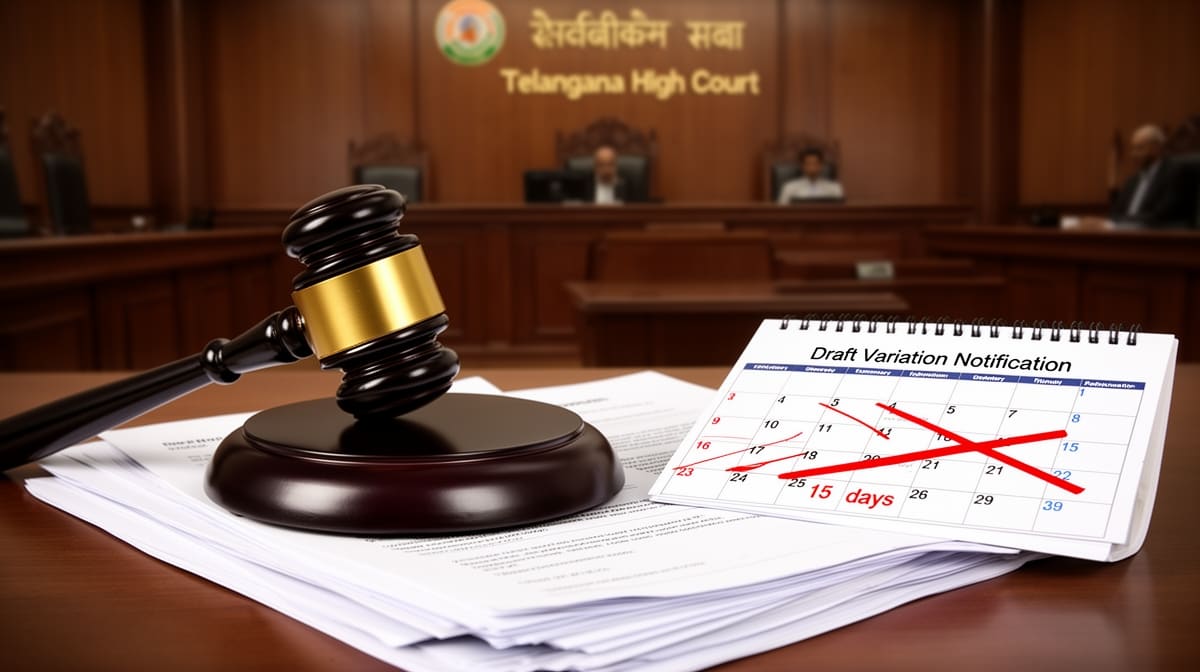
- 07.01.2026: HMDA issued the impugned Draft Variation Notification without waiting for the 15-day objection period specified in the preliminary notification dated 31.12.2025. The petitioners argued that this contravened the procedural timeline and deprived them of an opportunity to raise objections.
- 17.02.2026: The petitioners submitted a representation to the authorities regarding the potential land acquisition in Survey No. 242, Manchirevula Village.
- 09.02.2026 to 23.02.2026: The petitioners filed multiple representations/objections to the Draft Variation Notification, which went unaddressed.
Procedural History
- WP No. 5815 of 2026: Filed by Bitra Nageswara Rao and 19 others challenging the same Draft Variation Notification. The Court disposed of the petition on 24.02.2026, granting liberty to the petitioners to submit fresh objections within one week from the date of the order. The Court directed the respondent authorities to consider the objections and pass appropriate orders in accordance with law, ensuring a fair opportunity of hearing.
- WP No. 7197 of 2026: The present writ petition, filed by Smt. Mekala Vijaya Lakshmi and 13 others, seeking similar relief. The petitioners relied on the order dated 24.02.2026 in WP No. 5815 of 2026 and prayed for an identical disposal.
Relief Sought
The petitioners sought the following reliefs:
- A writ of mandamus declaring the Draft Variation Notification dated 07.01.2026 as illegal, arbitrary, and unconstitutional.
- Setting aside the said notification.
- Restraining the respondents from interfering with the petitioners’ plots in Green Valley Layout, Manchirevula Village.
- Directions to the respondents to consider the petitioners’ representations/objections dated 09.02.2026 to 23.02.2026 and pass appropriate orders in accordance with law.
- Stay of all further proceedings pursuant to the impugned notification, pending disposal of the writ petition.
The Legal Issue
The central legal question was whether the HMDA’s issuance of the Draft Variation Notification dated 07.01.2026 was valid, given that it was published before the expiry of the 15-day objection period specified in the preliminary notification dated 31.12.2025. Additionally, the Court had to determine whether the failure to adhere to procedural timelines under the HMDA Act, 2008 and the Right to Fair Compensation Act, 2013 rendered the notification void ab initio and violative of Articles 14, 19, and 300-A of the Constitution of India.
Arguments Presented
For the Petitioners
- Procedural Non-Compliance: The petitioners argued that the Draft Variation Notification dated 07.01.2026 was issued in contravention of the 15-day objection period specified in the preliminary notification dated 31.12.2025. This deprived them of a fair opportunity to raise objections, violating the principles of natural justice.
- Violation of Statutory Provisions: The impugned notification was issued in haste and without following the procedure contemplated under Section 15(3) of the HMDA Act, 2008 and the Right to Fair Compensation Act, 2013.
- Arbitrary and Malafide Action: The petitioners contended that the notification was arbitrary, malafide, and unsustainable, as it sought to acquire land without following due process.
- Existing Property Rights: The petitioners highlighted that they had valid building permissions and occupancy certificates for their plots, and the impugned notification adversely affected their vested rights.
- Precedent Reliance: The petitioners relied on the order dated 24.02.2026 in WP No. 5815 of 2026, which granted similar relief to similarly situated petitioners.
For the Respondents
- No Land Acquisition Initiated: Mr. V. Narasimha Goud, learned Standing Counsel for HMDA, submitted that no land acquisition proceedings had been initiated as of the date of the hearing.
- Purpose of Notifications: The preliminary notification dated 31.12.2025 was issued to call for objections and suggestions from the public regarding the proposed road widening and missing link road construction. The Draft Variation Notification dated 07.01.2026 was issued to improve road capacity, traffic movement, and connectivity in the Hyderabad Metropolitan Area.
- Willingness to Consider Objections: The respondents expressed their willingness to consider the petitioners’ objections/representations and pass appropriate orders in accordance with law.
The Court's Analysis
The Court observed that the Draft Variation Notification dated 07.01.2026 was issued without waiting for the expiry of the 15-day objection period specified in the preliminary notification dated 31.12.2025. This procedural lapse rendered the impugned notification invalid, as it deprived the petitioners of a fair opportunity to raise objections, a fundamental requirement under Section 15(3) of the HMDA Act, 2008 and the principles of natural justice.
The Court relied on its earlier order dated 24.02.2026 in WP No. 5815 of 2026, which disposed of a similar petition on consent terms. In that case, the Court had granted liberty to the petitioners to submit fresh representations/objections within one week from the date of the order. The respondent authorities were directed to consider the objections and pass appropriate orders in accordance with law, ensuring a fair opportunity of hearing.
"The respondent authorities shall consider the same and pass appropriate orders strictly in accordance with law, by giving a fair opportunity of hearing to the petitioners."
The Court emphasized that procedural compliance is non-negotiable, even in matters of public infrastructure development. The failure to adhere to the prescribed timelines vitiated the entire process, rendering the Draft Variation Notification void ab initio. The Court further noted that the petitioners had valid property rights, including building permissions and occupancy certificates, which could not be arbitrarily extinguished without following due process.
The Verdict
The Court disposed of WP No. 7197 of 2026 in terms of its earlier order dated 24.02.2026 in WP No. 5815 of 2026. The key directions issued were:
- The petitioners were granted liberty to submit fresh representations/objections to the Draft Variation Notification dated 07.01.2026 within one week from the date of receipt of a copy of the order.
- The respondent authorities were directed to consider the petitioners’ objections and pass appropriate orders strictly in accordance with law, ensuring a fair opportunity of hearing.
- No order as to costs was passed.
- All miscellaneous petitions pending in the writ petition were closed.
What This Means For Similar Cases
Procedural Compliance Is Mandatory
This judgment reaffirms that administrative bodies cannot bypass procedural safeguards, even in matters of public interest. Practitioners should note:
- Statutory timelines prescribed for public objections/suggestions must be strictly adhered to. Failure to do so renders the subsequent action void ab initio.
- Natural justice requires that affected parties be given a fair opportunity to be heard before any adverse action is taken.
- Precedential reliance: Courts are likely to follow similar reasoning in cases where procedural lapses are alleged, particularly under statutes like the HMDA Act, 2008 and the Right to Fair Compensation Act, 2013.
Vested Property Rights Are Protected
- Building permissions and occupancy certificates create vested rights that cannot be arbitrarily extinguished by administrative actions.
- Landowners and plot purchasers can challenge Draft Variation Notifications or land acquisition proceedings if they are issued without following due process.
- Representations/objections must be duly considered by authorities, and orders must be passed in accordance with law.
Strategic Litigation in Administrative Law
- Writ petitions under Article 226 of the Constitution remain an effective remedy for challenging arbitrary administrative actions.
- Consent orders granting liberty to submit fresh objections can be leveraged in subsequent petitions involving similarly situated parties.
- Multiple representations to authorities should be documented and relied upon in legal proceedings to demonstrate efforts at exhaustion of remedies.