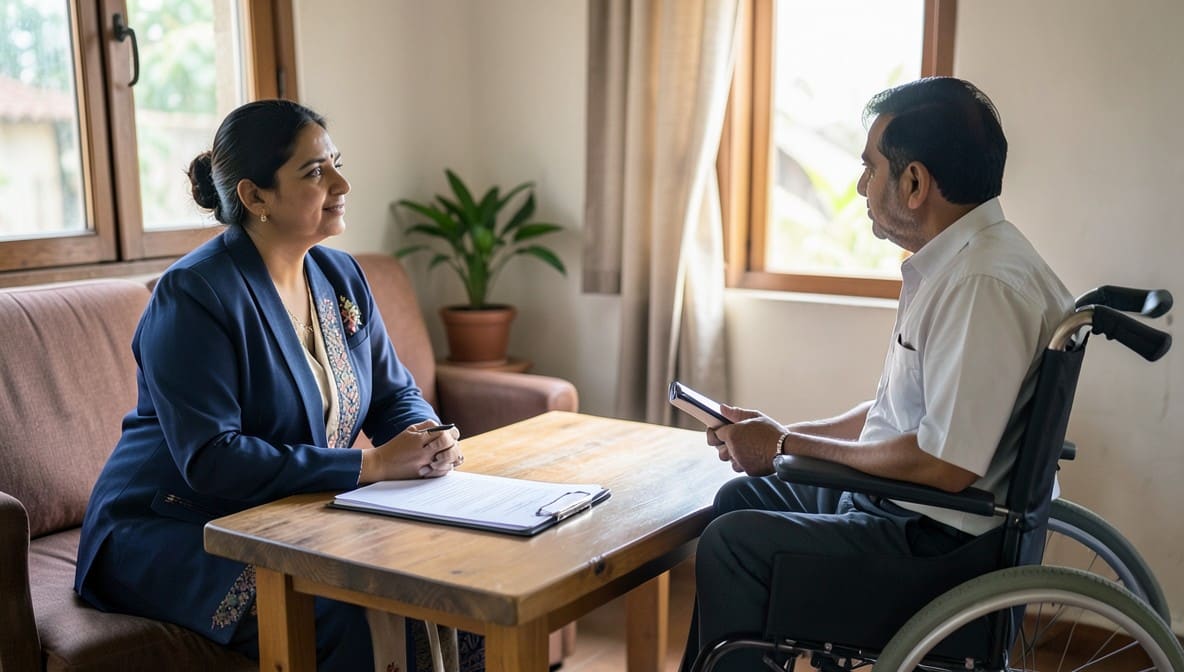
The Bombay High Court has reaffirmed that the right to cross-examine a witness in matrimonial proceedings is not a mere formality but a fundamental aspect of natural justice. When a party is prevented from completing cross-examination due to sudden and severe illness, the court must remand the matter to ensure a fair adjudication. This judgment underscores that procedural fairness cannot be sacrificed for expediency, even in long-pending divorce cases.
Background & Facts
The Dispute
The Appellant, Sheetal Deepak Kapde, filed a Family Court Appeal challenging the divorce decree granted by the Family Court, Thane, in Petition No. A-318/2017, filed by her husband, Deepak Daulat Kapde, under Section 13(1)(i-a) and (i-b) of the Hindu Marriage Act, 1955. The husband alleged cruelty and non-consummation of marriage since December 2014, claiming the wife left the matrimonial home on 02/10/2014 and has remained at her parental residence since.
Key Facts
- The marriage was solemnized on 22/12/2011
- The husband filed the divorce petition on 15/04/2017
- The wife filed a written statement (Exh.13) denying all allegations, asserting emotional neglect, financial hardship due to her medical conditions, and lack of support from the husband’s family
- The wife’s medical condition deteriorated during the pendency of the case, culminating in a paralytic stroke that rendered her physically unable to attend court proceedings
- The wife had commenced but not completed the cross-examination of the husband, whose evidence was recorded via affidavit
- No evidence was adduced by the wife due to her medical incapacitation
- The Family Court, on 02/06/2023, granted divorce on the ground that the wife’s failure to cross-examine rendered the husband’s affidavit uncontested and therefore credible
Procedural History
- 15/04/2017: Petition filed by husband under Section 13(1)(i-a) and (i-b) of the Hindu Marriage Act, 1955
- 2017 - 2023: Proceedings pending for over six years
- During 2021 - 2023: Wife suffered progressive health decline; paralytic stroke occurred during cross-examination phase
- 02/06/2023: Family Court granted divorce decree, accepting husband’s affidavit as gospel truth due to wife’s non-completion of cross-examination
- 02/06/2023: Decree drawn and filed
- 05/05/2023: Family Court Appeal No.73 of 2023 filed by wife
- 15/06/2024: Interim Application No.15620 of 2024 filed seeking maintenance
- 05/03/2026: Interim Application No.2780 of 2026 filed for stay of decree
- 12/07/2023: Interim Application No.15991 of 2023 filed for medical evidence admission
- 05/05/2026: Judgment delivered by Bombay High Court
The Parties' Positions
Appellant (Wife): Argued that her inability to complete cross-examination was due to sudden, severe medical emergency (paralytic stroke), supported by medical records. Contended that the Family Court violated principles of natural justice by proceeding ex parte and accepting unchallenged evidence.
Respondent (Husband): Argued that the wife had ample opportunity over six years to complete cross-examination, and her failure to do so, even after medical leave, amounted to abandonment of her defence. Asserted that the decree was lawful and should be upheld.
Relief Sought
The appellant sought: (1) setting aside of the divorce decree dated 02/06/2023; (2) remand of proceedings for fair opportunity to cross-examine and adduce evidence; (3) interim and permanent maintenance; and (4) costs.
The Legal Issue
The central question was whether a Family Court may grant a divorce decree based solely on an unchallenged affidavit when the respondent’s failure to cross-examine is due to a sudden, documented medical emergency, and whether such a proceeding violates the principles of natural justice under Section 13 of the Hindu Marriage Act and Article 21 of the Constitution.
Arguments Presented
For the Appellant
Counsel for the wife relied on K. Srinivas v. K. Sujatha and Rajesh Sharma v. State of U.P. to argue that the right to cross-examine is an essential component of a fair hearing under Article 21. She submitted that the Family Court’s reliance on an unchallenged affidavit, while the respondent was incapacitated, amounted to a denial of reasonable opportunity to defend. Medical records dated 15/01/2023 and 20/03/2023 were submitted to prove the paralytic stroke and consequent inability to attend court.
For the Respondent
The husband’s counsel contended that the wife had six years to complete her defence and that her failure to do so, even after multiple adjournments, constituted waiver of rights. He cited Smt. Sunita Devi v. Smt. Renuka Devi to argue that delay and non-participation justify adverse inference. He further submitted that the decree was based on the husband’s consistent testimony and the wife’s silence.
The Court's Analysis
The Court emphasized that natural justice is not a technicality but a constitutional imperative. The Family Court’s decision to accept the husband’s affidavit as conclusive, while the wife was medically incapacitated, was found to be legally unsustainable. The Court observed:
"The right to cross-examine is not a privilege but a procedural safeguard without which the adjudication becomes arbitrary and violative of the right to fair hearing. A party cannot be penalized for circumstances beyond her control, especially when medical evidence is on record."
The Court distinguished Smt. Sunita Devi, noting that in that case, the respondent had wilfully absented herself over multiple hearings. Here, the wife’s absence was due to a sudden, documented medical emergency. The Court held that the Family Court erred in treating the affidavit as gospel truth without affording the wife a meaningful opportunity to challenge it.
The Court further noted that the husband’s evidence was not independently corroborated, and the wife’s written statement contained specific allegations of neglect and emotional cruelty that remained unaddressed. The Court rejected the notion that delay alone justifies denial of fair hearing, especially when the delay is attributable to health crises.
The Verdict
The appeal was allowed. The Bombay High Court quashed and set aside the divorce decree dated 02/06/2023. The matter was remanded to the Family Court, Thane, with directions to permit the wife to cross-examine the husband and to allow both parties to file additional evidence. The Family Court was directed to decide the petition within six months from the date of judgment. The wife is entitled to file for interim maintenance and permanent alimony during the pendency of the remanded proceedings, and the Family Court must decide such applications expeditiously.
What This Means For Similar Cases
Fair Hearing Trumps Procedural Delay
- Practitioners must argue that delay alone cannot override the right to cross-examine when the delay is due to medical emergency
- Courts must examine the cause of non-participation before drawing adverse inference
- Medical records submitted in good faith must be accepted as prima facie proof of incapacity
Affidavits Are Not Conclusive Without Cross-Examination
- In matrimonial cases, affidavits cannot be treated as conclusive evidence if cross-examination is pending due to reasons beyond the party’s control
- The burden shifts to the court to ensure both parties have a fair opportunity to rebut evidence
- Judges must record reasons for proceeding ex parte, especially in cases involving serious allegations like cruelty
Remand Is the Correct Remedy, Not Dismissal
- Where a party is denied fair opportunity due to unforeseen circumstances, remand - not dismissal - is the legally mandated remedy
- Courts must avoid finality at the cost of justice, particularly in divorce cases where the stakes are personal and irreversible
- The six-month deadline for disposal on remand sets a new benchmark for expeditious resolution in family matters