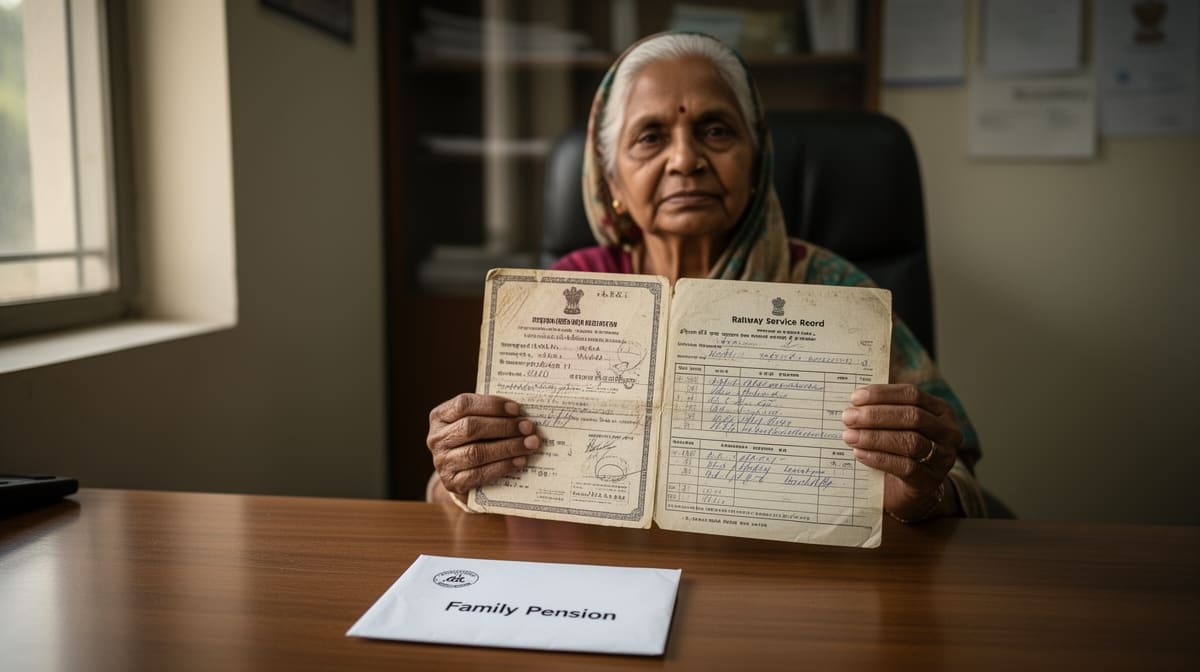
The Central Administrative Tribunal has affirmed that a widow’s entitlement to family pension is an indefeasible right under railway pension rules, irrespective of marital discord, pending litigation, or omission from service records. The judgment clarifies that pensionary benefits are not subject to private disputes among heirs and must be disbursed without undue delay or coercive conditions.
Background & Facts
The Dispute
The applicants, Sheela S. (widow) and Shibi B.S. (daughter), are legal heirs of Late G. Babu, a retired Chief Travelling Ticket Inspector of Southern Railway. Babu voluntarily retired on 30.09.2016. A bitter marital dispute led to litigation in the Family Court, Thiruvananthapuram, where the applicants sought recovery of gold ornaments, maintenance, and marriage expenses. On 25.07.2018, the Family Court passed an ex-parte decree in their favor, which Babu sought to set aside under Rule 13 of Order IX CPC the very next day.
Procedural History
- 2016: Family Court case (O.P. 2179/2016) initiated by applicants against Babu.
- 2018: Family Court granted ex-parte decree; Babu filed application under Rule 13 of Order IX CPC to set it aside.
- 2021: Babu filed O.A. 309/2021 before the Central Administrative Tribunal (CAT) seeking release of DCRG and commuted pension, alleging delay by Railway authorities.
- 2022: CAT directed release of Rs.26,96,742/- within 30 days, unaware of the pending Rule 13 application.
- 06.11.2022: Babu died.
- 17.11.2022: Railway authorities disbursed the entire amount to Babu’s nominated bank account.
- 21.11.2022: Railway authorities received notice of Babu’s death.
- 26.12.2022: Family Court issued injunction restraining disbursement of benefits.
- 2023: Applicants applied for family pension; application remained pending.
Relief Sought
The applicants sought: (i) immediate grant of family pension; (ii) 2/3rd share in DCRG and commuted pension; and (iii) interest on delayed payments.
The Legal Issue
The central question was whether the widow’s right to family pension can be withheld due to pending civil litigation, non-inclusion in service records, or alleged suppression of facts by the deceased, and whether the disbursement of retirement benefits to a deceased employee’s bank account constitutes valid discharge to his legal heirs.
Arguments Presented
For the Petitioner
The applicants relied on Jodh Singh v. Union of India to argue that family pension is a personal right accruing upon widowhood, not part of the deceased’s estate. They contended that the Railway authorities acted in bad faith by releasing funds to Babu’s account despite pending Rule 13 proceedings, violating Rule 10(c) of the Railway Services (Pension) Rules. They further asserted that Section 5 of the Transfer of Property Act rendered posthumous transfers to the deceased’s account void, and that the nominee was merely a trustee bound to share proceeds with legal heirs.
For the Respondent
The Railway authorities argued that the disbursement was made in compliance with CAT’s binding order, and that they had no knowledge of Babu’s death until 21.11.2022. They claimed the pension payment was processed through standard banking channels and that subsequent transactions were beyond their control. They denied coercing the applicants to withdraw litigation, stating that family pension processing was delayed due to pending criminal and civil proceedings.
The Court's Analysis
The Tribunal examined the nature of family pension under the Railway Services (Pension) Rules and the jurisprudence established in Jodh Singh v. Union of India. It held that family pension is not a gratuity or estate asset but a statutory benefit triggered by the widow’s status at the time of the employee’s death. The Court emphasized:
"What was not payable during the lifetime of the deceased over which he had no power of disposition could not form part of his estate."
The Tribunal rejected the argument that non-inclusion of the widow’s name in service records invalidated her claim, noting that the marriage certificate and legal heirship certificate were conclusive proof of status. It further held that the pendency of an application under Rule 13 of Order IX CPC did not constitute a lis under Rule 10(c) of the Pension Rules, as such applications are procedural remedies, not substantive claims affecting pensionary rights.
Regarding the disbursement of DCRG and commuted pension, the Tribunal acknowledged that the Railway authorities acted in good faith based on the CAT’s order and lack of notice of death. However, it clarified that once the employee dies, the right to receive such amounts devolves upon legal heirs, and the nominee holds the funds in trust. The Tribunal declined to adjudicate the inter-se dispute among heirs, noting that criminal proceedings and execution petitions were already pending before the Family Court.
The Verdict
The applicants won on the family pension claim. The Court held that the right to family pension is indefeasible and cannot be conditioned upon withdrawal of litigation or relinquishment of claims over retirement benefits. The respondents were directed to disburse family pension with arrears within 60 days, with interest at 8% per annum thereafter. The claim for 2/3rd share in DCRG and commuted pension was left to be resolved in pending civil and criminal proceedings.
What This Means For Similar Cases
Family Pension Cannot Be Conditional
- Practitioners must challenge any administrative condition requiring withdrawal of civil/criminal litigation as a prerequisite for family pension.
- The widow’s status, proven by marriage certificate, is sufficient - no requirement to be listed in service records.
- Denial of family pension on grounds of marital discord violates Article 21 and is per se illegal.
Posthumous Disbursement Does Not Discharge Liability to Heirs
- Disbursement to a deceased employee’s bank account does not extinguish the liability to legal heirs.
- Nominees are trustees; they cannot claim full ownership of pensionary benefits.
- Legal heirs must pursue recovery through civil execution or criminal proceedings for misappropriation.
Rule 13 Applications Do Not Trigger Lis Pendens in Pension Matters
- Applications under Rule 13 of Order IX CPC to set aside ex-parte orders are procedural and do not constitute a pending suit under Rule 10(c) of Railway Pension Rules.
- Authorities cannot withhold pension on the basis of such applications unless a substantive injunction is in place.
- Disclosure of pending Rule 13 applications is not mandatory for pension disbursement unless the court has stayed the payment.