The Central Administrative Tribunal has clarified that a nominee under pension rules cannot claim absolute ownership of family pension benefits, and that a legally wedded spouse, duly authenticated by competent civil authorities, is entitled to such benefits irrespective of nomination. This judgment reinforces the principle that nomination is a procedural convenience, not a substitute for succession law.
Background & Facts
The Dispute
The applicant, Krishan Kumar Gaba, sought family pension and other retiral dues following the death of his wife, Smt. Pushpa Kumari Puri, a retired teacher of the Government of NCT of Delhi. The respondents denied his claim on the ground that the deceased had nominated her brother, Mr. Yash Pal Puri, and sister-in-law, Mrs. Asha Puri, for payment of death-cum-retirement gratuity and arrears of pension, and that the applicant was not named as nominee in any official document.
Key Facts
- Smt. Pushpa Kumari Puri was born on 23.01.1940 and retired from service on 31.03.2000
- She passed away on 02.04.2022
- The applicant claims to have married her on 25.08.1989 at Arya Samaj Mandir
- The applicant submitted a marriage certificate, a handwritten note by the deceased dated 10.05.1989, and her death certificate naming him as spouse
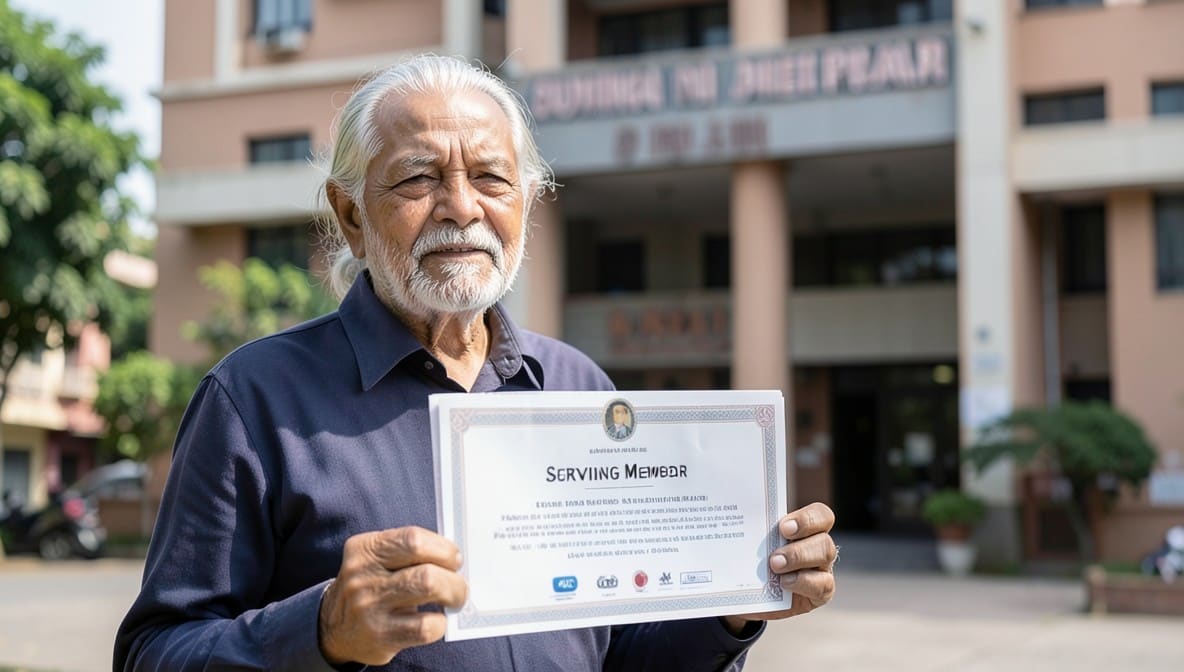
- The applicant produced a Surviving Member Certificate (No. 90660000201454) issued by the Revenue Department, Government of NCT of Delhi on 26.10.2023, certifying him as the sole surviving member of the deceased’s family
- The Surviving Member Certificate was publicly displayed on the notice board of the District Magistrate’s Office, Kapashera, Delhi
- Pension Payment Order (PPO No. 28062/05/0179/4) issued during the deceased’s lifetime identified her as the applicant’s wife and included his photograph
- The deceased’s Form 7 (used during pension revision in 2016) listed her father’s name and referred to her as "Kumari" (unmarried woman)
- The deceased had filled Form A and Form B for nomination of her brother and sister-in-law for death-cum-retirement gratuity and arrears of pension
- No nomination form for family pension was filed by the deceased, as family pension under CCS (Pension) Rules, 1972 is not subject to nomination
Procedural History
- 02.04.2022: Death of Smt. Pushpa Kumari Puri
- 20.01.2024: Impugned order issued by Sarvodaya Kanya Vidhyalaya rejecting applicant’s claim for family pension
- 12.03.2024: Original Application (OA No. 3102/2024) filed before Central Administrative Tribunal, Principal Bench, New Delhi
- 12.03.2026: Oral arguments concluded
- 24.03.2026: Order pronounced by the Tribunal
The Parties' Positions
Applicant’s Position: The applicant is the legally wedded husband of the deceased, as proven by multiple documents including the Surviving Member Certificate issued by the Revenue Department, the marriage certificate, and the PPO. Nomination for gratuity does not affect entitlement to family pension, which is governed by statutory entitlement, not nomination.
Respondents’ Position: The deceased nominated her brother and sister-in-law for death-cum-retirement gratuity and pension arrears. The applicant was never nominated. The use of "Kumari" in Form 7 and absence of husband’s name in service records cast doubt on the marital status. The Tribunal lacks jurisdiction to adjudicate marital claims and the applicant must approach civil court for a succession certificate.
Relief Sought
The applicant sought:
- Quashing of the impugned order dated 20.01.2024
- Release of family pension and all retiral dues including deposits
- Payment of interest on delayed payments
- Costs of litigation
- Permission to amend grounds as necessary
The Legal Issue
The central question was whether a nominee for death-cum-retirement gratuity under Rule 53 of the CCS (Pension) Rules, 1972 can override the statutory right of a legally wedded spouse to claim family pension, and whether the Central Administrative Tribunal has jurisdiction to determine marital status based on documentary evidence issued by civil authorities.
Arguments Presented
For the Appellant
Learned counsel for the applicant relied on the Surviving Member Certificate issued by the Revenue Department, Government of NCT of Delhi, which is a statutory document issued under the authority of the District Magistrate. He argued that the certificate, supported by marriage proof, PPO, and death certificate, conclusively establishes the applicant’s status as the spouse. He cited Sarbati Devi v. Usha Devi, Vishin Khanchandani v. Vidya Khanchandani, and Shipra Sengupta v. Mridul Sengupta to establish that a nominee is merely a trustee and not a beneficial owner. He emphasized that family pension is not subject to nomination under the CCS (Pension) Rules, and entitlement flows from legal status as spouse, not nomination.
For the Respondent
The respondents’ counsel contended that the deceased had formally nominated her brother and sister-in-law for all financial benefits, including pension arrears, and that the applicant’s name was absent from all service records. He relied on Form 7, where the deceased referred to herself as "Kumari" and used her father’s name, to argue that the marriage was not recognized during her lifetime. He invoked Rule 53 and the 1983 Government of India notification to argue that nomination is conclusive and binding. He further argued that the Tribunal lacks jurisdiction to adjudicate questions of marital status and that the applicant must obtain a succession certificate or letters of administration from a civil court.
The Court's Analysis
The Tribunal undertook a detailed examination of the nature of nomination under pension rules and its relationship with statutory entitlements. It observed that while nomination under Rule 53 of the CCS (Pension) Rules, 1972 governs the payment of death-cum-retirement gratuity and arrears of pension, it does not extend to family pension. Family pension, as held in Jodh Singh v. Union of India and Smt. Violet Issac v. Union of India, is a welfare benefit payable to specified legal heirs - widow, minor children - and is not subject to nomination.
"The nominee functions as an agent or trustee, and nomination is not construed as a method of testamentary succession or an alternative to a will."
The Tribunal emphasized that the Supreme Court has consistently held that nomination merely facilitates the discharge of liability by the paying authority and does not confer beneficial ownership. The funds received by the nominee become part of the deceased’s estate and are subject to succession laws.
The Tribunal further held that the Surviving Member Certificate issued by the SDM (South-West), Government of NCT of Delhi, is a public document issued under statutory authority and carries a presumption of truth under Section 79 of the Indian Evidence Act, 1872. The respondents’ reliance on the use of "Kumari" in Form 7 was rejected as insufficient to rebut this presumption, particularly in light of the PPO, marriage certificate, and death certificate.
The Tribunal also rejected the respondents’ contention that the applicant must approach a civil court. It held that where the claimant’s status as spouse is established by authoritative civil documents, the Tribunal is fully competent to adjudicate the claim without referring the matter to civil court. The Tribunal’s jurisdiction under the Administrative Tribunals Act, 1985, extends to disputes concerning service benefits, including family pension, and the existence of a nominee does not oust this jurisdiction.
The Verdict
The applicant succeeded. The Tribunal quashed the impugned order dated 20.01.2024 and directed the respondents to process the applicant’s claim for family pension and all retiral dues. The respondents were directed to release all funds, including pension arrears, subject to verification of the Surviving Member Certificate. An indemnity bond was mandated from the applicant to protect against claims by other potential legal heirs. The respondents were ordered to complete compliance within two months from the date of receipt of a certified copy of the order. In case of delay, interest at the GPF rate shall accrue until actual payment. No costs were awarded.
What This Means For Similar Cases
Nomination Does Not Override Statutory Entitlement
- Practitioners must distinguish between nomination for gratuity/arrears and statutory entitlement to family pension
- Family pension under CCS (Pension) Rules is not subject to nomination; it is payable to widow, minor children, or other designated heirs by rule
- Nomination cannot be used to displace a legally recognized spouse from family pension entitlement
Documentary Evidence from Civil Authorities Is Conclusive
- Surviving Member Certificates issued by SDMs or District Magistrates are public documents under Section 79 of the Evidence Act
- Such certificates create a rebuttable presumption of marital status and cannot be disregarded without cogent contradictory evidence
- Service departments cannot rely on internal records or informal notations (e.g., "Kumari") to override civil authority certifications
Tribunal Has Jurisdiction to Determine Spousal Status
- Administrative Tribunals are not barred from adjudicating marital status when supported by statutory civil documents
- Referral to civil court is unnecessary where the claimant’s status is established by authoritative public records
- Practitioners should not advise clients to file civil suits for family pension claims if documentary proof is available