The Kerala High Court dismissed a writ petition seeking to stall the trial of accused Nos.1-16 in a campus violence case pending completion of investigation against accused Nos.17-26. The Court held that distinct allegations - conspiracy and assault versus harbouring offenders - prevented any prejudice to the petitioners, rejecting arguments under Articles 14, 19, and 21 of the Constitution.
Background & Facts
The Dispute
The case arises from a fatal campus violence incident on 02.07.2018 at a Government College in Ernakulam, where a degree student was stabbed to death. The petitioners, accused Nos.1, 2, and 4-6, are among 16 individuals charged with criminal conspiracy and physical assault under Sections 120B, 302, 324, and 34 of the Indian Penal Code (IPC). The prosecution alleges that the accused, activists of Campus Front, conspired to unleash violence to suppress the rival students' organization, Students' Federation of India (SFI), leading to the fatal stabbing of the victim and injuries to other SFI activists.
Key Facts
- Incident Date: 02.07.2018, wee hours, rear side of Government College, Ernakulam
- Victim: Degree student (below 20 years) stabbed to death
- Accused Nos.1-16: Charged with criminal conspiracy (two counts) and physical assault with dangerous weapons (knife, punching block, wooden rod)
- First Conspiracy: To unleash terror and violence in the campus to facilitate entry of Campus Front
- Second Conspiracy: To physically attack SFI activists, including the victim, for effacing wall-writings
- Specific Acts: Accused No.1 pointed out the victim, who was held by Accused No.9 and stabbed by Accused No.10; other accused assaulted witnesses
- Accused Nos.17-26: Alleged to have harboured the offenders and aided their escape
- Final Report: Filed against Accused Nos.1-16 on 24.09.2018 (S.C No.1068/2018); investigation pending against Accused Nos.17-26
Procedural History
- 02.07.2018: Incident of campus violence
- 18.07.2018: Remand reports filed for Accused Nos.1, 24, and 25
- 24.09.2018: Final report filed against Accused Nos.1-16 (S.C No.1068/2018)
- 24.01.2025: Kerala High Court directs Sessions Court to dispose of S.C No.1068/2018 within nine months (O.P(Crl) No.920/2024)
- 05.06.2025: High Court directs expedited investigation against Accused Nos.17-26 (W.P(Crl) No.498/2025)
- 19.05.2026: Accused No.1 files petition in Sessions Court to call for complete final report
- 15.06.2026: Sessions Court dismisses petition (Crl.M.P No.3 of 2026)
- 07.07.2026: Present writ petition filed; additional 4th respondent impleaded
- 14.07.2026: High Court dismisses writ petition
The Parties' Positions
For the Petitioners (Accused Nos.1, 2, and 4-6):
- Argued that continuing the trial against Accused Nos.1-16 while investigation against Accused Nos.17-26 is pending would cause gross prejudice to their right to a fair trial
- Contended that piecemeal trial violates Articles 14, 19, and 21 of the Constitution
- Sought direction to complete investigation against Accused Nos.17-26 and file final report before proceeding with trial
For the Respondents (State and Additional 4th Respondent):
- Opposed the plea, arguing that the allegations against Accused Nos.1-16 and Accused Nos.17-26 are distinct and unrelated
- Accused Nos.1-16 are charged with conspiracy and assault, while Accused Nos.17-26 are accused of harbouring offenders
- No prejudice would arise from continuing the trial against Accused Nos.1-16
Relief Sought
The petitioners sought:
- A writ of mandamus directing the 2nd and 3rd respondents to complete investigation against Accused Nos.17-26 and file final report within a fixed timeframe
- Declaration that continuing trial against Accused Nos.1-16 pending investigation against Accused Nos.17-26 violates Articles 14, 19, and 21
- Quashing of Exhibit P7 (order dated 15.06.2026 dismissing petition in Sessions Court)
- Dispensation of translation of vernacular documents
The Legal Issue
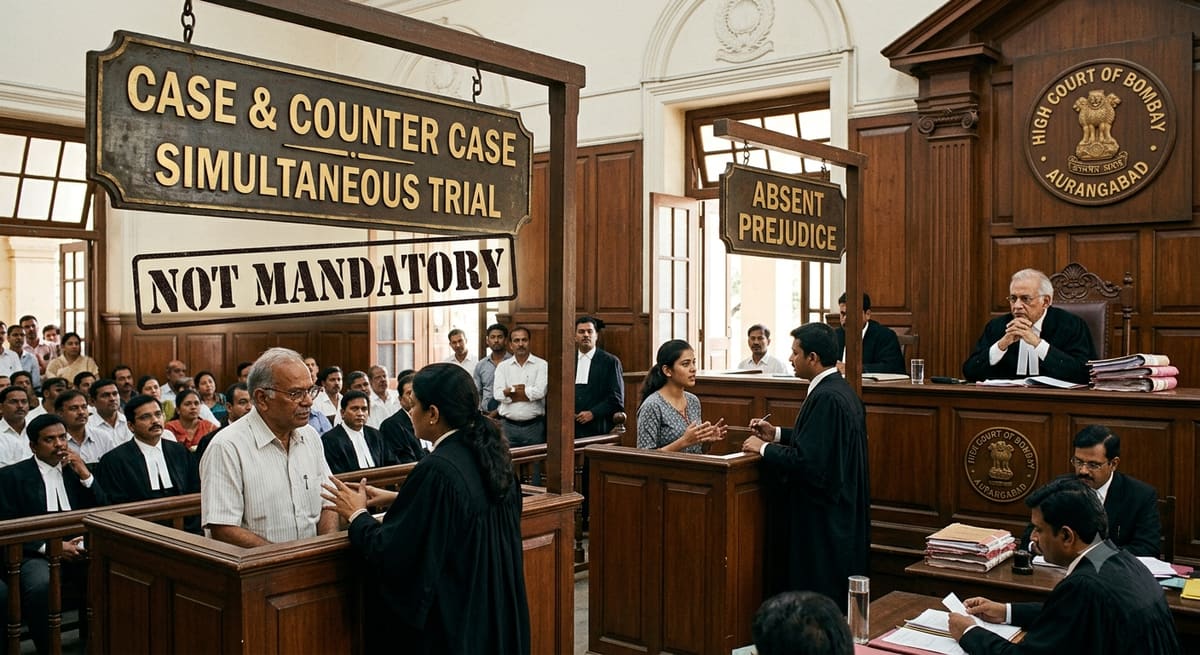
The central question was whether continuing the trial against Accused Nos.1-16 for criminal conspiracy and assault, while the investigation against Accused Nos.17-26 for harbouring offenders remains pending, violates the petitioners' right to a fair trial under Articles 14, 19, and 21 of the Constitution.
Arguments Presented
For the Petitioners
- Relied on Articles 14, 19, and 21 to argue that piecemeal trial would render gross prejudice to their defence
- Contended that materials collected during investigation against Accused Nos.17-26 could be used to their detriment
- Argued that the trial should be kept in abeyance until the investigation is completed
For the Respondents
- Distinguished the allegations against the two sets of accused:
- Accused Nos.1-16: Charged with criminal conspiracy and physical assault leading to the victim's death
- Accused Nos.17-26: Charged with harbouring offenders and aiding their escape
- Argued that no prejudice would arise as the charges are unrelated
- Contended that the petitioners' demand was an attempt to procrastinate the trial
The Court's Analysis
The Court examined the distinct nature of allegations against the two sets of accused and held that no prejudice would arise from continuing the trial against Accused Nos.1-16. Key observations:
- The final report against Accused Nos.1-16 is confined to two criminal conspiracies and the physical assault on 02.07.2018, resulting in the victim's death
- The allegations against Accused Nos.17-26 are limited to harbouring offenders and aiding their escape, which are unrelated to the charges against Accused Nos.1-16
- The Court noted:
"The argument of the learned counsel for the petitioners that the prosecution might use the materials collected in the investigation against accused Nos.17 to 26 to the detriment of the interests of accused Nos.1 to 16, is totally unfounded in view of the marked distinction in the nature of the allegations levelled against accused Nos.1 to 16 when compared to the allegation against accused Nos.17 to 26."
- The Court rejected the contention that continuing the trial would violate Articles 14, 19, and 21, holding that the petitioners' demand was an attempt to procrastinate the trial
- Emphasized that the Trial Court is bound by the earlier direction of the High Court in O.P(Crl) No.920/2024 to dispose of the case within a time-bound manner
The Verdict
The Kerala High Court dismissed the writ petition, holding:
- No prejudice would arise to Accused Nos.1-16 from continuing the trial pending investigation against Accused Nos.17-26
- The Trial Court must proceed with S.C No.1068/2018 in compliance with the earlier direction for time-bound disposal
- The petition was devoid of merit and an attempt to delay the trial
What This Means For Similar Cases
Distinct Allegations Prevent Prejudice
- Courts will not stall trials merely because investigation against other accused is pending, provided the allegations are distinct and unrelated
- Practitioners must argue that no prejudice arises when:
- The charges against different sets of accused pertain to separate offences (e.g., conspiracy vs. harbouring)
- The evidence against one set of accused does not overlap with the other
Procrastination Tactics Will Fail
- Attempts to delay trials by seeking piecemeal adjudication will be viewed skeptically
- Courts will prioritize expeditious disposal of cases, especially when earlier directions for time-bound trial exist
- Key Takeaway: Ensure that petitions for stalling trials demonstrate actual prejudice, not mere procedural delays
Fair Trial Rights Are Context-Dependent
- Articles 14, 19, and 21 do not guarantee absolute right to stall trials pending unrelated investigations
- The right to fair trial is balanced against the need for expeditious justice
- Practitioners should focus on proving material prejudice, not hypothetical detriments