The Madhya Pradesh High Court has clarified that the issuance of multiple cheques under a single commercial transaction does not automatically necessitate a joint trial under the Code of Criminal Procedure. This ruling reinforces the principle that procedural efficiency must not override the accused’s right to a fair and unambiguous defence.
Background & Facts
The Dispute
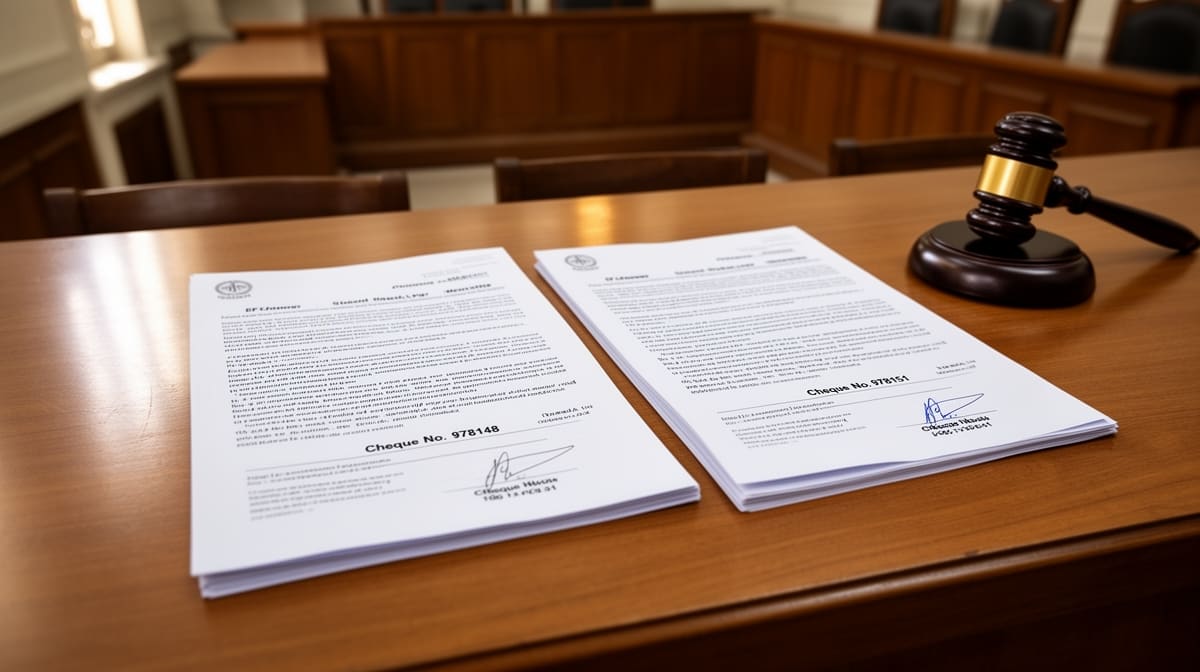
The dispute arose from a long-standing transport arrangement between M/s. Rachit Daga (accused) and M/s. Saluja Road Lines (complainant), wherein the complainant transported wheat for the accused over three years. In consideration, the accused issued two cheques: Cheque No. 978148 for Rs. 24 lakhs dated 07.05.2019 and Cheque No. 978151 for Rs. 26 lakhs dated 06.05.2019. Both cheques were dishonoured due to insufficient funds, triggering separate complaints under Section 138 of the Negotiable Instruments Act.
Procedural History
- May 2019: Two cheques issued for transport services.
- May & September 2019: Separate statutory demand notices issued for each cheque.
- 2019: Two private complaints filed under Section 138 NI Act, registered as SCNIA No. 176/2019 and SCNIA No. 175/2019.
- November 2024: Judicial Magistrate First Class rejected the accused’s application under Section 219 CrPC for joint trial, holding that distinct dates of issuance and demand notices created separate causes of action.
- August 2025: Additional Sessions Judge affirmed the Magistrate’s order in both revision petitions.
- February 2026: Petitions filed under Section 528 BNSS, 2023 before the Madhya Pradesh High Court.
Relief Sought
The petitioner sought quashing of the orders rejecting joint trial and requested that both cases be consolidated for a single trial to avoid duplication, prejudice to defence, and conflicting evidence.
The Legal Issue
The central question was whether two separate complaints under Section 138 NI Act, arising from cheques issued under a single commercial transaction but on different dates, must be tried jointly under Sections 219 and 220 of the CrPC, or whether separate trials remain lawful absent demonstrable prejudice.
Arguments Presented
For the Petitioner
The petitioner argued that both cheques were issued as part of a continuous business relationship for the same service - transport of wheat. The demand notices, though dated separately, were part of a unified dispute. Relying on Nasib Singh v. State of Punjab and Dalip Kumar v. Sachin Singal, counsel contended that joint trial is the norm when offences arise from the same transaction, and separate trials risk prejudicing the accused’s defence by fragmenting a unified narrative. The petitioner emphasized that cross-examination of the complainant would be repetitive and that the accused’s defence strategy would be compromised if tested in two separate proceedings.
For the Respondent
The respondent countered that each cheque constituted a distinct offence under Section 138 NI Act, with separate dates of issuance, presentation, dishonour, and statutory notice. The complainant argued that the Magistrate correctly applied Section 219 CrPC, which requires offences to be of the same kind and within a year, and Section 220 CrPC, which requires acts to form a single transaction. Since the cheques were issued on different dates and triggered independent legal actions, the complainant maintained that separate trials were legally sound and procedurally appropriate.
The Court's Analysis
The Court undertook a detailed examination of Sections 219 and 220 of the CrPC, distinguishing between the general rule of separate trials and the exceptions permitting joint trials. It affirmed that while each dishonoured cheque constitutes a distinct offence, the exceptions under Sections 219 and 220 allow consolidation where offences arise from the same transaction or are of the same kind within a year.
The Court critically assessed the precedents cited by the petitioner. It acknowledged Nasib Singh v. State of Punjab and State of A.P. v. Cheemalapati Ganeswara Rao for establishing that joint trial is permissible but not mandatory, and that the key consideration is whether separate trials would prejudice the accused’s defence. The Court emphasized that the word "may" in Sections 219 and 220 confers discretion, not obligation.
"The possibility of conducting a joint trial will have to be determined at the beginning of the trial and not after the trial based on the result of the trial. The appellate court may determine the validity of the argument that there ought to have been a separate/joint trial only based on whether the trial had prejudiced the right of accused or the prosecutrix."
The Court noted that both cases were pending before the same Judicial Magistrate, with hearings fixed on identical dates. This eliminated any risk of delay or inconsistent evidence. The accused could cross-examine the complainant on the same day in both proceedings, negating claims of prejudice. The Court further observed that consolidating the trials might create evidentiary confusion - particularly regarding cheque numbers, dates, and notice timelines - potentially undermining the clarity required for fair adjudication.
The Court also referenced Ranchhod Lal v. State of M.P., which held that even if offences arise from the same transaction, separate trials are not illegal. The discretion to consolidate lies with the trial court, and its decision must be disturbed only if it results in a miscarriage of justice.
The Verdict
The petitioner’s challenge failed. The Madhya Pradesh High Court dismissed both petitions, upholding the Magistrate’s and Sessions Judge’s orders. The Court held that separate trials for two cheques issued under a single transaction are lawful under CrPC, provided there is no demonstrable prejudice to the accused’s defence. The discretion to consolidate rests with the trial court and will not be interfered with absent manifest injustice.
What This Means For Similar Cases
Separate Cheques Do Not Mandate Joint Trial
- Practitioners must now argue joint trial under Sections 219/220 CrPC as a discretionary request, not a right.
- Merely showing that cheques arise from one transaction is insufficient; the burden is on the accused to prove actual prejudice.
- Courts will examine whether separate trials cause procedural confusion, witness fatigue, or inconsistent defence strategies.
Prejudice Must Be Demonstrated, Not Alleged
- Vague claims that "defence will be prejudiced" are inadequate. Petitioners must specify how cross-examination, evidence presentation, or legal strategy is compromised.
- Simultaneous hearings before the same magistrate negate claims of delay or inconsistency.
- Courts will not consolidate cases merely to reduce workload; fairness to the accused is the sole criterion.
Strategic Implications for Defence Counsel
- File applications for joint trial early, with affidavits detailing specific prejudice risks.
- If denied, preserve the issue for appeal by documenting how defence arguments were fragmented.
- In cases of multiple cheques, consider seeking concurrent sentencing under Shyam Pal or Benson post-conviction, even if trials remain separate.