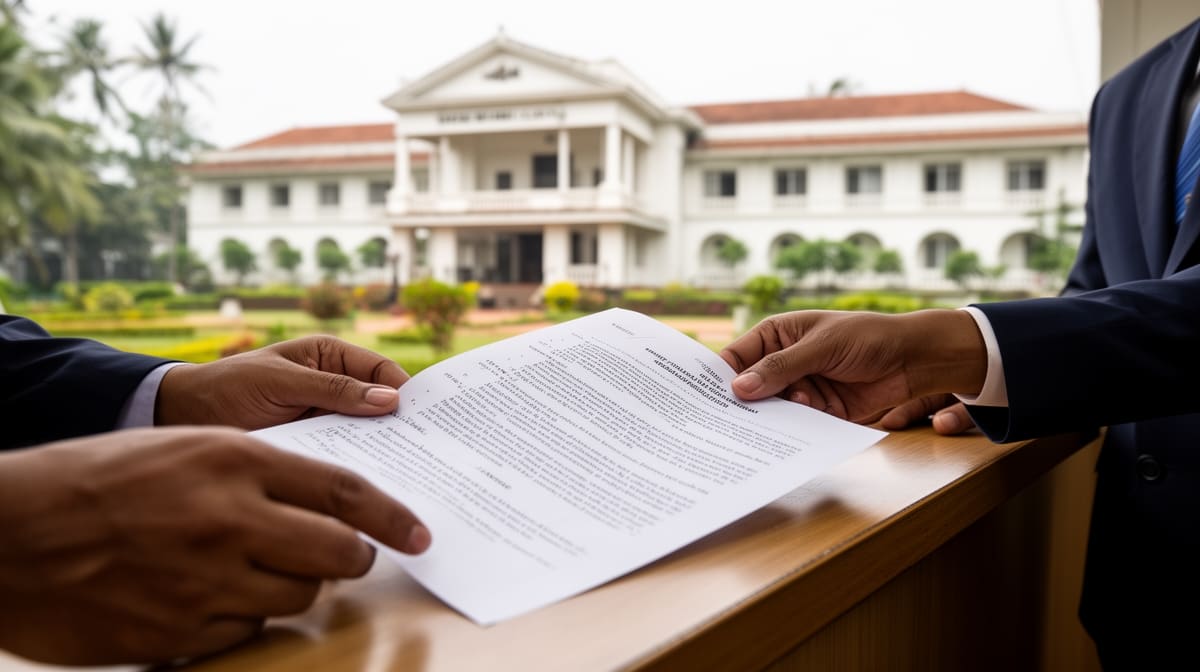
The Bombay High Court at Goa has reaffirmed that the pendency of a Special Leave Petition before the Supreme Court does not automatically suspend the duty of an executing court to enforce a decree. This ruling clarifies a critical procedural principle in civil enforcement, ensuring that legitimate decree holders are not left in legal limbo due to dilatory tactics or procedural missteps by executing courts.
Background & Facts
The Dispute
The petitioners, legal representatives of the deceased decree holder, sought enforcement of a compensation award granted by the Ad-hoc District Judge-2, North Goa, dated 15.04.2019. The award recognized their entitlement to a share of compensation originally granted to their father/uncle and aunt in a land acquisition matter. The respondent, Goa Housing Board, challenged this award before the High Court in Writ Petition No. 455/2019, which was dismissed on 19.08.2023. The respondent then filed a Special Leave Petition (SLP) in the Supreme Court, which remains pending.
Procedural History
- 15.04.2019: Ad-hoc District Judge-2, North Goa, passed order recognizing petitioners’ entitlement to compensation share.
- 2019: Respondent filed Writ Petition No. 455/2019 challenging the order; dismissed on 19.08.2023.
- 2024: Respondent filed SLP (C) Nos. 10071/2024 before the Supreme Court.
- 17.06.2025: Executing Court dismissed Execution Application No. 286/2016 solely on ground that SLP was pending before Supreme Court, granting liberty to file fresh application.
- 2025: Petitioners filed Writ Petition No. 508/2025 under Article 226 challenging the impugned order.
Relief Sought
The petitioners sought quashing of the impugned order dated 17.06.2025 and direction to the Executing Court to proceed with the execution of the decree without further delay.
The Legal Issue
The central question was whether the pendency of a Special Leave Petition before the Supreme Court absolves an executing court of its statutory duty to enforce a decree that has been upheld by a higher court.
Arguments Presented
For the Petitioner
The petitioners relied on S.P. Chengalvaraya Naidu v. Jagannath and K. Srinivasulu Reddy v. K. Srinivasulu, emphasizing that once a decree is affirmed by a higher court, the executing court has no discretion to stay execution merely because a review or SLP is pending. They argued that the Executing Court’s order amounted to a de facto stay without any formal application or order under Order XXI Rule 26 of the Code of Civil Procedure.
For the Respondent
The respondent contended that the pendency of the SLP before the Supreme Court created sufficient uncertainty to warrant suspension of execution. They cited general principles of judicial restraint and argued that allowing execution while an SLP is pending could lead to irreparable consequences if the Supreme Court later reversed the decision.
The Court's Analysis
The Court rejected the respondent’s argument outright, holding that the mere filing of an SLP does not operate as a stay of execution. The Court emphasized that execution of a decree is a statutory right, not a discretionary privilege. The order dated 19.08.2023 dismissing the writ petition had conclusively affirmed the decree. The Executing Court’s reliance on the pending SLP was legally untenable.
"The pendency of an SLP before the Supreme Court cannot be a ground to refuse execution of a decree which has been upheld by this Court. To hold otherwise would render the decree a nullity in practice, despite its legal validity."
The Court further noted that Order XXI Rule 26 provides the only lawful mechanism for staying execution, requiring a formal application and judicial determination. The Executing Court had no authority to suspend execution sua sponte. The Court observed that such conduct undermines the finality of judicial orders and violates the principle of res judicata in execution proceedings.
The Court also highlighted the undue delay suffered by the petitioners - over six years since the original award - and stressed that justice delayed is justice denied, particularly in cases involving compensation for land acquisition.
The Verdict
The petitioners won. The Court held that execution of a decree cannot be stalled merely because an SLP is pending before the Supreme Court. The impugned order was quashed, the Execution Application was restored, and the Executing Court was directed to dispose of it by 30.04.2026.
What This Means For Similar Cases
Execution Is Not Suspended by Pending SLP
- Practitioners must immediately challenge any executing court that refuses to proceed with execution on grounds of pending SLP or review petition.
- A decree affirmed by a higher court is enforceable unless a stay is formally granted under Order XXI Rule 26 CPC.
- No court may infer a stay from the mere filing of an SLP; such an inference is legally invalid.
Procedural Compliance Is Non-Negotiable
- Executing courts must act on the basis of the final decree, not speculative outcomes of appellate proceedings.
- Any objection to execution must be raised through proper application and adjudicated on merits - not by administrative inaction.
- Failure to execute a valid decree within a reasonable time may attract contempt proceedings.
Delay in Execution Is a Violation of Right to Effective Remedy
- Petitioners in land acquisition or compensation cases may now invoke Article 21 to argue that prolonged delay in execution violates their fundamental right to effective remedy.
- Courts must prioritize execution matters involving elderly or financially vulnerable decree holders.
- A timeline of 30.04.2026 set by the Court signals judicial intolerance for procedural stalling in execution matters.