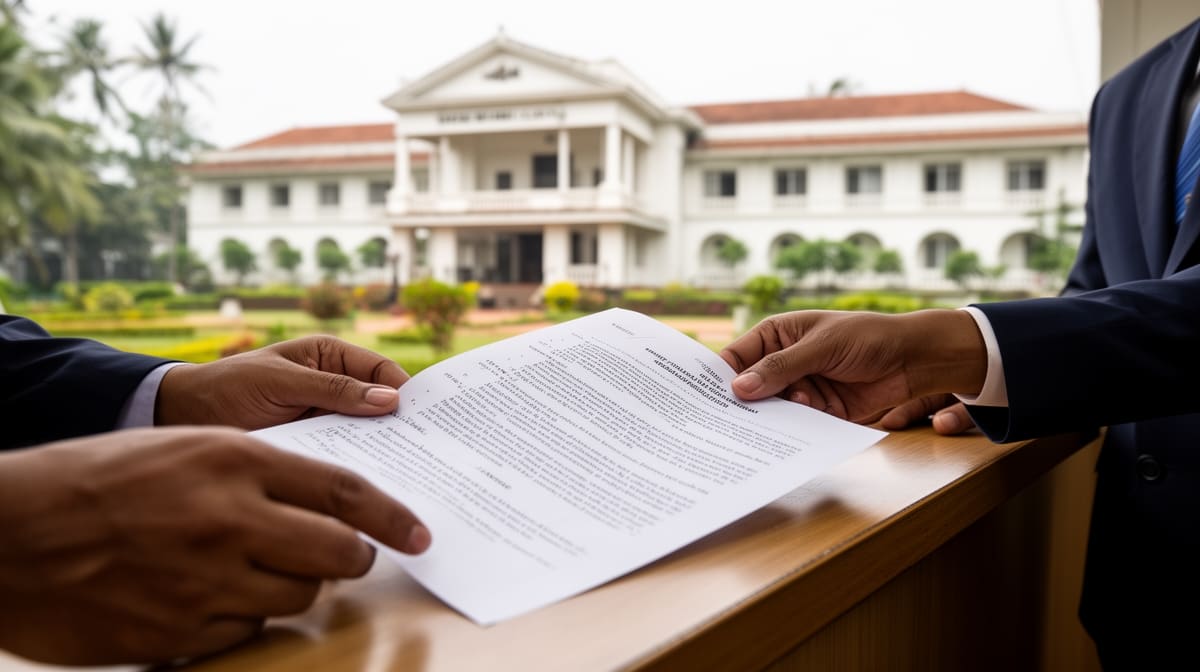
The Punjab & Haryana High Court has reaffirmed that the pendency of a first appeal against a decree for possession operates as a shield against immediate dispossession, even when a stay application has been dismissed by the appellate court. This judgment clarifies the procedural balance between enforcement of decrees and protection of appellate rights under the Code of Civil Procedure.
Background & Facts
The Dispute
The dispute arose from a suit for possession filed by the respondent, Balraj Singh, against the petitioner, Suresh Kumar. On 03.05.2023, the trial court decreed the suit and ordered possession to be delivered to the respondent. The petitioner filed a first appeal against this decree within the statutory period of limitation, along with an application for stay of execution. Notice was issued in both the appeal and the stay application.
Key Facts
- The decree for possession was passed on 03.05.2023
- The petitioner filed the first appeal and stay application within the limitation period
- The respondent initiated execution proceedings despite the pending appeal
- Warrants of possession were issued by the Executing Court on or before 17.11.2025
- The petitioner filed CR-8310-2025 before this Court seeking stay of execution
- On 17.11.2025, a Coordinate Bench of this Court directed the First Appellate Court to take up the stay application and directed the Executing Court to keep execution in abeyance
- On 03.12.2025, the First Appellate Court dismissed the stay application
- The main appeal was listed for hearing on 02.02.2026
- On 12.01.2026, this Court passed an interim order directing the petitioner to deposit Rs. 10,000 as litigation expenses and directing the Executing Court to defer execution beyond the next hearing date
- The petitioner deposited Rs. 10,000 on or before 10.04.2026, as confirmed by the respondent’s counsel
- The first appeal remains pending and is now listed for hearing on 10.04.2026
Procedural History
- 03.05.2023: Trial Court decreed suit for possession
- 03.06.2023: First appeal filed by petitioner
- 03.06.2023: Stay application filed concurrently
- 17.11.2025: Coordinate Bench of this Court directed stay of execution pending hearing of stay application
- 03.12.2025: First Appellate Court dismissed stay application
- 12.01.2026: This Court issued interim order: deposit Rs. 10,000, defer execution, list appeal in urgent list
- 10.04.2026: First appeal listed for hearing; petitioner deposited Rs. 10,000 as directed
- 20.03.2026: Judgment delivered in Civil Revision No. 9566 of 2025
Relief Sought
The petitioner sought: (i) setting aside the order dated 03.12.2025 dismissing the stay application; (ii) continuation of stay on execution of possession warrants until disposal of the first appeal; and (iii) liberty to parties to jointly apply for disposal of execution with liberty to revive it post-decision.
The Legal Issue
The central question was whether the dismissal of a stay application by the First Appellate Court, while the main appeal remains pending, automatically permits execution of a decree for possession, or whether the pendency of the appeal itself warrants continued protection from dispossession.
Arguments Presented
For the Petitioner
The petitioner’s counsel submitted that the dismissal of the stay application was procedural and did not address the merits of the appeal. He emphasized that the appeal was filed within time, notice was issued, and the petitioner had complied with all interim directions, including depositing Rs. 10,000. He argued that allowing execution at this stage would cause irreparable loss, as the appeal may ultimately succeed. He relied on the principle that execution cannot proceed when a substantial appeal is pending, absent a clear finding that the appeal is frivolous or vexatious.
For the Respondent
The respondent’s counsel did not oppose the continuation of stay but insisted that the interim order should not be construed as any expression on the merits of the appeal. He urged the Court to direct the First Appellate Court to decide the appeal expeditiously and emphasized that the petitioner’s undertaking to argue on 10.04.2026 should be binding. He sought no immediate dispossession but insisted on the finality of the decree unless overturned.
The Court's Analysis
The Court observed that the dismissal of a stay application does not ipso facto validate the execution of a decree. The pendency of a first appeal, particularly one filed within limitation and where notice has been issued, creates a legitimate expectation of appellate redressal. The Court noted that the petitioner had acted diligently: filing appeal on time, depositing the court-ordered amount, and undertaking to argue on the next date.
"The dismissal of the stay application by the First Appellate Court does not amount to a determination on the merits of the appeal or a finding that the appeal is devoid of merit. The execution of a decree for possession during the pendency of a first appeal, absent a final dismissal of the appeal, would defeat the very purpose of the appellate remedy."
The Court further held that the petitioner’s compliance with the interim order dated 12.01.2026 - specifically the deposit of Rs. 10,000 - demonstrated good faith and a willingness to mitigate any prejudice to the respondent. The Court rejected the notion that procedural dismissal of a stay application equates to abandonment of appellate rights.
The Court emphasized that the First Appellate Court must decide the appeal expeditiously, given its pendency since 2023. The Court also recognized the respondent’s legitimate interest in enforcing the decree, but held that this interest must yield to the constitutional right to appeal until the appeal is finally decided.
The Verdict
The revision petition was disposed of with the following directions: (i) the execution proceedings are stayed until the disposal of the first appeal; (ii) the First Appellate Court is requested to decide the appeal pending since 2023 expeditiously, with both parties ready to argue on 10.04.2026 or any date fixed by the Appellate Court; (iii) the parties may jointly apply before the Executing Court to dispose of the execution application with liberty to revive it after the appeal’s disposal; (iv) the interim order shall not be construed as an expression on the merits of the appeal; and (v) if the petitioner fails to appear on 10.04.2026 or any subsequent date fixed by the Appellate Court, the respondent may apply for revival of this revision petition.
What This Means For Similar Cases
Execution Cannot Proceed Solely on Dismissal of Stay Application
- Practitioners must argue that dismissal of a stay application is procedural, not substantive
- The pendency of a timely-filed appeal alone justifies continued stay of execution
- Courts must distinguish between procedural delays and substantive appellate rights
Compliance with Interim Orders Preserves Appellate Protection
- Deposit of court-ordered amounts (e.g., litigation expenses) demonstrates good faith
- Such compliance strengthens the petitioner’s claim for continued stay
- Non-compliance may be grounds for revocation, but compliance mandates protection
Joint Applications for Execution Disposal Are Viable
- Parties may jointly move the Executing Court to terminate execution proceedings with liberty to revive
- This avoids multiplicity of proceedings and promotes judicial efficiency
- Such applications should be encouraged where appeal is pending and merits are not yet decided