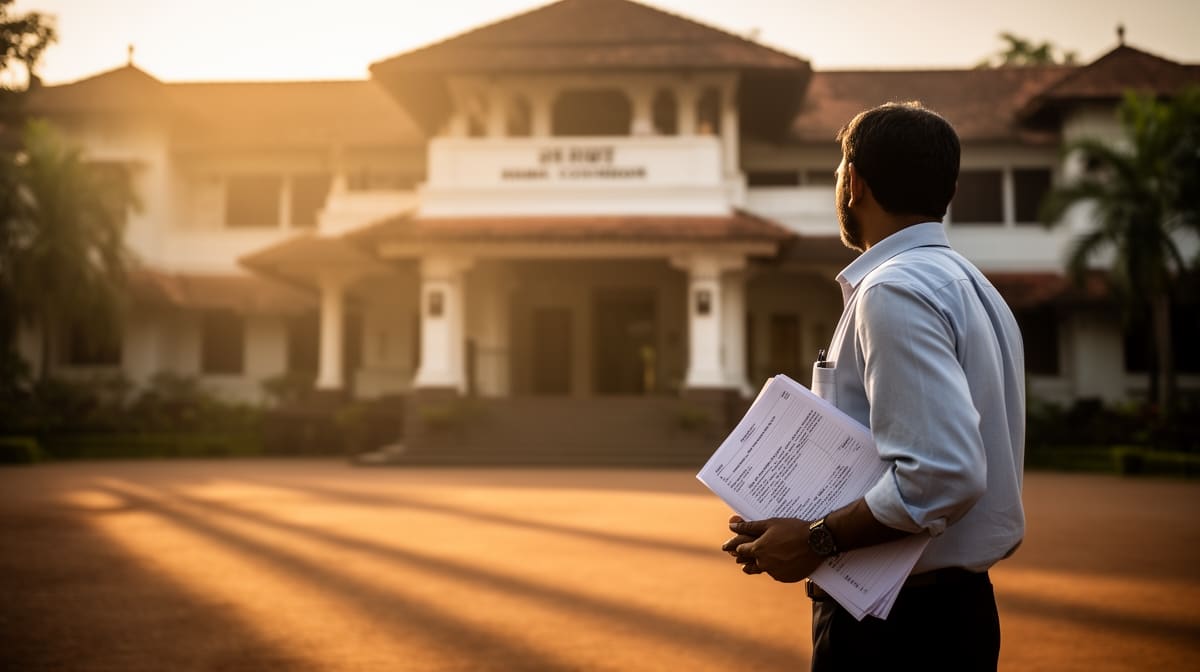
The Kerala High Court has established a pragmatic equilibrium between procedural rigour and substantive justice by permitting the setting aside of an ex parte decree upon the defendant furnishing a bank guarantee. This ruling reinforces that courts must not mechanically deny relief to litigants who, despite procedural lapses, demonstrate a genuine intent to contest the suit.
Background & Facts
The Dispute
The plaintiff filed a money suit in 2015 against the defendant, Favas, seeking recovery of a debt. On the date fixed for trial, the defendant’s counsel appeared but reported no instructions from the defendant, resulting in an ex parte decree being passed against Favas.
Procedural History
- 2015: Original suit filed by plaintiff Ameer
- Prior to 2024: Two earlier ex parte decrees were passed against the defendant and subsequently set aside on his applications
- August 2025: Trial court dismissed the defendant’s application to set aside the third ex parte decree, citing a pattern of negligence and callousness
- February 2026: First Appeal From Order filed before the Kerala High Court
Relief Sought
The defendant sought to set aside the ex parte decree and be permitted to contest the suit on its merits, arguing that his absence was due to an urgent business trip to Mysore and not wilful neglect.
The Legal Issue
The central question was whether an ex parte decree can be set aside under Order IX Rule 13 of the Code of Civil Procedure when the defendant’s absence stems from inadvertence rather than wilful disobedience, and whether the court may impose a bank guarantee as a condition for granting relief.
Arguments Presented
For the Appellant/Petitioner
The appellant’s counsel argued that the defendant’s failure to inform his advocate was due to an unforeseen emergency - urgent travel for business - and not a pattern of mala fide conduct. Reliance was placed on Sardar Amarjit Singh v. Baldev Singh to contend that courts must exercise discretion liberally to ensure justice is not defeated by technicalities. The counsel emphasized that the application was filed within limitation and that the defendant had always cooperated in prior proceedings.
For the Respondent/State
The respondent contended that the defendant had a history of non-appearance, with two prior ex parte decrees having been set aside. The learned counsel argued that the trial court was justified in refusing relief, citing K. Srinivasan v. K. Srinivasan to assert that repeated negligence cannot be condoned without strict conditions. The respondent opposed any relaxation of procedural norms, fearing it would encourage litigants to treat court dates with indifference.
The Court's Analysis
The Court acknowledged the trial court’s concern over the defendant’s repeated non-appearance but held that mechanical denial of relief under Order IX Rule 13 would defeat the object of civil procedure, which is to decide cases on merits. The Court observed that the defendant’s conduct, while careless, did not amount to fraud or deliberate defiance.
"The court must not become an instrument of procedural tyranny where the substantive rights of a litigant are at stake. A single lapse, even if repeated, does not forfeit the right to be heard."
The Court further noted that the plaintiff’s interest in securing the decree amount could be adequately protected through a bank guarantee, which would ensure compensation if the defendant ultimately lost the suit. This condition, the Court held, strikes a fair balance between the defendant’s right to a fair hearing and the plaintiff’s right to financial security.
The Court distinguished prior cases where defendants had shown total disregard for court processes, emphasizing that here, the defendant had not absconded, concealed assets, or filed frivolous applications.
The Verdict
The appellant won. The Kerala High Court held that an ex parte decree may be set aside on the condition that the defendant furnishes a bank guarantee for the decree amount, inclusive of interest and costs. The suit was directed to be expedited, and failure to comply with the condition would result in dismissal of the appeal.
What This Means For Similar Cases
Bank Guarantee as a Viable Condition
- Practitioners may now propose bank guarantees as an alternative to depositing cash or providing sureties when seeking to set aside ex parte decrees
- Courts are empowered to impose such conditions without requiring full payment upfront, reducing financial burden on defendants
- This approach aligns with the spirit of Order IX Rule 13, which prioritizes adjudication on merits over procedural penalties
Repeated Non-Appearance Does Not Automatically Bar Relief
- Courts must evaluate each instance of non-appearance on its own facts, not merely on past conduct
- A history of prior set-asides does not equate to abuse of process unless there is evidence of mala fide intent
- Legal teams should document reasons for absence (e.g., travel records, medical emergencies) to rebut allegations of callousness
Procedural Flexibility Enhances Access to Justice
- The judgment signals judicial willingness to innovate remedies that uphold both fairness and efficiency
- Litigants and advocates should proactively suggest conditional relief rather than merely pleading for unconditional set-aside
- This precedent may influence similar applications under Order IX Rule 13 across civil courts in India