The Punjab & Haryana High Court has affirmed that co-sharers in acquired land are entitled to the same compensation awarded to other co-owners, irrespective of whether they filed objections under Section 18 or 28-A of the Land Acquisition Act, 1894. This ruling aligns with the Supreme Court’s recent precedent in Ramphal & Ors. v. HSIDC, reinforcing equitable treatment in land acquisition proceedings.
Background & Facts
The Dispute
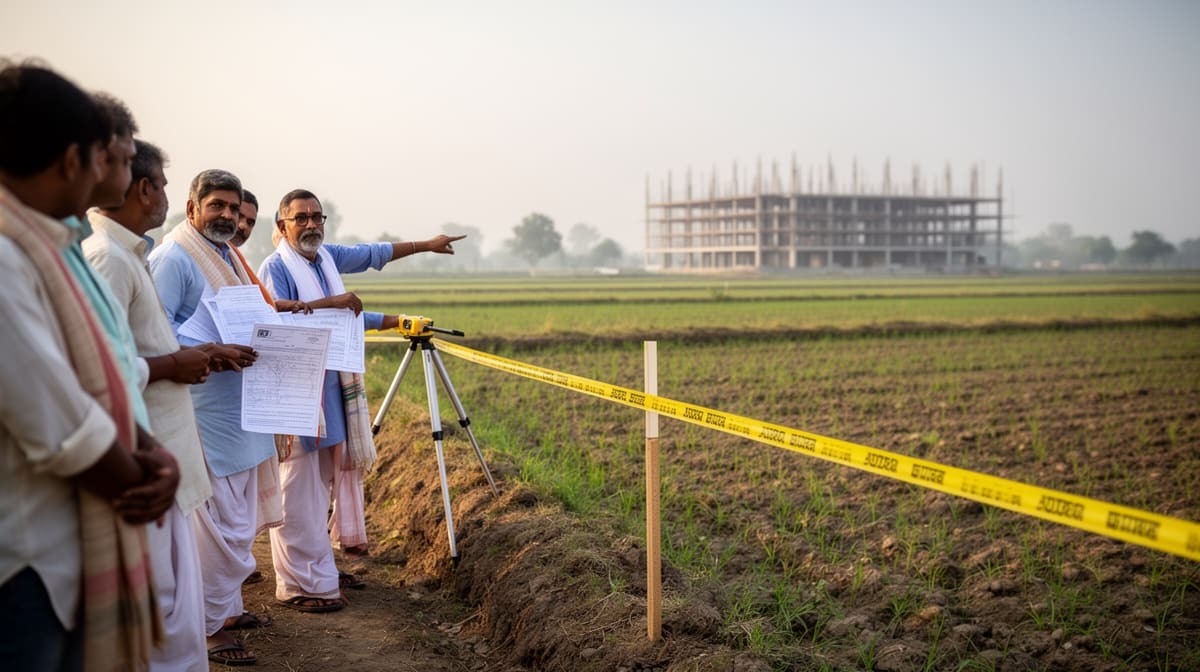
The petitioner, a landowner in Fatehabad, Haryana, sought execution of an award passed in favor of his co-sharers in a parcel of land acquired under the Land Acquisition Act, 1894. The petitioner claimed entitlement to the same compensation amount awarded to other co-owners who had filed objections under Section 18 or 28-A of the Act. The Executing Court dismissed his execution petition on the ground that he had not himself filed any objection under those provisions.
Key Facts
- The land in question was acquired by the State for industrial development purposes
- Multiple co-sharers held undivided interests in the acquired land
- Some co-sharers filed objections under Section 18 or 28-A of the Act and received compensation awards
- The petitioner did not file any objection under Section 18 or 28-A
- The petitioner filed an execution petition seeking payment of the same compensation amount as awarded to his co-sharers
- The Executing Court dismissed the petition on 24.09.2025, holding that absence of objection barred execution
Procedural History
- Date of acquisition: Not specified in judgment, but acquisition occurred prior to 2025
- Date of award to co-sharers: Not specified, but award was passed under Section 18 or 28-A
- 24.09.2025: Execution petition dismissed by Additional District Judge, Fatehabad
- 10.04.2026: Civil Revision No. 3103 of 2026 (O&M) heard and decided by Punjab & Haryana High Court
The Parties' Positions
For the Petitioner
- Argued that as a co-sharer in the same land parcel, he was entitled to equal compensation under the principle of equity and natural justice
- Relied on the Supreme Court’s decision in Ramphal & Ors. v. HSIDC dated 13.01.2026, which recognized the entitlement of co-sharers to uniform compensation
- Contended that the refusal to execute the award was arbitrary and violative of Article 14 of the Constitution
For the Respondents
- State of Haryana and HUDA (now HSVP) opposed the petition on procedural grounds
- Argued that only those who filed objections under Section 18 or 28-A were entitled to compensation awards
- Maintained that the petitioner’s failure to invoke statutory remedies barred his claim
Relief Sought
The petitioner sought:
- Setting aside of the order dated 24.09.2025 dismissing the execution petition
- Direction to the Executing Court to release compensation equivalent to that awarded to co-sharers
- Payment of statutory interest and consequential benefits as per Ramphal’s case
The Legal Issue
Can a co-sharer in acquired land claim execution of compensation awarded to other co-sharers under Section 18 or 28-A of the Land Acquisition Act, 1894, without having filed a separate objection under those provisions?
Arguments Presented
For the Petitioner
The petitioner relied on the Supreme Court’s judgment in Ramphal & Ors. v. Haryana State Industrial and Infrastructure Development Corporation Limited & Ors. (Civil Appeal Nos. 391-398 of 2026), which held that co-sharers in the same land parcel are entitled to the same compensation, regardless of whether they individually filed objections under Section 18 or 28-A. The petitioner argued that the execution petition was merely seeking enforcement of an existing award in favor of co-owners, and that denying such relief on procedural grounds violated the principle of equal treatment under Article 14. He emphasized that the acquiring authority had already determined the market value and awarded compensation to others in identical circumstances.
For the Respondent
The State contended that the Land Acquisition Act is a self-contained code and that only those who invoke statutory remedies under Section 18 or 28-A are entitled to enhanced compensation. It argued that the petitioner’s failure to file an objection precluded him from claiming the benefit of any award passed in favor of others. The respondents maintained that allowing execution without a prior objection would undermine the statutory framework and create administrative chaos.
The Court's Analysis
The Court examined the Supreme Court’s decision in Ramphal & Ors. v. HSIDC dated 13.01.2026, which directly addressed the issue of co-sharer entitlement in land acquisition. The Supreme Court held that where land is acquired and compensation is awarded to one co-sharer, other co-sharers are entitled to the same amount, even if they did not file objections under Section 18 or 28-A. The Court emphasized that the acquisition was for public purpose and the land was utilized by a state instrumentality, making equitable treatment imperative.
"We are of the considered view that apart from the compensation, the appellants would be entitled to the interest for a period of five years to be reckoned from today backwards and we make it explicitly clear that the appellants are not entitled for any interest for any other period. We would also hasten to add that the appellants would be entitled to all other consequential benefits which flow from award of compensation..."
The Punjab & Haryana High Court found that the Executing Court erred in dismissing the petition on the sole ground of non-filing of objection. The Court held that the petitioner’s status as a co-sharer in the same land parcel made him equally entitled to the compensation awarded to others. The refusal to execute the award was arbitrary and inconsistent with the Supreme Court’s binding precedent. The Court further noted that the acquiring authority had already determined the compensation amount based on market value and that denying the petitioner’s claim would result in unjust enrichment of the State.
The Verdict
The revision petition was allowed. The order dated 24.09.2025 dismissing the execution petition was set aside. The matter was remitted to the Executing Court to determine the petitioner’s entitlement to the same compensation awarded to his co-sharers, along with statutory benefits and interest as per Ramphal’s case. The compensation and interest shall be disbursed within three months of the determination, and if delayed, interest at 9% per annum shall accrue from the date of determination. All pending applications are disposed of.
What This Means For Similar Cases
Co-sharers Are Entitled to Uniform Compensation
- Practitioners must now argue that co-sharers in acquired land are entitled to the same compensation as other co-owners, irrespective of whether they filed objections under Section 18 or 28-A
- Execution petitions based on awards to co-sharers are maintainable even without prior statutory objections
- The principle of equity overrides strict procedural compliance in land acquisition matters
Statutory Framework Must Yield to Equitable Principles
- The Land Acquisition Act cannot be interpreted to deny equal compensation to co-sharers merely due to procedural omission
- Courts must apply the Ramphal precedent uniformly across jurisdictions
- Authorities must proactively compute and disburse compensation to all co-sharers upon determination, without waiting for individual applications
Execution Relief Is Not Dependent on Prior Objection
-
An execution petition is not a substitute for a Section 18 objection; it is an enforcement mechanism for an existing award
-
The Executing Court’s role is to implement the award, not to re-examine eligibility
-
Delay in filing objections does not extinguish substantive rights to equal compensation
-
Practitioners should file execution petitions on behalf of co-sharers immediately upon awareness of awards to others
-
Maintain documentary proof of co-ownership (mutation records, title deeds, survey maps)
-
Cite Ramphal & Ors. v. HSIDC as binding precedent in all similar cases