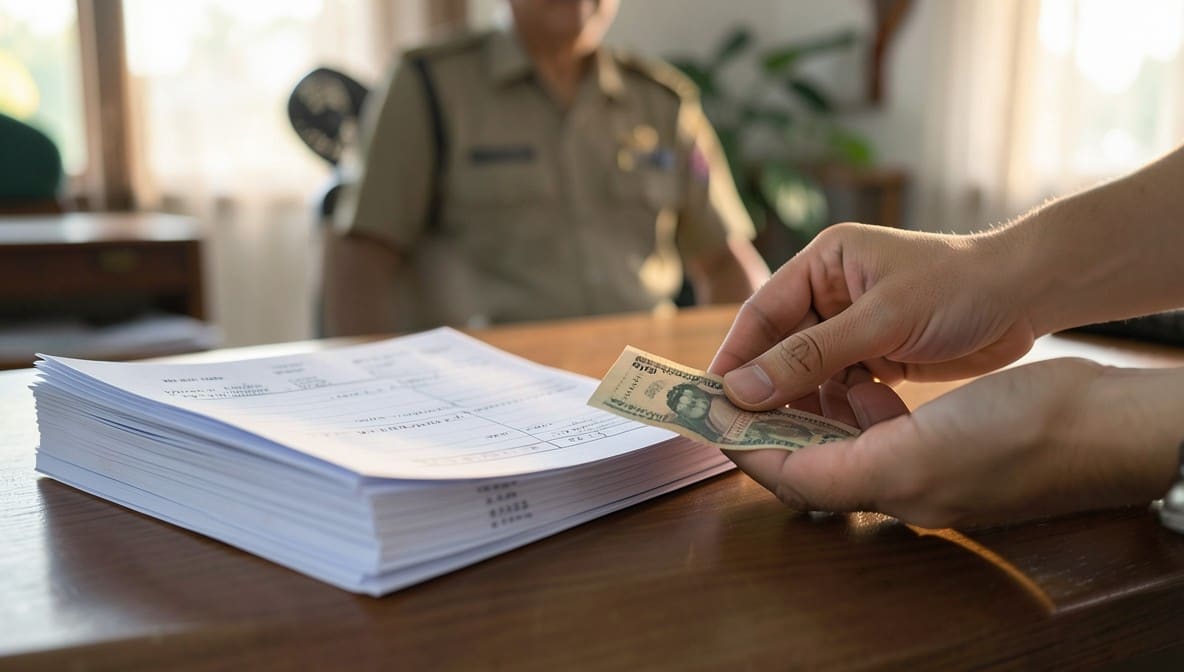
The Rajasthan High Court has affirmed that a conviction under the Prevention of Corruption Act, 1988, can be sustained solely on admissible electronic evidence and corroborative circumstantial proof, even when the primary complainants turn hostile. This judgment reinforces the evolving jurisprudence on digital proof in corruption cases, offering critical guidance to prosecutors and defense practitioners alike.
Background & Facts
The Dispute
The case arose from an alleged bribe demand by Prithvilal Meena, a public servant serving as Assistant Engineer with Jaipur Vidyut Vitaran Nigam Limited (JVVNL), and his associate Hemraj @ Foru. On 29 January 2016, Meena allegedly imposed a VCR penalty of Rs. 80,000 on complainants Kailash Meena and Ramphool Meena for irregularities in electricity meter readings. Subsequently, he demanded Rs. 20,000 to settle the matter, of which Rs. 5,500 was paid on 2 February 2016 after a trap was laid by the Anti-Corruption Bureau (ACB).
Procedural History
- 01.02.2016: Written complaint filed by complainants with ACB Bundi.
- 02.02.2016: Trap conducted; Rs. 5,500 in phenolphthalein-treated currency was handed over to Hemraj @ Foru, who accepted it in the presence of Prithvilal Meena.
- 09.02.2016: FSL report confirmed positive phenolphthalein test on Hemraj’s trousers.
- 2016: Charge sheet filed under Sections 7, 8, 13(1)(d) read with 13(2) of the Prevention of Corruption Act, 1988, and Section 120-B IPC.
- 06.07.2019: Special Judge, Kota, convicted both appellants and sentenced them to rigorous imprisonment with fines.
- 2019: Criminal Appeal filed before Rajasthan High Court, Jaipur Bench.
Relief Sought
The appellants sought quashing of their convictions, arguing that the prosecution failed to prove demand and acceptance, that key witnesses turned hostile, and that the voice recording was inadmissible due to non-compliance with Section 65-B of the Indian Evidence Act.
The Legal Issue
The central question was whether conviction under Section 7 and Section 8 of the Prevention of Corruption Act, 1988, can be sustained when the complainant turns hostile, provided the demand and acceptance are established through admissible electronic evidence and corroborative circumstantial proof.
Arguments Presented
For the Appellant
Learned counsel contended that:
- The prosecution case collapsed because the star witnesses, PW-8 Ramphool and PW-13 Kailash, turned hostile.
- The voice recording lacked a valid certificate under Section 65-B(4) of the Indian Evidence Act, rendering it inadmissible.
- Recovery of tainted money alone, without direct proof of demand, is insufficient under Sarwan Singh v. State of Punjab and Madan Lal v. State of Rajasthan.
- The trial court erred in convicting on moral grounds rather than legal proof.
- The sanction for prosecution was granted without application of mind.
For the Respondent
The Public Prosecutor argued that:
- The prosecution case was fully corroborated by independent electronic evidence, including digitally recorded conversations and their transcripts.
- The certificate under Section 65-B(4) (Ex. P-38) was duly produced, satisfying admissibility requirements.
- The recovery of Rs. 5,500 from Hemraj, in the presence of Prithvilal Meena, coupled with the voice recording, established demand and acceptance.
- The presumption under Section 20 of the Prevention of Corruption Act was triggered, and the appellants failed to rebut it.
- The Supreme Court in Neeraj Dutta v. State of NCT of Delhi permits conviction based on electronic evidence even if complainants turn hostile.
The Court's Analysis
The Court undertook a meticulous review of the evidentiary chain, emphasizing that proof of demand is the sine qua non for conviction under the Prevention of Corruption Act, 1988, and that mere possession of tainted money is insufficient. However, it held that demand may be established through circumstantial or electronic evidence, as affirmed in Neeraj Dutta v. State of NCT of Delhi.
"The electronic evidence is sufficient to establish the demand. The testimony of a hostile complainant does not demolish the prosecution case if other reliable evidence survives."
The Court found that the voice recording, transcribed as Ex. P-11 and Ex. P-15, clearly captured Prithvilal Meena demanding Rs. 5,500 and directing its delivery through Hemraj. The recording was authenticated by a valid Section 65-B certificate (Ex. P-38), which included details of the device, custody, and integrity of the recording. Crucially, the appellants did not challenge the recording during trial and refused to provide voice samples, inviting an adverse inference under Section 114(g) of the Indian Evidence Act.
The Court further noted that the recovery of the tainted amount from Hemraj’s trouser pocket - confirmed by phenolphthalein test and corroborated by multiple shadow witnesses - was immediate and directly linked to the recorded conversation. The joint presence of both accused in the same room at the time of recovery, the seizure of Meena’s red diary containing references to the complainants’ meters, and the absence of any plausible explanation from the defense collectively formed an unbroken chain of incriminating circumstances.
The Court distinguished the appellants’ cited precedents, noting that in Madan Lal and Rattaram, demand was not established, and in S.K. Saini and Ashok Kumar Yadav, the Section 65-B certificate was absent. Here, the electronic evidence was not only admissible but also independently corroborated.
The Court also held that Hemraj’s role as a middleman did not absolve Prithvilal Meena of liability. Under Neeraj Dutta and State v. Nalini, acceptance through an agent constitutes acceptance by the public servant, provided the agent acts on the principal’s direction. The conduct of both accused satisfied the ingredients of criminal conspiracy under Section 120-B IPC.
Finally, the Court rejected the challenge to sanction, noting that PW-11, the sanctioning authority, had testified to reviewing all documents, and the defense failed to demonstrate any procedural lapse.
The Verdict
The appeal was dismissed. The Rajasthan High Court upheld the convictions of both appellants under Sections 7, 8, and 13(1)(d) read with 13(2) of the Prevention of Corruption Act, 1988, and Section 120-B IPC. The Court held that admissible electronic evidence, when corroborated by circumstantial proof and the statutory presumption under Section 20, can sustain a conviction even when complainants turn hostile.
What This Means For Similar Cases
Electronic Evidence Can Replace Hostile Testimony
- Practitioners must now prioritize securing and authenticating digital recordings in corruption cases.
- The Section 65-B certificate is mandatory for admissibility; failure to produce it renders electronic evidence inadmissible.
- Defense strategies based solely on hostile witnesses will fail if electronic or circumstantial evidence is robust.
Middlemen Are Not Shielded from Liability
- A private person acting as a conduit for a public servant can be convicted under Section 8 of the Prevention of Corruption Act.
- Joint presence, prior communication, and routing of funds through a middleman establish criminal conspiracy under Section 120-B IPC.
- The burden shifts to the accused to explain why a middleman received tainted money on their behalf.
Section 20 Presumption Is Triggered by Demand + Recovery
- Once demand is established through electronic or circumstantial means, and tainted money is recovered from the accused or their agent, Section 20’s presumption is activated.
- The accused must offer a plausible, credible explanation; silence or refusal to provide voice samples strengthens the prosecution’s case.
- Courts will no longer tolerate technical defenses that ignore the practical realities of trap operations.