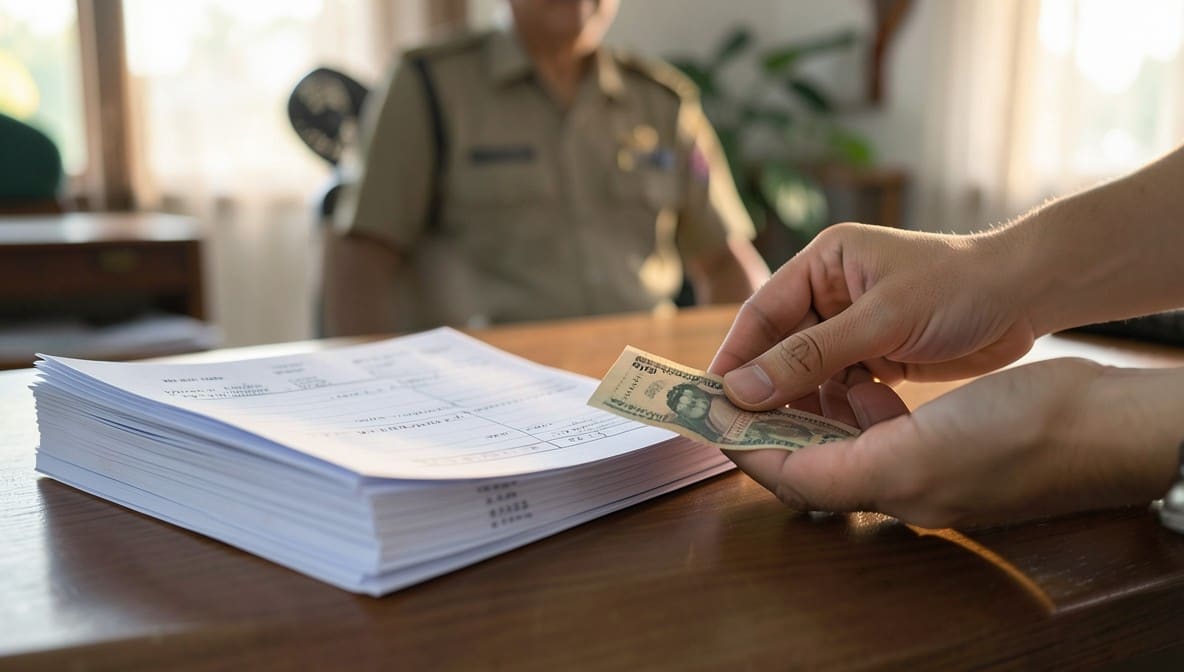
The Calcutta High Court has reaffirmed that proof of demand for illegal gratification is the gravamen of an offence under Section 7 of the Prevention of Corruption Act, 1988, and that circumstantial evidence - including forensic handling of tainted currency - can establish a prima facie case even in the absence of direct recovery from the accused’s person.
Background & Facts
The Dispute
The petitioner, Sandip Kumar Roy, a Deputy Excise Collector in the West Bengal Civil Services (Executive), was appointed on 31.01.2014 and posted at Canning Range, South 24-Parganas, following field training. On 05.10.2016, he was directed to undergo training at the Swami Vivekananda State Police Academy, Barrackpore. He sought medical exemption due to spinal pain, which was denied. He joined training on 01.11.2016 but was later medically advised rest.
Key Facts
- On 26.11.2016, at approximately 10:10 p.m., the petitioner was arrested by the Anti-Corruption Branch (ACB), West Bengal, based on a complaint by Swastik Nag.
- The complaint alleged that the petitioner demanded Rs. 16 lakhs as illegal gratification for facilitating an excise licence for a bar-cum-restaurant at Dumdum, North 24-Parganas, with Rs. 1 lakh as the first installment.
- On 25.11.2016 and 26.11.2016, phone calls were exchanged between the petitioner and the complainant, as corroborated by call records from Bharti Airtel and Vodafone (Case Diary pp. 349, 371).
- On 26.11.2016, the complainant allegedly met the petitioner at his residence and handed over Rs. 1 lakh in currency notes (14 pieces of ₹2000, 101 pieces of ₹500, 215 pieces of ₹100), treated with phenolphthalein powder.
- The notes were not recovered from the petitioner’s person but from a sofa. However, hand wash samples (Ext. A and Ext. B) taken from the petitioner’s right and left hands were sent to the Forensic Science Laboratory.
- The FSL report dated 23.12.2016 confirmed the presence of phenolphthalein and sodium carbonate in both samples, indicating contact with the tainted currency.
- The petitioner’s jurisdiction was Canning Range, South 24-Parganas; the alleged offence related to Dumdum, North 24-Parganas.
- The petitioner challenged the jurisdiction of the ACB, citing Government Notification dated 22.11.2012 requiring prior assignment by the P & AR Department and mandatory preliminary enquiry.
- RTI replies indicated the New Secretariat Building (ACB headquarters) was closed on 26.11.2016 (a Saturday), casting doubt on the complaint’s genesis.
Procedural History
- 26.11.2016: FIR registered under Sections 7, 13(2) read with 13(1)(d) of the Prevention of Corruption Act, 1988 (ACB P.S. Case No. 11/2016).
- 24.01.2017: Charge sheet submitted.
- 01.02.2017: Petitioner filed application under Section 227 Cr.P.C. for discharge.
- 15.03.2017: Additional District & Sessions Judge, Bench-II, Calcutta, rejected the discharge application.
- 20.12.2017: Petitioner filed CRR 3841 of 2017 under Section 482 Cr.P.C. seeking quashing of proceedings.
- 21.11.2017: Special Public Prosecutor submitted a report recommending withdrawal of case due to lack of evidence.
- 11.12.2017: Senior Public Prosecutor concurred with withdrawal recommendation.
- 16.09.2022: Copies of withdrawal reports sent to DIG, ACB.
- 04.09.2025: State Administrative Tribunal quashed departmental proceedings (OA 450/2017) on grounds of delay and lack of proof of demand.
The Parties' Positions
For the Petitioner:
- No preliminary enquiry was conducted before FIR registration.
- ACB lacked jurisdiction as the case was not assigned by the P & AR Department under Notification dated 22.11.2012.
- Tainted money was not recovered from his person; recovery from a sofa is unreliable.
- The alleged offence occurred outside his jurisdiction.
- The New Secretariat Building was closed on 26.11.2016, making the complaint implausible.
- Departmental proceedings were quashed on merits, rendering criminal prosecution an abuse of process (Ashoo Surendranath Tewari).
For the Respondent/State:
- The ACB had jurisdiction under Notification No. 2208 P.S. Cell dated 14.11.2012, which declared it a state-wide police station for corruption cases.
- Preliminary enquiry is not mandatory in trap cases, as per Lalita Kumari v. UP and subsequent rulings.
- Hand wash forensic evidence proves handling of tainted currency.
- Phone records corroborate demand and meeting.
- Jurisdictional objection is irrelevant under Section 7, as the offence relates to official functions, not territorial limits.
- The departmental proceeding was quashed on procedural grounds, not on merits of the demand allegation.
Relief Sought
The petitioner sought quashing of Special Case No. 11/16 under Section 482 Cr.P.C., arguing that the entire proceeding was illegal, without jurisdiction, and based on insufficient evidence.
The Legal Issue
The central question was whether Section 7 of the Prevention of Corruption Act, 1988 requires direct recovery of tainted money from the accused’s person, or whether circumstantial evidence - including forensic proof of handling and corroborative witness testimony - can establish a prima facie case of demand and acceptance.
Arguments Presented
For the Appellant/Petitioner
The petitioner relied on C. Sukumaran v. State of Kerala, P. Satyanarayana Murthy v. State of A.P., and K. Shanthamma v. State of Telangana to argue that proof of demand is sine qua non for conviction under Section 7. He contended that the absence of direct recovery, lack of preliminary enquiry, and jurisdictional irregularities rendered the prosecution baseless. He further cited Ashoo Surendranath Tewari to argue that acquittal in departmental proceedings on merits bars criminal prosecution. The RTI evidence questioning the ACB’s operational status on 26.11.2016 was presented as fatal to the prosecution’s narrative.
For the Respondent/State
The State countered that Neeraj Dutta v. State (NCT of Delhi) permits proof of demand through circumstantial evidence, including forensic reports and witness testimony. It emphasized that trap cases are exempt from preliminary enquiry under Lalita Kumari. The FSL report confirming phenolphthalein on the petitioner’s hands was deemed conclusive. The jurisdictional objection was dismissed as legally untenable under Section 7, which penalizes official misconduct irrespective of posting. The departmental proceeding was quashed on delay and procedural grounds, not on substantive denial of demand.
The Court's Analysis
The Court undertook a detailed review of Supreme Court jurisprudence on Section 7 of the Prevention of Corruption Act. It emphasized that the demand for illegal gratification is the essential ingredient of the offence, as held in C. Sukumaran, P. Satyanarayana Murthy, and Mir Mustafa Ali Hasmi. The Court noted that while direct oral evidence of demand is ideal, it is not indispensable.
"Proof of demand and acceptance of illegal gratification by a public servant as a fact in issue by the prosecution is a sine qua non in order to establish the guilt of the accused public servant under Sections 7 and 13(1)(d)(i) and (ii) of the Act."
The Court then examined the evidentiary chain: the phone records establishing contact, the shadow witness’s testimony regarding demand, the use of phenolphthalein-treated currency, and the FSL report confirming the petitioner’s handling of the notes. The Court held that these elements, taken together, constitute sufficient circumstantial evidence to satisfy the threshold for framing charges.
Regarding jurisdiction, the Court accepted the State’s reliance on Notification No. 2208 P.S. Cell dated 14.11.2012, which conferred state-wide jurisdiction on the ACB for corruption cases. The objection that the New Secretariat was closed on 26.11.2016 was rejected, as the complaint was lodged at the ACB PS, not the Secretariat, and police stations do not close on weekends.
On the issue of preliminary enquiry, the Court acknowledged the 22.11.2012 P & AR Department notification requiring assignment and preliminary enquiry. However, it held that in trap cases, the pre-trap memo and independent witness presence serve as functional equivalents, and the Supreme Court has consistently held that preliminary enquiry is not mandatory in such cases (Lalita Kumari, State of Karnataka v. T.N. Sudhakar Reddy).
The Court distinguished Ashoo Surendranath Tewari, noting that the departmental proceeding was quashed on procedural grounds - delay and lack of opportunity to cross-examine - not on a merits-based finding that no demand occurred. Therefore, it could not operate as an estoppel against criminal proceedings.
The Verdict
The revisional application was dismissed. The Court held that a prima facie case under Section 7, 13(2) read with 13(1)(d) of the Prevention of Corruption Act, 1988 is made out based on circumstantial evidence, including forensic proof of handling tainted currency and corroborative phone records. The criminal proceedings shall continue before the Additional District & Sessions Judge, Bench-II, Calcutta. The duplicate case diary shall be handed over to the Public Prosecutor. No costs were awarded.
What This Means For Similar Cases
Circumstantial Evidence Suffices for Prima Facie Case in Bribery Traps
- Practitioners must now treat forensic evidence (e.g., phenolphthalein traces on hands, clothing, or surfaces) as a critical component of prosecution in trap cases.
- Absence of direct recovery from the accused’s person is not fatal if other circumstantial links - phone records, witness testimony, chemical analysis - are robust.
- Defence counsel should focus on challenging the chain of custody and reliability of forensic samples, not merely the location of recovery.
Jurisdictional Objections Are Not Absolute in Corruption Cases
- A public servant’s posting location does not immunize them from prosecution under Section 7 if the alleged demand relates to official functions, even if performed outside jurisdiction.
- The Court rejected the notion that corruption must be confined to territorial boundaries; the focus is on the misuse of official position.
- Defence arguments based solely on posting or jurisdictional limits are likely to fail unless they demonstrate complete absence of official nexus.
Departmental Acquittal Does Not Bar Criminal Prosecution Unless on Merits
- If departmental proceedings are quashed on procedural grounds (e.g., delay, non-compliance with natural justice), they do not constitute a merits-based exoneration.
- Criminal courts are not bound by such acquittals; the burden remains on the accused to prove that the departmental order was based on a full and fair adjudication of the demand allegation.
- Practitioners must carefully distinguish between procedural dismissals and substantive findings of innocence when invoking Ashoo Surendranath Tewari.