The Supreme Court has clarified that a demand for bribe under Section 7 of the Prevention of Corruption Act, 1988, need not be proved by direct testimony alone. Even when the complainant prevaricates or turns hostile, the court may infer demand from consistent circumstantial evidence, prior statements, and corroborative testimony.
Background & Facts
The Dispute
The prosecution arose from allegations that K.A. Abdul Rasheed, the Taluk Supply Officer (TSO), demanded a bribe of Rs.500 from K.A. Abdul Rasheed, an Authorized Ration Dealer (ARD), to countersign the weekly "Abstract" register maintained under the Public Distribution System. The ARD, who was required to submit the Abstract for verification by the TSO, alleged that the accused refused to sign unless a bribe was paid. After repeated refusals, the ARD approached the Vigilance Department, leading to a trap operation.
Key Facts
- The ARD was required to submit the "Abstract" to the TSO weekly for countersignature
- The TSO refused to countersign on two occasions: 13.07.2009 and 20.07.2009
- Other ration dealers informed the complainant that the TSO demanded Rs.500 for signing
- The complainant lodged an oral complaint with the Vigilance Department on 21.07.2009
- The complaint was recorded in writing as Ext.P1 by Dy.S.P. PW17, in the presence of two independent witnesses: PW2 (Assistant Engineer, PWD) and the Special Tahsildar
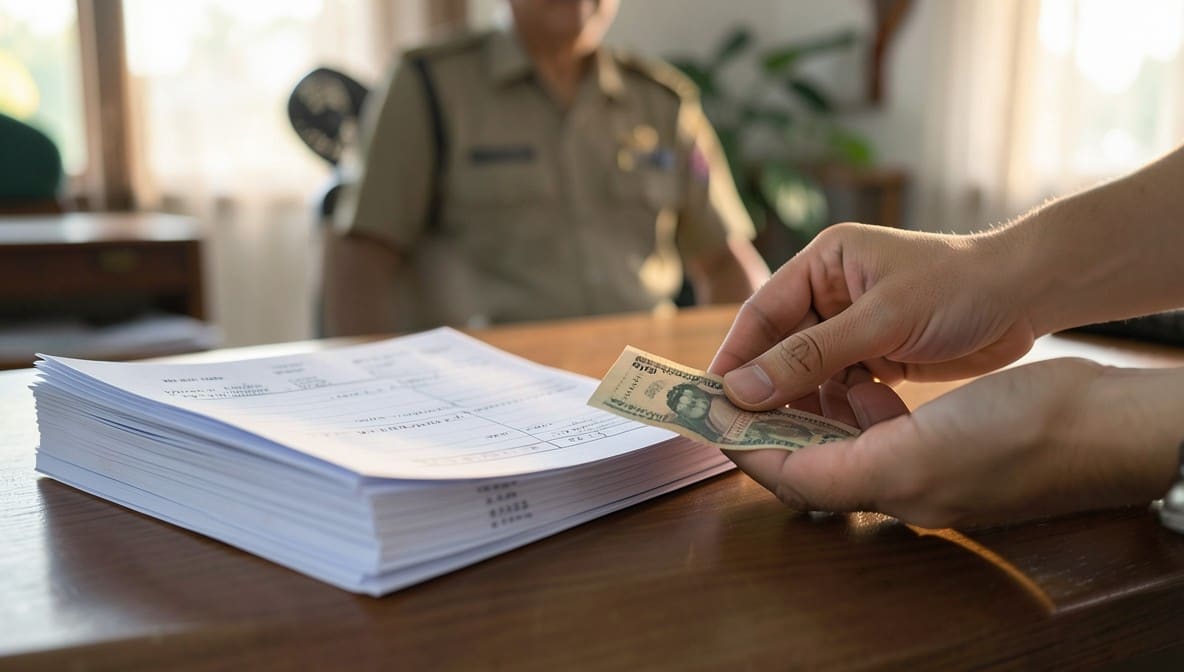
- A marked Rs.500 note was handed over to the TSO on 22.07.2009 during the trap
- The TSO received the note with his left hand and placed it in the right upper drawer of his table
- After the signal, the trap team entered and recovered the marked note from the accused’s shirt pocket
- The left hand and shirt pocket of the accused tested positive for the powder residue; the right hand did not
- The accused claimed the money was entrusted to him by the complainant to give to Swayam Prakash, an office attendant, but PW8 (Swayam Prakash) turned hostile and denied any loan
Procedural History
- 13.07.2009: First refusal to countersign by TSO
- 20.07.2009: Second refusal to countersign
- 21.07.2009: Oral complaint lodged with Vigilance Department
- 22.07.2009: Trap operation conducted; marked note handed over and recovered
- 23.07.2009: FIR registered
- 15.03.2012: Trial Court convicted accused under Section 7 and Section 13(1)(d) read with Section 13(2) of the Prevention of Corruption Act, 1988; sentenced to two years imprisonment concurrently and fined Rs.10,000
- 10.08.2018: High Court acquitted the accused, holding that demand was not proved and complainant’s testimony was unreliable
- 15.04.2026: Supreme Court heard appeal and delivered judgment
The Parties' Positions
For the State (Appellant): The demand was established through the complainant’s prior consistent statements to Vigilance officers, corroborated by independent witnesses and the recovery of the marked note from the accused’s person. The accused’s explanation was false and self-serving.
For the Accused (Respondent): The complainant was hostile and retracted his prior statements. No direct evidence of demand was adduced. The non-examination of the Special Tahsildar created a fatal lacuna. The recovery of money alone cannot prove demand.
Relief Sought
The State sought setting aside of the High Court’s acquittal order and restoration of the Trial Court’s conviction and sentence of two years imprisonment and fine of Rs.10,000.
The Legal Issue
Can a demand for illegal gratification under Section 7 of the Prevention of Corruption Act, 1988 be inferred from circumstantial evidence and prior consistent statements, even when the complainant prevaricates or denies the demand during trial?
Arguments Presented
For the Appellant
The State relied on Neeraj Dutta v. State (NCT of Delhi) to argue that while direct proof of demand is ideal, it is not indispensable. The complainant’s prior statement to Vigilance officers (Ext.P1), affirmed in court, along with the conduct of the accused and recovery of the marked note, established the demand inferentially. The non-examination of the Special Tahsildar was not fatal, as the evidence of PW1, PW2, and PW17 was mutually corroborative. The accused’s false explanation under Section 313 CrPC further indicated guilt.
For the Respondent
The accused relied on Jayaraj B. v. State of Andhra Pradesh to contend that where the complainant disowns his complaint and denies the demand, the prosecution fails. The absence of testimony from the Special Tahsildar, who was present during the handover, created an irreparable gap in proving demand. The complainant’s inconsistent statements rendered his entire testimony unreliable.
The Court's Analysis
The Court examined the applicability of Neeraj Dutta and Sat Paul v. Delhi Administration to hostile witnesses. It held that the deposition of a hostile witness is not automatically discarded. The trial court and High Court must sift the testimony to identify creditworthy portions.
"Even in a criminal prosecution when a witness is cross-examined and contradicted with the leave of the court, his evidence cannot, as a matter of law, be treated as washed off the record altogether. It is for the Judge of fact to consider... whether as a result of such cross-examination and contradiction, the witness stands thoroughly discredited or can still be believed in regard to a part of his testimony."
The Court found that PW1, despite his evasive answers and adoption of defense suggestions, had repeatedly affirmed the contents of Ext.P1 - the complaint made before the Vigilance officers - which explicitly stated that the accused had demanded Rs.500 on two occasions. PW2 and PW17 independently corroborated that the complaint was made in their presence and confirmed as truthful.
The recovery of the marked note from the accused’s shirt pocket, the positive test result on his left hand and shirt, and the false explanation offered under Section 313 CrPC collectively formed a compelling chain of circumstantial evidence. The Court emphasized that the accused’s admission of receipt of the note, coupled with his implausible claim of acting as a courier for a loan, undermined his defense.
The High Court erred in treating the non-examination of the Special Tahsildar as fatal. The Court held that while his testimony would have strengthened the case, its absence did not negate the sufficiency of the existing evidence. The demand could be inferred from the complainant’s prior consistent statements, the context of repeated refusals to sign, and the timing of the trap.
The Verdict
The State succeeded. The Supreme Court set aside the High Court’s acquittal order and restored the Trial Court’s conviction. The accused was sentenced to two years imprisonment under Section 7 and Section 13(1)(d) read with Section 13(2) of the Prevention of Corruption Act, 1988, to be served concurrently. The fine of Rs.10,000 was upheld. All pending applications were disposed of.
What This Means For Similar Cases
Demand Need Not Be Directly Proved
- Practitioners may now rely on prior statements to investigating agencies, if affirmed in court, to establish demand under Section 7
- Inference of demand is permissible where conduct, context, and recovery of money align with the allegation
- Absence of one witness does not automatically vitiate the prosecution case if other evidence is robust
Hostile Witness Testimony Is Not Dismissed Automatically
- Courts must apply the Sat Paul test: assess whether the witness is wholly discredited or retains creditworthy portions
- Even if a complainant denies the demand in court, prior consistent statements recorded before independent witnesses remain admissible
- Cross-examination that appears to aid the defense does not nullify earlier admissions if corroborated
False Explanation Is a Strong Indicator of Guilt
- An implausible explanation under Section 313 CrPC, especially when contradicted by other evidence, strengthens the prosecution’s case
- Recovery of marked currency from the accused’s person, coupled with forensic testing, remains a critical evidentiary pillar
- The burden shifts to the accused to offer a plausible, consistent explanation - failure to do so supports conviction