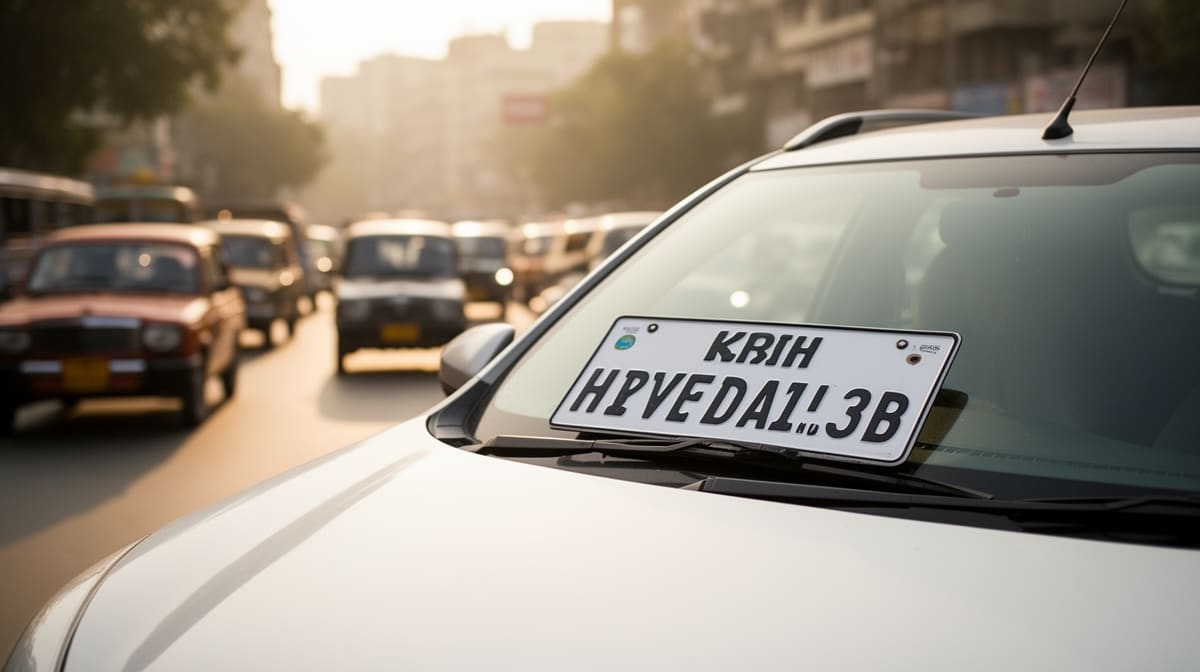
The High Court of Telangana has delivered a significant clarification on the limits of criminal liability for minor traffic violations, holding that driving a vehicle without a number plate cannot be prosecuted as cheating under the Bharatiya Nyaya Sanhita. This ruling prevents the misuse of serious criminal provisions for routine regulatory infractions, reinforcing the principle that criminal law must be reserved for acts involving dishonest intent or fraud.
Background & Facts
The Dispute
The petitioner, a 20-year-old student, was named as Accused No.2 in Criminal Case No.15413 of 2024 after a Head Constable, Respondent No.2, lodged a complaint alleging that the petitioner drove a vehicle without a registration number at Putlibowli Junction, Hyderabad, with the intention to evade traffic challans. The constable seized the vehicle and registered Crime No.318 of 2024, invoking Section 318(4) of the Bharatiya Nyaya Sanhita, 2023 (BNS), along with Sections 80(a), 177, and 196 of the Motor Vehicles Act, 1988.
Procedural History
- March 2024: Crime No.318 of 2024 registered against the petitioner and others
- 2024: Chargesheet filed before the II Additional Chief Judicial Magistrate, Hyderabad
- 2026: Petitioner filed Criminal Petition No.1639 of 2026 under Section 528 of the Bharatiya Nagarik Suraksha Sanhita (BNSS) seeking quashing of proceedings
- 10 February 2026: Hearing conducted before Justice J. Sreenivas Rao
Relief Sought
The petitioner sought quashing of the criminal proceedings on the grounds that the allegations, even if true, do not constitute any cognizable offence under the BNS or the Motor Vehicles Act, and that the prosecution is an abuse of process.
The Legal Issue
The central question was whether driving a vehicle without a registration number, without any allegation of deception or dishonest intent, can attract Section 318(4) of the Bharatiya Nyaya Sanhita, which criminalizes cheating by dishonest inducement to deliver property.
Arguments Presented
For the Petitioner
Learned counsel for the petitioner argued that Section 318(4) BNS requires proof of dishonest intention to induce another person to deliver property or alter/destroy valuable property. The complaint contained no allegation that the vehicle belonged to the complainant, nor that the petitioner made any false representation to obtain any benefit. He further contended that Section 80(a) of the Motor Vehicles Act merely mandates display of registration numbers and does not prescribe punishment for non-compliance. The absence of penal consequences under the Act rendered the criminal prosecution legally unsustainable.
For the Respondent
The Additional Public Prosecutor contended that the allegations raised disputed questions of fact requiring trial. He submitted that the act of driving without a number plate, coupled with an alleged intent to evade traffic challans, could be construed as an attempt to defraud the state of revenue, thereby attracting criminal liability under Section 318(4) BNS.
The Court's Analysis
The Court undertook a strict textual and purposive interpretation of Section 318(4) BNS, which criminalizes acts where a person, by deceit, dishonestly induces another to deliver property or to make, alter, or destroy any valuable security. The Court observed that the provision is rooted in the concept of fraud, not regulatory non-compliance.
"The offence under Section 318(4) BNS requires a deliberate act of deception leading to transfer of property or alteration of a valuable item. Mere non-display of a registration number, without any element of fraud or inducement, cannot be stretched to fit this provision."
The Court further noted that the Motor Vehicles Act, 1988, provides a comprehensive administrative framework for traffic violations, including imposition of fines under Section 177 and other provisions. The legislature’s intent, the Court held, was to treat such violations as civil or quasi-criminal infractions, not as serious offences under the penal code.
The Court emphasized that criminal proceedings must not be initiated for acts that are adequately addressed by statutory penalties under the Motor Vehicles Act. To allow such prosecutions would open the floodgates to misuse of criminal law for minor regulatory breaches, violating the principle of proportionality and the doctrine of mens rea.
The Verdict
The petitioner won. The Court held that driving without a number plate does not constitute cheating under Section 318(4) BNS, and that the complaint fails to disclose any offence under the law. The proceedings against the petitioner were quashed as legally unsustainable.
What This Means For Similar Cases
Traffic Violations Cannot Be Criminalized Through Stretching Cheating Provisions
- Practitioners must challenge any FIR or chargesheet invoking Section 318 BNS for traffic-related non-compliance without proof of dishonest inducement
- Police and prosecutors must rely on the Motor Vehicles Act’s prescribed penalties, not criminal statutes, for registration or documentation violations
- Courts should apply the doctrine of proportionality to prevent over-criminalization of minor infractions
Prosecution Must Align with Statutory Punitive Frameworks
- Where a specific statute (e.g., Motor Vehicles Act) provides a clear penalty regime, criminal charges under general penal codes are impermissible unless the act goes beyond mere non-compliance
- A complaint must explicitly allege elements of fraud, deception, or property transfer to sustain a charge under Section 318 BNS
- Legal advisors should routinely file quashing petitions where the facts disclose only regulatory breaches without criminal intent
Judicial Scrutiny of Police Complaints Is Mandatory
- Courts are under a duty to examine the prima facie sufficiency of complaints before allowing criminal proceedings to proceed
- This judgment reinforces the precedent in Arnesh Kumar v. State of Bihar that arrest and prosecution must not be automatic for non-bailable offences arising from minor disputes
- Lawyers should cite this judgment to oppose unnecessary arrests or prolonged litigation in traffic-related matters