The National Green Tribunal, Western Zone Bench at Pune, has clarified that an Environment Clearance (EC) cannot be invalidated merely because a project proponent did not explicitly mention vegetation in Form-1 of the environmental impact assessment, provided comprehensive details about tree retention, cutting, and transplantation are disclosed in the EC and supporting SEAC minutes. This ruling reinforces the principle that substantive environmental disclosure trumps technical omissions in application forms.
Background & Facts
The Dispute
The appellant, Sachin Khobragade, challenged the Environment Clearance (EC) dated 03.01.2025 granted to the Divisional Sports Complex Executive Committee, Nagpur (Respondent No.2), alleging that the project proponent made a false declaration in Form-1 by indicating "No" to the question: "Whether any clearance of existing vegetation due to project activity?" The appellant contended that this omission constituted suppression of material information, rendering the EC legally invalid.
Key Facts
- The project involves construction of a sports complex on a 99,796.5227 m² site in Nagpur
- Form-1, Sr. No. 3.2, filed by the project proponent, answered "No" to the question on vegetation clearance
- The appellant alleged the site contained 1,500 to 2,000 trees over 50 years old, none of which were disclosed
- The EC, however, contains detailed environmental management plans for vegetation:
- Total green area: 42,353.21 sq. m.
- Existing trees on site to be retained: 811
- Trees to be planted: 2,086
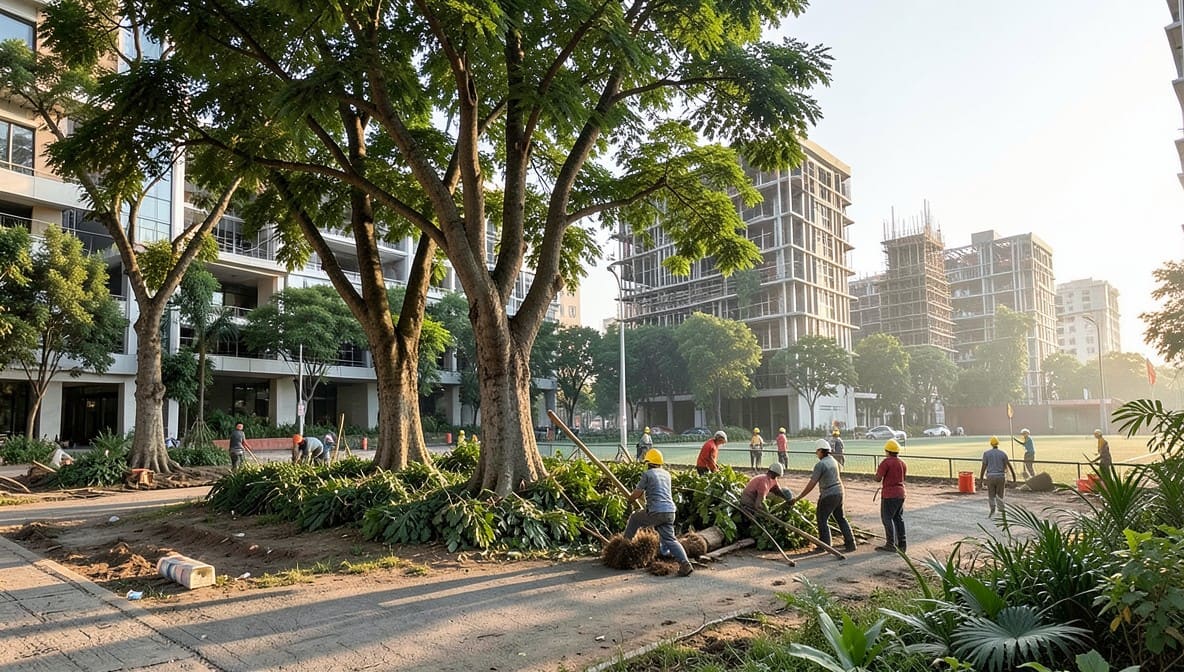
- Trees to be cut: 103
- Trees to be transplanted: 254
- These figures are consistently recorded in:
- The EC dated 03.01.2025 (Page 23)
- Minutes of the 199th meeting of SEAC-3 held on 03.10.2024 (Pages 45 and 51)
- SEIAA’s approval minutes dated 19.12.2024 (Annexure-2)
- The project proponent obtained consent to establish from MPCB on 31.03.2025
- Permission to cut/transplant 357 trees was sought from Nagpur Municipal Corporation’s Tree Authority under the Maharashtra (Urban Areas) Protection and Preservation of Trees Act, 1975
- The appellant provided no documentary evidence to substantiate the claim of 1,500 - 2,000 ancient trees
Procedural History
- 03.01.2025: Environment Clearance granted by SEIAA, Maharashtra
- 2025 (early): Appellant filed Appeal No.29 of 2025 (WZ) before NGT Pune seeking quashing of EC
- 25.06.2025: Respondent No.2 filed reply, clarifying that "vegetation" in Form-1 refers to natural vegetation under statutory definition, and disclosed full tree details in EC
- 11.07.2025: SEIAA filed affidavit confirming SEAC-3’s detailed review and recommendation
- 10.04.2026: Case reserved for judgment
- 24.04.2026: Judgment pronounced
The Parties' Positions
Appellant’s Position: The omission of vegetation in Form-1, Sr. No. 3.2, was a deliberate suppression of material information, violating the principle of informed consent under the Environment (Protection) Act, 1986. The EC is void ab initio.
Respondents’ Position: The term "vegetation" in Form-1 refers to natural vegetation under statutory definitions, not individual trees. Full disclosure of tree numbers, retention, cutting, and transplantation was made in the EC and SEAC minutes. The project complied with the Maharashtra Tree Act and obtained all necessary permissions.
Relief Sought
The appellant sought quashing of the Environment Clearance dated 03.01.2025 and directions to re-evaluate the project with full disclosure of vegetation.
The Legal Issue
The central question was whether an Environment Clearance can be invalidated solely on the ground that the project proponent answered "No" to the question on vegetation clearance in Form-1, when detailed tree management data is fully disclosed in the Environmental Impact Assessment report and SEAC minutes.
Arguments Presented
For the Appellant
The appellant’s counsel, Mr. Sailesh Sitani, argued that the answer "No" in Form-1, Sr. No. 3.2, was a material misrepresentation under Section 19 of the Environment (Protection) Act, 1986, which mandates full and truthful disclosure. He relied on the principle of uberrimae fidei (utmost good faith) in environmental approvals, citing T.N. Godavarman Thirumulpad v. Union of India to argue that any suppression of ecological data, regardless of scale, vitiates the entire clearance process. He contended that the absence of any mention of trees in Form-1 misled the SEAC and SEIAA into granting clearance without full awareness.
For the Respondent
The respondents, represented by multiple advocates including Mr. Aniruddha S. Kulkarni and Dr. Prashant Bhat, countered that Form-1’s question on vegetation was not intended to capture individual trees but rather to identify legally protected forest land under the Forest (Conservation) Act, 1980. They cited Lafarge Umiam Mining Pvt. Ltd. v. Union of India to distinguish between private land with tree cover and statutory forest land. They emphasized that the EC, SEAC minutes, and Tree Authority permissions contained exhaustive, verifiable data on 811 retained trees, 103 to be cut, and 254 to be transplanted. The respondents argued that the appellant’s claim was speculative and unsupported by evidence.
The Court's Analysis
The Tribunal examined the distinction between procedural non-disclosure and substantive misrepresentation. It noted that while Form-1 is a preliminary application form, the Environment Clearance itself is the final, legally binding document incorporating all environmental conditions and mitigation measures.
"The impugned EC contains minute details regarding existing trees, their number, how many to be retained, how many to be planted and how many to be cut and transplanted all has been given in minute details."
The Court observed that the SEAC-3 meeting minutes of 03.10.2024, which formed the basis of SEIAA’s decision, contained comprehensive data on vegetation management. The EC explicitly incorporated conditions under Section XIV(a) requiring compliance with the Maharashtra (Urban Areas) Protection and Preservation of Trees Act, 1975, thereby ensuring legal oversight of tree felling.
The Tribunal rejected the appellant’s reliance on Godavarman and Lafarge Umiam as inapposite, noting that those cases dealt with forest land classification, not disclosure obligations in urban development projects. It held that the appellant’s allegation of suppression was not substantiated by any documentary proof of the alleged 1,500 - 2,000 ancient trees.
The Court emphasized that environmental law does not penalize technical omissions in preliminary forms where the final approval document contains full, accurate, and actionable environmental safeguards. The principle of proportionality applies: a minor discrepancy in a form does not nullify a comprehensive, condition-laden clearance supported by multiple layers of scrutiny.
The Verdict
The appeal was dismissed. The Environment Clearance dated 03.01.2025 is upheld. The Tribunal found no legal infirmity in the EC, as all vegetation-related information was fully disclosed in the SEAC minutes and the clearance conditions. No costs were awarded. The project proponent is directed to strictly comply with the tree retention, transplantation, and planting conditions specified in the EC and under the Maharashtra Tree Act, 1975.
What This Means For Similar Cases
Disclosure in Final EC Supersedes Form-1 Omissions
- Practitioners must ensure that all environmental disclosures are comprehensive in the final EIA report and EC, not merely in Form-1
- A "No" answer in Form-1 does not automatically invalidate an EC if detailed vegetation data is present in supporting documents
- Legal challenges based on Form-1 discrepancies must be supported by evidence of actual environmental harm or concealment in the final clearance
SEAC Minutes Are Critical Evidence
- SEAC meeting minutes are legally binding records that form the basis of EC decisions
- Any challenge to an EC must be addressed against the full record, including SEAC recommendations and SEIAA minutes
- Petitioners must cite specific contradictions between Form-1 and SEAC/EC data, not general allegations
Municipal Tree Laws Are Integral to EC Compliance
- Compliance with state tree protection laws (e.g., Maharashtra Tree Act, 1975) is now a mandatory condition of EC
- Project proponents must obtain separate permissions from Tree Authorities even after EC
- Failure to comply with these conditions may lead to enforcement action, independent of EC validity