The National Green Tribunal has reaffirmed that environmental clearances are not mere formalities but binding legal commitments requiring strict, documented compliance with all stipulated conditions. This judgment underscores the necessity of substantive verification before final approval is granted, particularly in infrastructure projects impacting ecologically sensitive areas.
Background & Facts
The Dispute
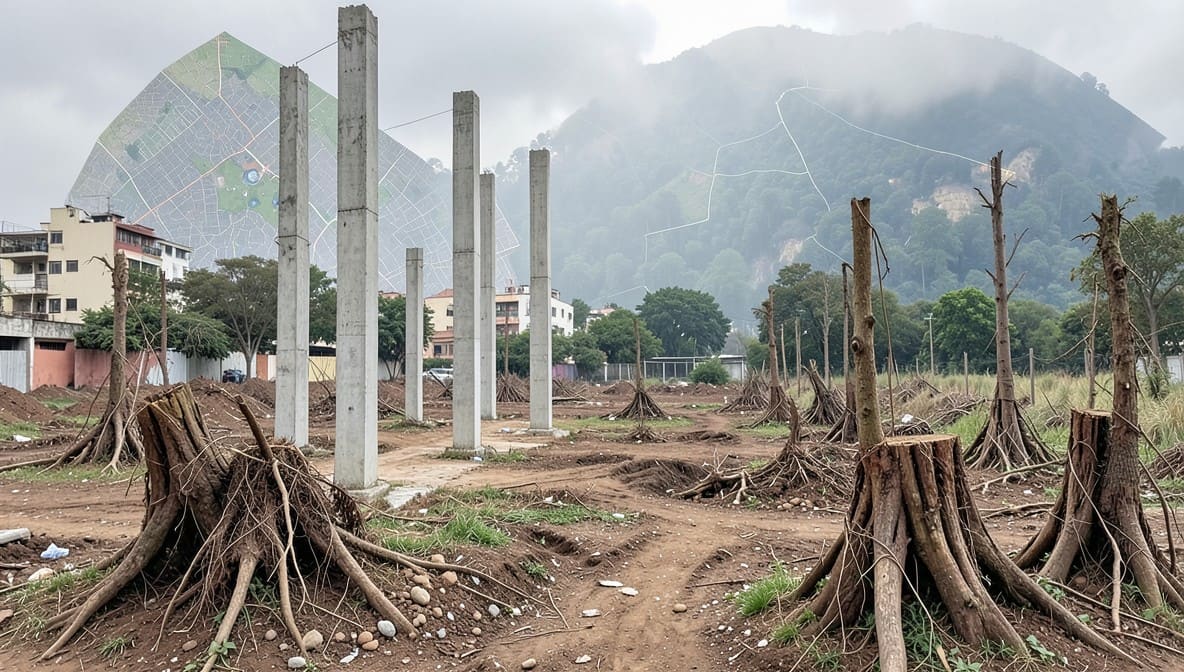
The applicant, Public Action Committee, challenged the felling of hundreds of trees along the 22-kilometer stretch of the Major District Road Sirhind-Patiala Road, part of a four-laning project. The petitioner alleges that the project proponent violated mandatory conditions under the Stage-I environmental clearance granted on 01.08.2023, specifically failing to adhere to the Indian Roads Congress (IRC) Code SP: 21-2009 guidelines for tree conservation and replacement.
Procedural History
- 01.08.2023: Stage-I environmental clearance granted with specific conditions, including mandatory fund allocation via State CAMPA and prohibition on layout changes without Central Government approval.
- 24.11.2025: NGT directed Respondent No. 7 (Regional Office, MoEF&CC) to file an affidavit verifying compliance with Stage-I conditions.
- 17.02.2026: Respondent No. 7 filed an affidavit claiming final approval was granted on 18.01.2024 after "analysis" of State Government reports, but provided no documentary evidence of verification.
- 18.02.2026: Hearing concluded with Tribunal noting the affidavit was vague and lacked proof of due diligence.
Relief Sought
The applicant seeks suspension of tree felling activities, restoration of felled trees, and cancellation of final environmental clearance until full compliance with Stage-I conditions is independently verified and documented.
The Legal Issue
The central question was whether final environmental clearance under the EIA Notification 2006 can be lawfully granted without verified, documented proof that all Stage-I conditions have been strictly complied with by the project proponent.
Arguments Presented
For the Petitioner
The applicant argued that Stage-I conditions are mandatory pre-conditions, not suggestions, and that the Central Government’s reliance on unverified State Government reports violates the principle of substantive due process under Article 21 of the Constitution. Reliance was placed on M.C. Mehta v. Union of India to assert that environmental approvals require active, not passive, oversight. The absence of site inspections, tree audit reports, or CAMPA fund release records rendered the final approval legally defective.
For the Respondent
The State and MoEF&CC contended that the final clearance was granted after "examination" of the State’s compliance report, and that technical verification was a matter of administrative convenience. Counsel argued that the absence of explicit non-compliance in the State’s submission should be construed as tacit approval, citing Rajasthan Pollution Control Board v. M/s. M.P. Birla Group to suggest that minor procedural lapses do not invalidate approvals if environmental harm is not proven.
The Court's Analysis
The Tribunal rejected the Respondent’s argument that "examination" of a report substitutes for active verification. It held that Stage-I conditions are not discretionary but statutory obligations under the Environment (Protection) Act, 1986 and the EIA Notification 2006. The Court emphasized that procedural compliance is a precondition for substantive approval, and that the Central Government cannot delegate its statutory duty of verification to State authorities without independent scrutiny.
"The grant of final clearance without independent verification of compliance with mandatory conditions renders the entire process a colourable exercise, undermining the very purpose of environmental impact assessment."
The Tribunal distinguished Rajasthan Pollution Control Board by noting that case involved post-facto remediation, whereas here, the violation occurred prior to final approval. It further held that the burden of proof lies squarely on the approving authority to demonstrate compliance, not on the petitioner to disprove it.
The Verdict
The applicant prevailed. The National Green Tribunal held that final environmental clearance cannot be granted without documented, independent verification of compliance with all Stage-I conditions. The Tribunal directed Respondent No. 7 to file a fresh affidavit within four weeks, attaching site inspection reports, CAMPA fund release records, and tree replacement plans.
What This Means For Similar Cases
Procedural Compliance Is Non-Negotiable
- Practitioners must now insist on production of verified compliance reports before accepting any environmental clearance as valid.
- Any approval relying solely on State government assurances without central verification is vulnerable to challenge.
- Legal notices should cite this judgment to demand production of audit trails for CAMPA fund utilization and tree replacement.
Burden of Proof Shifts to the Approving Authority
- In challenges to environmental clearances, the burden now rests on the MoEF&CC or State agencies to prove compliance - not on petitioners to prove non-compliance.
- Petitioners may file applications under Section 19 of the NGT Act to compel disclosure of verification records.
- Failure to produce such records may lead to automatic suspension of project activities pending compliance.
Tree Felling Requires Pre-Approval Documentation
- Projects involving tree removal must now attach IRC SP: 21-2009 compliance certificates to environmental applications.
- Absence of such documentation renders the project non-compliant even if other clearances are in place.
- NGOs and citizen groups may use this judgment to initiate public interest litigation against highway projects lacking verified tree conservation plans.