The Allahabad High Court examined whether a prolonged, unexplained failure by a District Magistrate to issue a No Objection Certificate (NOC) for a petrol retail outlet amounted to malice in law, thereby violating the petitioner’s constitutional rights under Articles 14, 19(1)(g) and 21.
Background & Facts
The Dispute
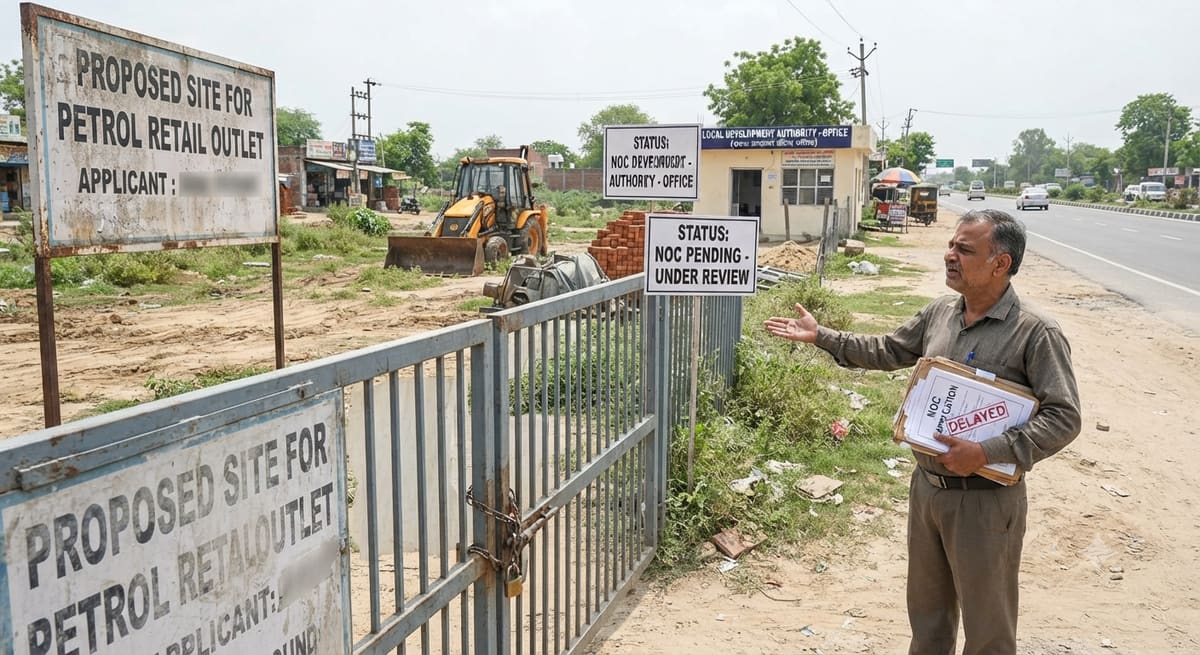
The petitioner, M/S Ramraj Filling Station, sought a writ of mandamus directing the District Magistrate, Fatehpur, to grant an NOC for establishing a retail fuel outlet at Khasra No. 180, Village Udaharanpur, Tehsil Sadar, District Fatehpur.
Key Facts
29.03.2024: Oil company Reliance BP Mobility Limited issued a Letter of Intent to the petitioner.
01.07.2024: The oil company requested an NOC from the District Magistrate.
30.01.2023: Government Order governing NOC issuance was in force.
18.12.2025: State Government issued a revised policy simplifying NOC procedures.
22.06.2026: The Court ordered the District Magistrate to show cause for not granting the NOC.
24.06.2026: The Court directed personal appearance of the District Magistrate for clarification.
25.06.2026: The District Magistrate filed an affidavit and appended the NOC, subject to two conditions (building plan sanction and process fee deposit).
30.07.2026: Judgment delivered, disposing of the petition.
Procedural History
2026: Writ Petition (No. 23761 of 2026) filed before Allahabad High Court.
22.06.2026: Court issued show-cause order to District Magistrate.
24.06.2026: Court ordered personal appearance of District Magistrate.
25.06.2026: District Magistrate submitted affidavit and NOC.
30.07.2026: Final judgment delivered.
The Parties' Positions
Petitioner: Asserted violation of fundamental right to carry on trade (Art 19(1)(g)) and right to equality (Art 14) due to arbitrary, unexplained delay; claimed the delay manifested malice in law.
Respondents (Union of India & Oil Company): Contended that the NOC had already been issued, and the delay was caused by late police report; argued no cause of action remained.
Relief Sought
The petitioner prayed for a writ of mandamus directing the District Magistrate to grant the NOC forthwith, without further delay.
The Legal Issue
Whether the District Magistrate’s failure to issue the required NOC for more than two years, without any reasonable or plausible justification, attracts the doctrine of malice in law and constitutes a violation of Articles 14, 19(1)(g) and 21 of the Constitution of India.
Arguments Presented
For the Petitioner
The petitioner relied on Ratnagiri Gas and Power Private Limited v. RDS Projects and State of AP v. Goverdhanlal Pitti to argue that administrative action taken without lawful justification, even absent personal ill-will, amounts to malice in law.
Cited Article 19(1)(g) (right to trade), Article 14 (equality), and Article 21 (right to life and dignity) to demonstrate that the unexplained delay was arbitrary and unconstitutional.
Emphasised that the revised Government Order of 18.12.2025 expressly simplified NOC issuance, yet the Magistrate remained inert.
For the Respondent
Asserted that the NOC had been issued on 25.06.2026 following the Court’s direction, and any prior delay was due to the late submission of a police report dated 22.06.2026.
Maintained that once the NOC was in hand, the petition lost its cause of action.
Argued that the Magistrate’s actions were within administrative discretion and not motivated by malice.
The Court's Analysis
The Court began by delineating the distinction between malice in fact and malice in law. It reiterated that malice in law does not require proof of personal ill-will; it is sufficient that a public authority acts without lawful justification or on extraneous grounds.
"Any action taken wrongfully and intentionally, without just cause, excuse, or lawful justification, is distinct from personal ill-will or malice in fact and would be construed as malice in law."
The Court examined authoritative pronouncements, notably Ratnagiri Gas and Power Private Limited v. RDS Projects (2013 12 SCC 786), State of AP v. Goverdhanlal Pitti (2003 4 SCC 739), and Ravi Yashwant Bhoir v. District Collector (2012 2 SCC 407), to underscore that malice in law can be inferred where an authority deliberately defies statutory mandates.
Applying this doctrine, the Court observed that:
The original Letter of Intent dated 29.03.2024 created a legitimate expectation of timely NOC issuance.
The Government Order of 30.01.2023, later superseded by the simplified policy of 18.12.2025, imposed a clear procedural framework.
The District Magistrate’s inaction for over two years, despite the petitioner’s repeated representations and the existence of a statutory timeline, lacked any plausible explanation, as reflected in her affidavit.
The Court found the Magistrate’s reliance on a delayed police report insufficient to excuse the prolonged silence, especially when the revised policy expressly removed procedural bottlenecks.
The Court further linked the administrative lapse to constitutional violations. It held that arbitrariness - the hallmark of a breach of Article 14 - was evident, and that such arbitrariness, when coupled with the denial of a trade-related right, also infringed Articles 19(1)(g) and 21.
Consequently, the Court concluded that the delay itself constituted malice in law, even though the NOC was eventually issued. However, because the NOC had now been granted, there was no longer a substantive dispute requiring further adjudication.
The Verdict
The petition was disposed of on the ground that the NOC has been issued. No order as to costs was made. The Court directed the District Magistrate to act promptly in future matters involving citizen rights and to ensure compliance with the Government Orders of 30.01.2023 and 18.12.2025.
What This Means For Similar Cases
Administrative Delay as Malice in Law
Courts may deem prolonged, unexplained administrative inertia as malice in law, even absent evidence of personal animus.
Practitioners should compel authorities to provide a plausible justification for any delay, lest the delay itself become a ground for mandamus.
Mandamus for NOC and Similar Licences
A writ of mandamus remains a potent remedy where statutory or policy-based timelines are ignored.
Parties must document all communications and statutory deadlines to establish the absence of reasonable cause.
Constitutional Scrutiny of Bureaucratic Action
Violations of Articles 14, 19(1)(g) and 21 can be invoked jointly when administrative inaction impedes a lawful trade or business.
Lawyers should frame arguments within the “golden triangle” of equality, liberty, and life to strengthen claims of arbitrariness.
Actionable takeaways:
File a show-cause notice promptly when an authority delays a statutory licence.
Cite relevant Government Orders and policy revisions to demonstrate the expected timeline.
Prepare to argue malice in law by highlighting the lack of any lawful justification for the delay.