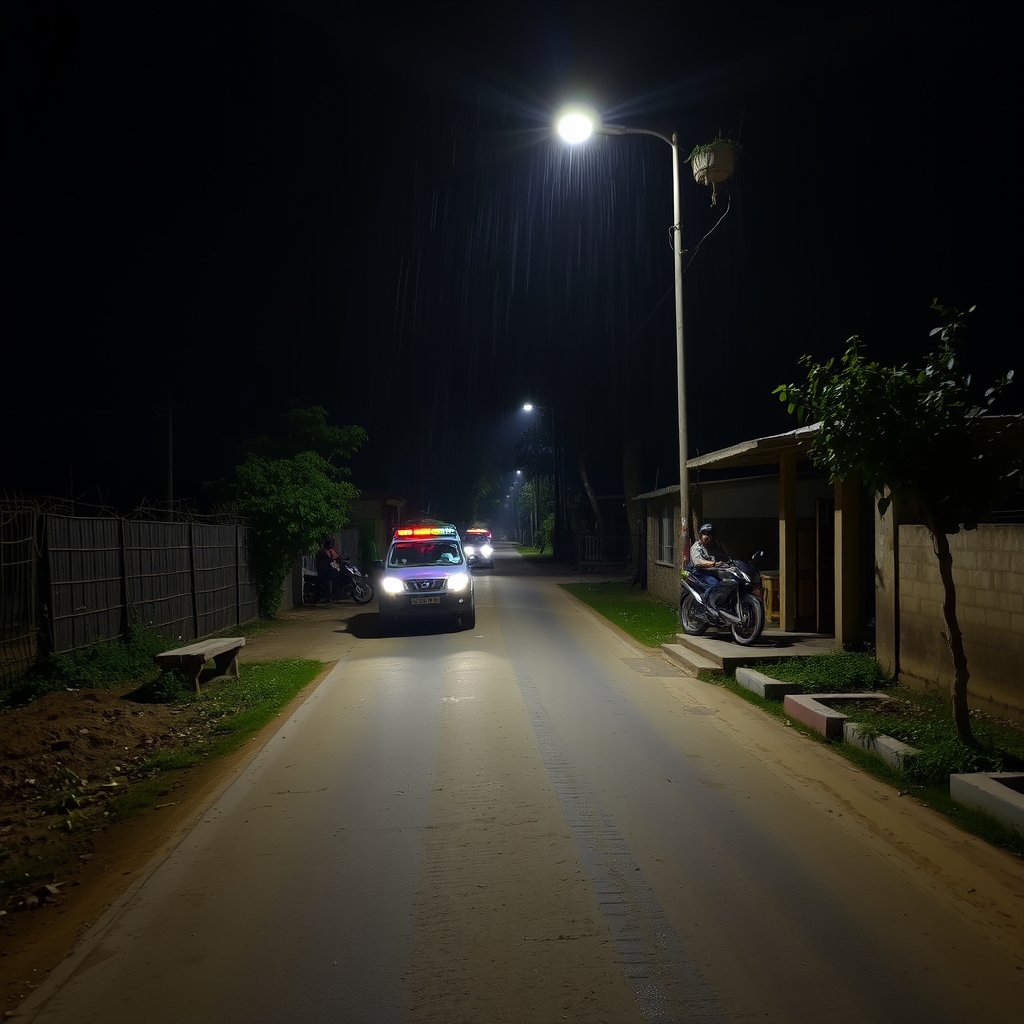
The Allahabad High Court set aside an impugned order directing registration of an FIR against police personnel, holding that the Special Judge failed to exercise judicial mind and overlooked mandatory procedural safeguards under Sections 175(3) and 175(4) of the Bharatiya Nagarik Suraksha Sanhita, 2023 (BNSS). The Court emphasized that mechanical acceptance of allegations against public servants without considering contemporaneous police records, cross-cases, and the official duty nexus violates binding Supreme Court principles.
Background & Facts
The Dispute
The dispute originated from a land and money conflict between the family of Ramasare and the family of Sheela (wife of Pramod) and Anju (wife of Rajesh), residents of Village Basantpur, Police Station Ghughuli, District Maharajganj. Both Sheela and Anju belong to the Chamar caste, a Scheduled Caste category. On the night of June 6, 2026, a clash occurred between the families, injuring Rajesh and Pintoo. Later that night (around 10:00 PM - 11:00 PM), police took away Pintoo, Molai, Suresh, and Rahul.
Key Facts
-
Around 1:00 AM - 2:00 AM on June 7, 2026 (06/07-06-2026), Sub-Inspector Rakesh Kumar Yadav (appellant), Constable Amit Kumar (appellant), and about 20 other policemen from Police Station Ghughuli forcibly entered the house of Sheela and Anju without a search warrant.
-
When objected to, the police personnel turned aggressive, committed obscenity, denied the women access to the bathroom, and outraged their modesty by making caste-based remarks targeting their Chamar identity.
-
On June 10, 2026, threats were received via mobile number 7235815717 warning of severe consequences.
-
Sheela and Anju informed the Superintendent of Police, Maharajganj, on June 12, 2026, but received no response, compelling them to approach the court.
-
The accused persons (Rakesh Kumar Yadav, Amit Kumar, and about 20 other police personnel) were charged under Sections 74, 351, 333 of the Bharatiya Nyaya Sanhita (BNS) and Sections 3(1)(r) and 3(1)(s) of the Scheduled Castes and Scheduled Tribes (Prevention of Atrocities) Act, 1989 (SC/ST Act).
-
It is admitted that Anju is the wife of Rajesh (informant in Crime No. 126 of 2026 and accused in Crime No. 127 of 2026), and Sheela is the Jethani (sister-in-law) of Anju.
-
Rakesh Kumar Yadav was the Investigating Officer in both Crime No. 126 of 2026 (under Sections 115(2), 351(3), 352 BNS against Munna and four others) and Crime No. 127 of 2026 (under same sections against Molai and four others), registered at Police Station Ghughuli on the same day as the incident.
-
The General Diary (G.D.) Entry No. 64 dated June 6, 2026, indicates that police personnel proceeded to the place of occurrence upon receiving information about a cognizable offence to maintain peace and public order and apprehend alleged offenders.
-
G.D. Entry No. 62 indicates certain police personnel had been deputed for night patrolling in Village Basantpur where the alleged occurrence took place.
Procedural History
- June 6, 2026: Clash occurred between families; police action taken later that night/early morning.
- June 10, 2026: Threats received via mobile number.
- June 12, 2026: Sheela and Anju approached Superintendent of Police with no response.
- August 11, 2026: Impugned order passed by Special Judge, Exclusive Special Court (SC/ST Act), Maharajganj in Misc. Application No. 199 of 2026 (Sheela & Anr. vs. Rakesh Kumar Yadav & Ors.) under Section 173(4) BNSS, directing registration of FIR and investigation.
- October 9, 2026: Present judgment delivered by Hon'ble Santosh Rai, J., Allahabad High Court.
The Parties' Positions
-
Appellants (Rakesh Kumar Yadav et al.): Contended the impugned order was passed mechanically without proper consideration of the police inquiry report and relevant BNSS/SC/ST Act provisions. Alleged the allegations were vague, omnibus, uncorroborated, and motivated. Contended the essential requirement of "public view" under the SC/ST Act was not prima facie satisfied as the alleged occurrence took place inside private residential premises. Argued the learned Special Judge failed to comply with mandatory procedural safeguards under Sections 175(3) and 175(4) BNSS and did not consider protection under Section 218 BNSS.
-
Respondents (State of U.P. and Sheela/Anju): Supported the impugned order, asserting that a cognizable offence prima facie appeared to have been committed based on the application under Section 173(4) BNSS, necessitating FIR registration and investigation.
Relief Sought
The appellants prayed to set aside the impugned order dated August 11, 2026, passed by the Special Judge, Exclusive Special Court (SC/ST Act), Maharajganj in Misc. Application No. 199 of 2026 under Section 173(4) BNSS.
The Legal Issue
The central question was whether the Special Judge, Exclusive Special Court (SC/ST Act), Maharajganj, properly exercised jurisdiction under Sections 173(4) and 175(3)/(4) of the BNSS when directing registration of an FIR against police personnel, specifically whether the Court considered the mandatory requirement to apply judicial mind, examine the contemporaneous police report and cross-cases, and comply with the procedural safeguards for public servants under Section 175(4) BNSS before issuing such a direction.
Arguments Presented
For the Appellant/Petitioner
The appellants argued that the impugned order dated August 11, 2026, was passed mechanically without application of judicial mind. They relied on State of Haryana & Ors. Vs. Bhajan Lal & Ors. (1992) Supp (1) SCC 335, Anil Kumar & Ors. Vs. M.K. Aiyappa & Anr. (2013) 10 SCC 705, Priyanka Srivastava & Anr. Vs. State of U.P. & Ors. (2015) 6 SCC 287, and Om Prakash Ambadkar Vs. State of Maharashtra & Ors. (2026) 2 SCC 622 to contend that Magistrates must apply judicial mind before directing investigation under Section 156(3) CrPC (corresponding to Section 175(3) BNSS). They asserted that the allegations were vague, omnibus, uncorroborated, and motivated, and that the essential ingredient of "public view" under the SC/ST Act was absent as the incident occurred inside a private residence. The appellants further argued that the Special Judge failed to consider the statutory safeguards under Sections 175(3) and 175(4) BNSS, including the requirement to examine the application supported by affidavit, make necessary inquiry, and consider the police officer's submission, and overlooked the contemporaneous circumstance that the appellants were public servants acting in connection with a cognizable criminal case where family members of the complainants had been arrested the same day.
For the Respondent/State
The respondents contended that the application under Section 173(4) BNSS disclosed a cognizable offence prima facie, justifying the direction for FIR registration and investigation. They emphasized that the Special Judge had considered the material on record and found it necessary to thoroughly investigate the matter, register an FIR, and have the investigation conducted by police in accordance with law, based on the allegations of forcible trespassing and obscene acts against women inside a house.
The Court's Analysis
The Court commenced its analysis by clarifying the statutory scheme under the BNSS. It held that Section 173(4) BNSS provides a remedy to a person whose information has not been recorded by the officer-in-charge, but the judicial power to direct investigation/registration traces to Section 175(3) BNSS, which operates in sequence with Section 173(4). The Court emphasized that, unlike Section 156(3) CrPC, Section 175(3) BNSS requires the Magistrate to (i) consider the application supported by affidavit, (ii) make such inquiry as he thinks necessary, and (iii) consider the submission made by the police officer. Furthermore, Section 175(4) BNSS introduces an additional safeguard where a complaint is made against a public servant arising in the course of discharge of official duties, mandating consideration of a report from the officer superior to the accused public servant and the assertions of the public servant regarding the situation leading to the incident.
The Court drew upon Supreme Court precedents to establish that the power to direct investigation must be exercised judicially, not mechanically. Quoting from State of Haryana & Ors. Vs. Bhajan Lal & Ors., it noted that such power requires application of judicial mind and cannot be exercised as a matter of course. From Anil Kumar & Ors. Vs. M.K. Aiyappa & Anr., it extracted that the Magistrate cannot refer a matter under Section 156(3) CrPC against a public servant without a valid sanction order, and the mere statement of having gone through documents is insufficient; the application of mind must be reflected in the order. The Court further relied on Priyanka Srivastava & Anr. Vs. State of U.P. & Ors. and Om Prakash Ambadkar Vs. State of Maharashtra & Ors. to reinforce that the Magistrate must remain vigilant regarding the nature of allegations and cannot issue directions without proper application of mind.
Applying these principles, the Court found that the impugned order suffered from a material non-application of mind. It held that the Special Judge failed to consider the significant circumstance that appellant Rakesh Kumar Yadav was the Investigating Officer in both cross-cases (Crime Nos. 126 and 127 of 2026), appellant Amit Kumar was a Constable, and about 20 other police personnel were implicated, all of whom had acted in connection with a cognizable criminal case on the very day when family members of the complainants were arrested. The police report called for by the Court contained material relevant to this aspect, yet the impugned order disclosed no meaningful consideration of whether the alleged acts of the police personnel had a reasonable nexus with their official functions or were wholly extraneous. The Court stressed that where allegations arise out of an incident occurring in the course of official police action, Section 175(4) BNSS requires the Court to take into consideration the report of the superior police officer and the assertions of the public servant explaining the circumstances leading to the incident to distinguish between an act having a reasonable nexus with official duty and one that is wholly extraneous. The absence of such consideration rendered the impugned order unsustainable in law.
The Verdict
The appeal was allowed. The impugned order dated 11.08.2026, passed by the learned Special Judge, SC/ST Act, Maharajganj, on the application under Section 173(4) BNSS, is hereby set aside. If any consequential proceedings arising solely out of the said order shall also stand quashed. The District & Sessions Judge shall monitor compliance with the aforesaid directions in the monthly meetings of the judicial officers, while the District Monitoring Cell shall review the same in its monthly meetings with the officers of the district administration to ensure effective implementation. A copy of this judgment shall be forwarded to the Learned Registrar General, High Court of Judicature at Allahabad, for circulation amongst all judicial officers in the State of Uttar Pradesh for strict compliance with the principles and guidelines contained herein; to the Director, Judicial Training and Research Institute (JTRI), Lucknow; and to all District Magistrates, Senior Superintendent of Police/Superintendent of Police, and Commissioners of Police in the State of Uttar Pradesh for information and necessary compliance.
What This Means For Similar Cases
Judicial Mind Application Is Non-Negotiable
Magistrates and Special Courts exercising jurisdiction under Sections 173(4) and 175(3) BNSS must actively apply judicial mind before directing FIR registration or investigation. Mechanical acceptance of allegations, without examining the contemporaneous police report, cross-cases, or the official duty nexus, violates binding Supreme Court principles. The order must reflect consideration of whether inquiry was necessary and, if not, provide cogent reasons for dispensing with such inquiry.
Statutory Safeguards for Public Servants Must Be Observed
Where a complaint is made against a public servant alleging commission of a cognizable offence arising in the course of discharge of official duties, Section 175(4) BNSS mandates a two-step procedure: (i) obtaining a report containing facts and circumstances from the officer superior to the accused public servant, and (ii) considering the assertions made by the public servant as to the situation leading to the incident. This safeguard cannot be reduced to an empty formality and is essential to distinguish between acts connected with official duty and those that are wholly extraneous.
Contemporaneous Police Record Is Material
The contemporaneous police record, including General Diary entries, FIRs, criminal cases, arrest memos, and police reports, is material when determining whether allegations against police personnel represent acts wholly unconnected with official functions or arose in the course of police action. The existence of prior police action or criminal cases involving the complainant's family members neither establishes falsity nor truth of the complaint but necessitates judicial consideration of the chronological sequence of events and surrounding circumstances.
Directions for UP Judicial Officers
All judicial officers in Uttar Pradesh exercising jurisdiction under Sections 173(4) and 175 BNSS must: (i) bear in mind that the words "after making such inquiry as he thinks necessary" in Section 175(3) BNSS are a conscious statutory departure from Section 156(3) CrPC; (ii) consider the submission/report of the concerned police officer regarding refusal or failure to register the FIR; (iii) verify that the applicant has followed the statutory course contemplated by Section 173 BNSS; (iv) read Sections 175(3) and (4) BNSS harmoniously when the allegation arises in the course of official duty; (v) where the alleged act appears to have arisen in the course of discharge of official duty, follow the procedure contemplated by Section 175(4) BNSS; and (vi) exercise heightened judicial caution where the proposed accused is a public servant or police personnel, particularly if they had earlier registered/investigated a criminal case against the complainant, arrested the complainant or family members, taken preventive/coercive action, were involved in investigation of a connected case, or submitted a final/closure report in a connected case.