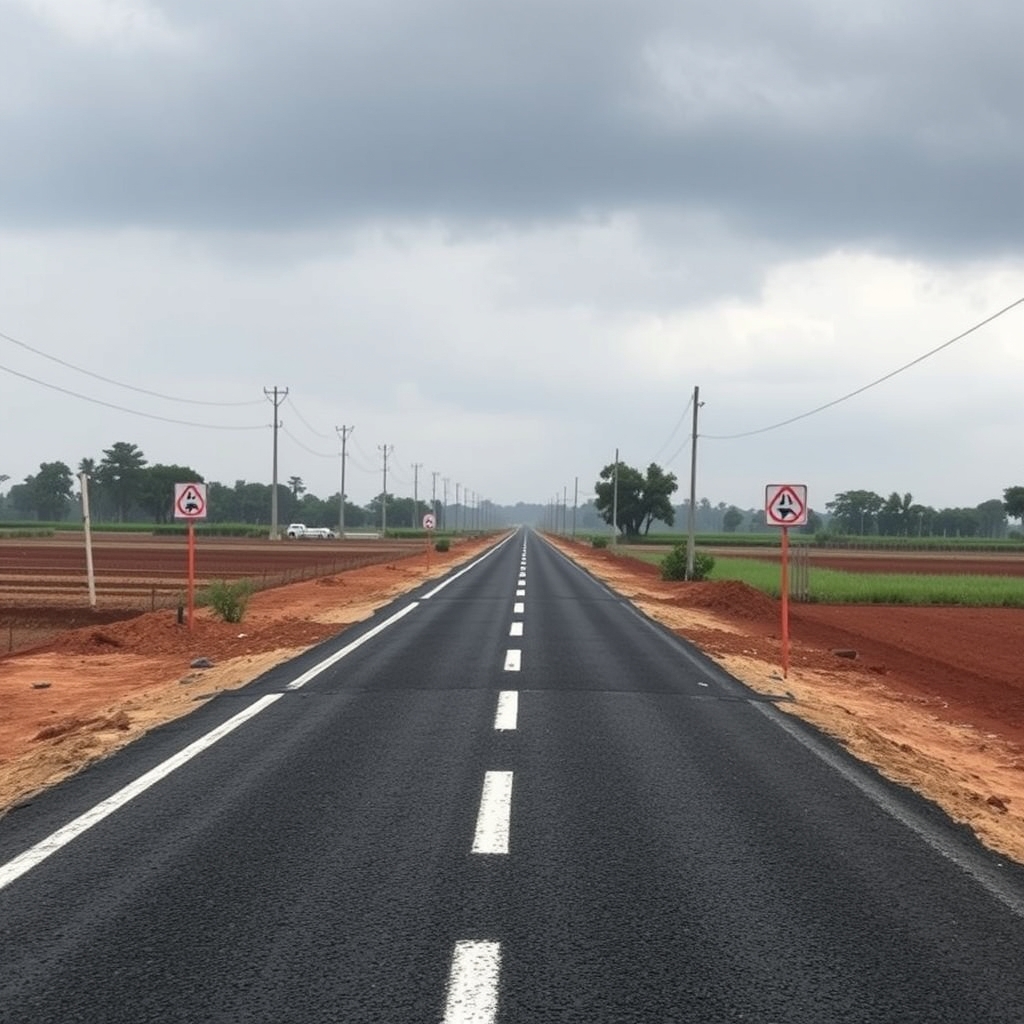
The Supreme Court quashed a recovery order issued under the Pradhan Mantri Gram Sadak Yojana (PMGSY) for violating natural justice and lacking contractual authority, directing the State of Chhattisgarh to release Rs.84,17,003 with 6% interest from the date of deduction. The Court held that recovery from subsequent works for alleged overpayment in earlier works violated Clause 4.1 of the Special Conditions of Contract and principles of natural justice, as no hearing was afforded and the amount remained disputed.
Background & Facts
The Dispute
The controversy arose from road construction contracts awarded to M/S Awadhesh Singh Gautam (appellant), a partnership firm, under the Pradhan Mantri Gram Sadak Yojana (PMGSY) by the Chhattisgarh Rural Road Development Agency (CGRRDA). The appellant executed works under two distinct sets of contracts: 'earlier works' awarded on 03.01.2023 and 'subsequent works' with work orders issued on 01.09.2023 and 05.11.2024.
Key Facts
- The appellant was awarded two separate contracts for construction of two roads on 03.01.2023 at 10.10% above Schedule of Rates, with an approved cost of approximately Rs.437.43 lakhs ('the earlier works').
- A substantial part of the contract value for the earlier works had already been paid to the appellant.
- Pursuant to tender notices, the appellant was awarded three packages under PMGSY for subsequent works, with work orders issued on 01.09.2023 and 05.11.2024.
- Having executed approximately 40% of each subsequent work, the appellant raised running bills aggregating Rs.39,78,500, Rs.45,62,000, and Rs.23,55,000 respectively.
- Reminders for payment were issued on 22.09.2025 and 25.09.2025, but the amounts remained unreleased.
- The Collector, South Bastar, Dantewada, constituted a five-member committee on complaints of irregularity in the earlier works. The committee's report dated 09.01.2024 found that although Rs.3,55,82,055 had been paid to the appellant, the value of work actually executed was only Rs.1,54,75,938, disclosing an excess payment of Rs.2,01,06,117.
- The committee recommended recovery of the said sum, blacklisting of the appellant, a probe into other works, and departmental action against concerned CGRRDA officers.
- Acting on the report, the Collector issued a memo dated 03.06.2024 directing the Tehsildar to recover Rs.2,01,06,117 from the appellant.
- The Tehsildar registered a revenue case and issued a demand notice dated 16.12.2024 under Section 146 of the Chhattisgarh Land Revenue Code, 1959, calling for payment within ten days.
- The demand notice was assailed in a writ petition. By order dated 05.03.2025, the High Court quashed it for want of notice or hearing to the appellant (violative of natural justice), while reserving liberty to respondents to act afresh on the committee's report in accordance with law and natural justice.
- Independently, upon a complaint by an Assistant Engineer of CGRRDA, a First Information Report was registered against Mr. Awadhesh Singh Gautam (partner of appellant firm) and CGRRDA officers for offences under Sections 420, 467, 468, 471, 409, and 120-B of the Indian Penal Code, 1860. A chargesheet was filed on 30.12.2025.
- Drawing upon inspection reports (District Level Investigation Team dated 18.12.2024, Departmental Supervising Engineer dated 28.10.2024, and Departmental Sub-Engineer), the Executive Engineer-cum-Member Secretary, Project Implementation Unit K-01 ('the Executive Engineer'), passed an order dated 27.09.2025 ('the recovery order'). By this order, a sum of Rs.84,17,003 was blocked out of amounts currently payable to the appellant, to be recovered by deduction from the three subsequent works in the sums of Rs.28,00,000, Rs.38,00,000, and Rs.18,17,003 respectively.
- The appellant's representation dated 09.10.2025 to the Executive Engineer pointed out that deductions were being made from bills payable under contracts wholly distinct from the earlier works (where the alleged liability arose) and sought a refund of Rs.84,17,003 within fifteen days, eliciting no response.
- Three writ petitions were filed assailing the recovery order and seeking release of the deducted amounts.
Procedural History
- 05.03.2025: High Court quashed demand notice dated 16.12.2024 for want of notice/hearing (natural justice violation), reserving liberty to respondents to act afresh.
- 27.09.2025: Recovery order passed by Executive Engineer blocking Rs.84,17,003 from subsequent works.
- 09.10.2025: Appellant's representation to Executive Engineer seeking refund within fifteen days (no response).
- 07.01.2026: Impugned common order of High Court dismissing three writ petitions, holding relief claimed was contingent on adjudication of disputed facts under Article 226, and reserving liberty to pursue alternate remedy.
- 30.09.2026: Judgment of the Supreme Court.
Relief Sought
The appellant sought quashing of the recovery order dated 27.09.2025, release of the deducted sum of Rs.84,17,003, and interest thereon.
The Legal Issue
The central question was whether the recovery order dated 27.09.2025, effected under contractual clauses relied upon by respondents, satisfied the conditions prescribed in those clauses and complied with principles of natural justice.
Arguments Presented
For the Appellant/Petitioner
The appellant, through Senior Counsel Mr. Gaurav Agrawal, contended that the recovery order was passed without notice or opportunity of hearing, violating Clause 4.1 of the Special Conditions of Contract (SBD), which mandates a hearing before recovery consequent on audit. It was argued that appropriation of amounts payable under one contract (subsequent works) towards a liability alleged to arise under an altogether different contract (earlier works) was impermissible, as Clauses 43 and 53 (dealing with security deposit and payment upon termination) had no bearing on the recovery. The appellant highlighted that Rs.1,07,02,594 remained payable under the earlier works themselves, yet respondents chose to recover from unconnected ongoing contracts. Reliance was placed on ABL International Ltd. & Anr. v. Export Credit Guarantee Corporation of India Ltd. & Ors., (2004) 3 SCC 553.
For the Respondent/State
The State, through Learned Additional Advocate General Mr. Bishwajit Dubey, submitted that the power of cross-contract recovery flowed expressly from the contract. Reliance was placed on Clause 7(iv) of the Pre-Contract Integrity Pact and Clause 38 of the Conditions of Contract, which permit recovery of dues under one contract from sums payable under another. The State further relied on Clauses 44.1 and 53.1(ii) of the General Conditions of Contract in the SBD. It was submitted that the allegation against the appellant was not a mere billing discrepancy but manipulation of measurement books to draw excess payments from public funds, and that a contractual set-off founded on agreement was enforceable.
The Court's Analysis
The Court examined each contractual clause relied upon by respondents to determine if it authorized the recovery order.
First, Clause 44.1 of the General Conditions of Contract in the SBD was found to be confined to liquidated damages for delay in achieving completion or milestones, capped at ten percent of the initial contract price. The recovery order had never been founded on a claim for liquidated damages for delay; it proceeded from an allegation of overpayment detected on technical audit, dealt with exclusively by Clause 4.1 of the Special Conditions of Contract. Thus, Clause 44.1 furnished no foundation for the recovery order.
Second, Clause 53.1(ii) of the General Conditions of Contract was attracted only where a contract is terminated for the contractor's fundamental breach of defects-liability and five-year maintenance obligations under Clause 32. There was nothing on record to show that either the earlier works or subsequent works were ever terminated, still less terminated on the ground of breach of defects-liability or maintenance obligations. The recovery rested on an allegation of manipulation of measurement books during execution, a ground distinct from post-completion default. Hence, Clause 53.1(ii) was not attracted.
Third, Clause 7(iv) of the Integrity Pact contemplates recovery with interest from dues payable under any other contract, but its invocation necessarily presupposes a prior determination that the bidder has violated the pact. The recovery order neither referred to the Integrity Pact nor recorded any finding that it stood violated. Therefore, it could not be said that recovery was made under this clause.
Fourth, Clause 38 of the Conditions of Contract permits recovery of sums payable under other contracts only upon breach of a term or condition being first ascertained and forfeiture effected as damages. The recovery order recorded no finding of breach, and no notice preceded it. Thus, the action could not be said to have been taken under Clause 38.
Fifth, Clause 4.1 of the Special Conditions of Contract alone answered the description of what respondents purported to do: a technical audit of the earlier works resulting in a finding of overpayment and consequential recovery. This clause permits recovery from the security deposit of the contractor or from dues payable to the contractor from the account pertaining to the very work audited (the earlier works). It is not in dispute that a sum of about Rs.1.07 crore remained due to the appellant under the earlier works themselves, yet respondents took no step to appropriate that amount; they chose instead to recover from three unconnected and ongoing packages. Clause 4.1 further makes it obligatory that the contractor be given an opportunity to explain his case before any recovery consequent on audit, and mandates that 'no recovery should be made without orders of CEO, CGRRDA whose decision shall be final'. It was common ground that no such opportunity was afforded, and the recovery order, issued by the Executive Engineer alone, did not disclose that the approval of the Chief Executive Officer, CGRRDA, was ever obtained. The clause additionally requires that action be initiated and intimated to the contractor within twelve months of completion of the audited work, and no material was placed before the Court to establish the date of completion of the earlier works.
The Court concluded that none of the clauses relied upon by respondents, whether read singly or cumulatively, authorised either the deduction of the disputed amount from the three subsequent contracts or the manner in which it was effected. Furthermore, the recovery order was passed without notice, consent, and sanction, violating principles of natural justice incorporated within Clause 4.1 itself. Until the alleged overpayment is established in accordance with law, it remains a disputed and unadjudicated claim for damages and not a debt presently due. A party to a contract cannot, merely because it also holds amounts otherwise payable under it, treat such a claim as though it were an ascertained debt and appropriate those amounts in satisfaction of it. Therefore, the recovery effected by the recovery order was not only in contravention of the conditions prescribed in the clause but also in flagrant violation of principles of natural justice.
The High Court fell into error by holding that the relief claimed was contingent upon resolution of disputed questions of fact touching the earlier works, which could not be gone into under Article 226 of the Constitution. The question before it was whether the respondent-State was justified in appropriating the disputed amount from money admittedly payable to the appellant under the three subsequent contracts. For the reasons set out above, neither the agreement governing the contracts consented to by the contractor nor any provision of law permits such appropriation, and that question turns entirely on the construction of the contract and compliance with its terms, not on the resolution of the disputed facts pertaining to the earlier works.
The Verdict
The appeals are allowed. The recovery order dated 27.09.2025 is quashed and set aside. The respondents are directed to release to the appellant the sum of Rs.84,17,003 (Rupees Eighty-Four Lakh Seventeen Thousand and Three only), together with interest thereon at the rate of 6% per annum from 27.09.2025 till the date of actual payment. The judgment clarifies that it shall not preclude respondents from taking recourse to appropriate proceedings, in accordance with law, for recovery of any amount ultimately found due from the appellant in respect of the earlier works. The observations are confined to the legality of the manner in which the impugned recovery was effected and shall have no bearing on: (a) the pending criminal proceedings arising out of Chargesheet No. 87 of 2025; or (b) the correctness or quantum of the alleged overpayment in respect of the earlier works, which shall be examined and decided independently on their own merits. There shall be no order as to costs.
What This Means For Similar Cases
Cross-Contract Recovery Requires Express Contractual Authority
The Court emphasized that recovery from sums payable under one contract to satisfy a liability arising under another distinct contract is impermissible unless expressly authorized by contractual terms. Practitioners must scrutinize whether the specific clause invoked permits cross-contract recovery and whether all conditions precedent (such as hearing, breach determination, or CEO approval) are satisfied. Mere breadth of language (e.g., Clause 38) is insufficient without proof of breach and compliance with procedural mandates.
Natural Justice is Non-Negotiable in Contractual Recovery
Even where contractual authority exists, recovery consequent on technical audit or overpayment allegations mandates adherence to natural justice principles. Clause 4.1 of the SBD explicitly requires an opportunity for the contractor to explain his case before recovery and mandates initiation of action within twelve months of work completion. Authorities cannot bypass these requirements by issuing unilateral deduction orders; failure to afford hearing or obtain requisite approvals (e.g., from CEO, CGRRDA) renders the recovery invalid, irrespective of the merits of the underlying claim.
Statutory Remedies Preclude Writ Jurisdiction for Disputed Facts
The High Court erred by treating the recovery dispute as contingent on factual adjudication under Article 226. Where a claim for recovery is disputed and unadjudicated, it remains a claim for damages, not a presently due debt. Writ jurisdiction cannot be invoked to resolve such factual disputes; parties must pursue appropriate civil or contractual remedies. This reinforces that Article 226 is not a substitute for civil suits where liability is contested and requires evidentiary appraisal.
Practitioners Must Verify Sequential and Procedural Compliance
Recovery under audit clauses demands strict compliance with sequential steps: (1) valid invocation of the clause (e.g., breach determination for Clause 38), (2) adherence to procedural safeguards (hearing, notice, opportunity to explain), (3) observance of temporal limits (e.g., twelve-month window from work completion), and (4) sourcing recovery only from the specific fund or security tied to the audited work. Deviations at any stage invalidate the recovery, as demonstrated by the Executive Engineer's unilateral action without CEO approval or hearing.