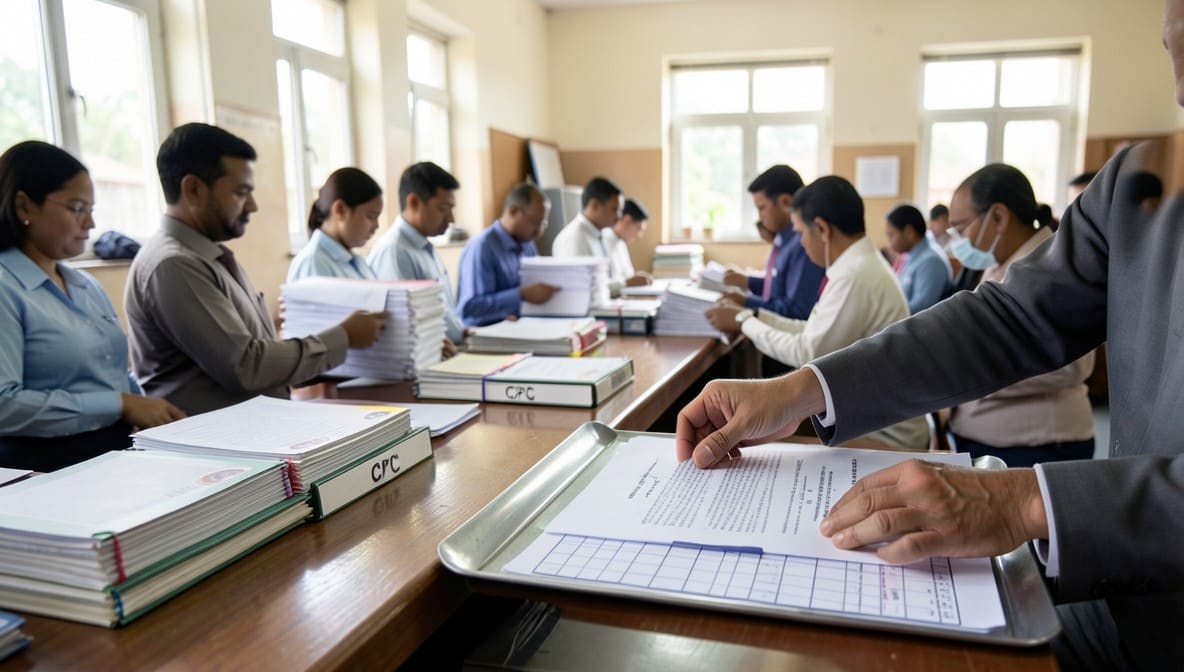
The Andhra Pradesh High Court has laid down a critical procedural safeguard against indefinite delays in the numbering of execution applications, reinforcing the principle that access to justice cannot be stymied by ministerial inaction. This judgment establishes a clear, enforceable timeline for subordinate courts to ensure litigants are not left without remedy due to bureaucratic inertia.
Background & Facts
The Dispute
The present Civil Revision Petition was filed by Chinta Prasuna, the petitioner, who had purchased a property through a registered sale deed dated 14.11.2017 (Document No. 1755 of 2017) from Kothapalli Gangaraju, one of the judgment debtors in Execution Petition No. 15 of 2023, filed under O.S. No. 73 of 2017. The decree holders in that execution proceeding sought to sell the entire property to recover Rs. 85,10,163/-, including interest and costs. The petitioner, however, claimed to be the absolute owner of the property and sought to exclude her portion from the sale proceedings under Order XXI Rule 58 of the Code of Civil Procedure.
Key Facts
- The petitioner purchased the property on 14.11.2017 via a registered sale deed after obtaining an Encumbrance Certificate confirming no encumbrances.
- The property was originally inherited by Sri Bhogi Viswanadham and subsequently sold to Kothapalli Gangaraju via registered sale deed dated 29.01.2011 (Document No. 161 of 2011).
- The petitioner has been in peaceful, uninterrupted possession since 14.11.2017.
- Her name has been duly mutated in all revenue records, and she holds the Pattadar Pass Book and Adangals in her name.
- The property was converted to commercial land via Application No. NLCR011800012112.
- The petitioner filed an Execution Application on 03.02.2023 before the IV Additional District Judge, Srikakulam, seeking declaration of her rights and exclusion of her portion from auction.
Procedural History
- 03.02.2023: Execution Application filed under Order XXI Rule 58 CPC.
- 10.11.2025: Execution Application returned by the Office of the IV Additional District Judge with queries.
- 08.12.2025: Returned again with additional objections.
- 28.01.2026: Returned for the third time, with seven days granted to cure defects.
- 09.04.2026: Civil Revision Petition filed before the High Court.
- 10.04.2026: Judgment pronounced.
The Parties' Positions
Petitioner: Argued that the repeated returns of her Execution Application without judicial intervention violated her right to effective remedy under Article 21 of the Constitution. She contended that the ongoing auction proceedings would cause irreparable harm, as she had acquired the property in good faith and was in lawful possession.
Respondents: No counsel appeared for the respondents.
Relief Sought
The petitioner sought directions to the IV Additional District Judge to number her Execution Application, suspend auction proceedings pending adjudication, and ensure a judicial hearing on the maintainability of her claim under Order XXI Rule 58 CPC.
The Legal Issue
The central question was whether the subordinate court’s office may indefinitely delay the numbering of an Execution Application under Order XXI Rule 58 CPC by returning it multiple times without referring it to the presiding judge for a judicial determination.
Arguments Presented
For the Petitioner
The learned counsel, Sri T. Diwakar Reddy, relied on the Andhra Pradesh State Judicial Academy’s Guide for Ministerial Officers, which mandates that plaints or applications may be returned only thrice. He argued that continued non-numbering without judicial oversight effectively denies access to justice and violates the principles of natural justice and Article 21. He emphasized that the petitioner’s claim was prima facie valid, supported by documentary evidence, and that the auction of the property would render her remedy infructuous.
For the Respondent
No arguments were presented by the respondents.
The Court's Analysis
The Court observed that while ministerial officers are entitled to raise procedural objections to ensure compliance with court rules, indefinite delays at the numbering stage are impermissible. The Court cited its own earlier order in C.R.P. No. 448 of 2025 dated 05.06.2025, which had laid down binding guidelines for subordinate courts. The Court emphasized that the Guide for Ministerial Officers is not merely advisory but a mandatory procedural framework.
"The claim of the citizen, maintainable or otherwise, shall be decided, lest the cause might become infructuous due to the ongoing Proceedings, and the Applicant, who had approached the Court, might be left high and dry without a legal remedy."
The Court held that once an application is returned thrice, the only lawful course is to list it before the presiding judge for a judicial hearing. The ministerial office lacks the authority to indefinitely withhold numbering or adjudication. The Court further noted that the petitioner’s claim, supported by a registered sale deed, revenue records, and possession, warranted immediate judicial scrutiny to prevent irreparable loss.
The Court rejected the notion that procedural irregularities justify prolonged inaction. It underscored that the purpose of the numbering process is to facilitate adjudication, not to obstruct it. The repeated returns without judicial intervention amounted to a denial of remedy, contrary to the spirit of the CPC and constitutional guarantees.
The Verdict
The Civil Revision Petition was disposed of with the following directions: (i) The Execution Application filed by the petitioner in E.P. No. 15 of 2023 must be listed before the IV Additional District Judge within one week from the date of uploading of this order; (ii) The presiding officer shall decide the maintainability of the Execution Application after hearing all parties on a day-to-day basis; (iii) All auction proceedings in the Execution Petition shall be suspended until the judicial order on the Execution Application is passed. No costs were awarded. The Court clarified that no opinion was expressed on the merits of the petitioner’s claim.
What This Means For Similar Cases
Judicial Oversight Is Mandatory After Three Returns
- Practitioners must immediately file a revision petition if an application is returned thrice without referral to the judge.
- The three-return limit under the Andhra Pradesh Judicial Academy Guidelines is binding, not discretionary.
- Delay in numbering cannot be justified on grounds of technical defects alone.
Suspension of Enforcement Pending Adjudication
- In cases involving third-party claims under Order XXI Rule 58 CPC, courts must suspend sale or auction proceedings once a valid application is filed and returned thrice.
- Irreparable injury to a bona fide purchaser is presumed once possession and documentation are established.
- Courts must treat such applications as urgent matters requiring day-to-day hearing.
Procedural Compliance Is Non-Negotiable
- All subordinate court offices must be trained on the Guidelines and their mandatory application.
- Registrar (Judicial) is now obligated to circulate this order to all judicial officers and ministerial staff.
- Failure to comply may attract contempt proceedings or departmental action.