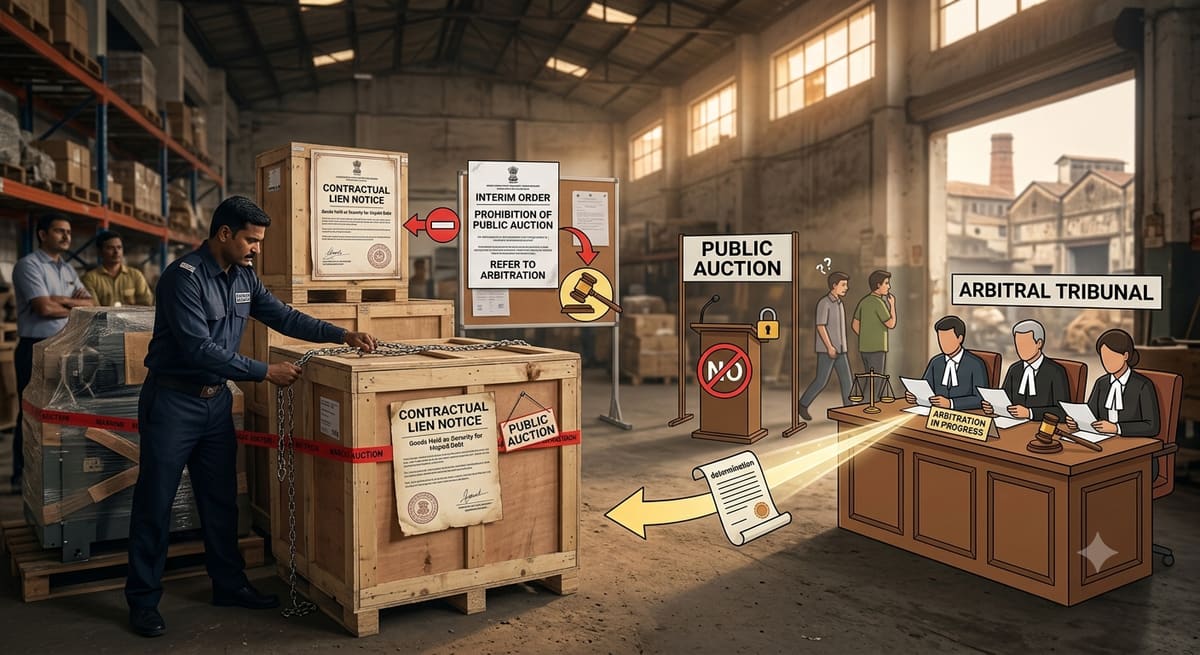
The Bombay High Court has reaffirmed that the discharge of a Court Receiver appointed under Section 9 of the Arbitration and Conciliation Act, 1996 cannot be granted merely because the original dispute has been adjudicated, if subsequent agreements have created new, unresolved obligations over the subject property. The Court emphasized that equitable custody must endure until the parties' post-arbitration rights are formally adjudicated.
Background & Facts
The Dispute
The dispute originates from a redevelopment arrangement involving land at C.T.S. No. 251, Malad (East), owned by Win Construction Pvt. Ltd. (Applicant). Four identical Development Agreements dated 29.05.1997 were executed between the Applicant and the partnership firm M/s Shah and Sejpal Developers (Firm), covering 16,500 sq. ft. of development rights at Rs. 1,741 per sq. ft.
Key Facts
- The Firm comprised partners Rajendra D. Shah and the Sejpals (Pratap K. Thakkar/Sejpal and Bhagwandas K. Thakkar/Sejpal)
- The Applicant was not a party to the partnership but held development rights under the Agreements
- Disputes arose between the Shahs and Sejpals over implementation of redevelopment, leading to arbitration
- On 11.04.2001, the Arbitrator directed maintenance of status quo
- The Sejpals filed Section 9 Petition No. 338 of 2001 on 20.06.2001, alleging breach of status quo
- On 03.07.2001, the Court appointed a Court Receiver to preserve the Subject Property (July 2001 Order)
- Contempt Petition No. 102 of 2001 followed, alleging unauthorized occupation by Rajendra
- On 02.11.2001, the Court ordered the Receiver to take physical possession of the entire property (November 2001 Order)
- Rajendra’s wife, a partner, passed away; her three daughters relinquished their shares and were discharged
- The Applicant filed Notice of Motion No. 2806 of 2001 seeking recall of the July 2001 Order
- On 02.12.2002, a Single Judge dismissed the motion, holding the Receiver’s custody should continue and benefit the Applicant as well
- On 20.04.2005, an Arbitral Award was passed in favor of Pratap, directing him to complete redevelopment within two years
- On 06.04.2009, the Applicant and the Firm entered into a Consent Award, resolving their own disputes
- Under the Consent Award, the Firm agreed to pay Rs. 80 lakhs to the Applicant: Rs. 13 lakhs paid upfront, Rs. 67 lakhs payable within 90 days of the Applicant obtaining Municipal approvals
- Interest at 15% per annum was payable on the unpaid balance
- The Consent Award explicitly stated that upon full payment, the Subject Property would be conveyed to the Firm/Pratap
- The Applicant failed to obtain approvals for the remaining 4,350 sq. ft. of FSI
- On 23.07.2012, the Applicant issued a Termination Notice
- On 04.09.2012, the Firm responded, asserting the Applicant’s non-compliance with the Consent Award
- On 19.02.2015, the Applicant issued a public notice of termination
- On 05.03.2015, Pratap responded, asserting the property remained custodia legis
- No legal action followed the Termination Notice
- On 07.05.2017, Pratap filed Chamber Summons No. 707 of 2017 seeking discharge of the Receiver - never pursued
- On 09.10.2023, Pratap’s Execution Application No. 2837 of 2021 was rejected by the Prothonotary & Senior Master
- On 14.06.2024, the Applicant filed the present Interim Application (IAL 14635 of 2024) seeking discharge of the Court Receiver and possession of the Subject Property
Procedural History
- 29.05.1997: Four Development Agreements executed between Win Construction and M/s Shah and Sejpal Developers
- 11.04.2001: Arbitrator directs status quo in intra-partnership dispute
- 20.06.2001: Section 9 Petition filed by Sejpals
- 03.07.2001: Court Receiver appointed (July 2001 Order)
- 02.11.2001: Court Receiver ordered to take physical possession (November 2001 Order)
- 02.12.2002: Single Judge dismisses IA 2806; confirms Receiver’s custody continues and benefits Applicant
- 20.04.2005: Arbitral Award in favor of Pratap; directs redevelopment within two years
- 06.04.2009: Consent Award between Applicant and Firm executed
- 23.07.2012: Termination Notice issued by Applicant
- 04.09.2012: Firm responds, alleging Applicant’s default under Consent Award
- 19.02.2015: Public notice of termination issued by Applicant
- 05.03.2015: Pratap responds, asserting Court Receiver’s custody remains valid
- 07.05.2017: Chamber Summons filed by Pratap seeking discharge of Receiver - not pursued
- 09.10.2023: Execution Application rejected by Prothonotary & Senior Master
- 14.06.2024: Present Interim Application filed seeking discharge of Court Receiver and possession
- 22.06.2026: Judgment delivered by Justice Somasekhar Sundaresan
The Parties' Positions
The Applicant contends that the original purpose of the Court Receiver - preserving the subject matter of the arbitration between the Shahs and Sejpals - has lapsed since the 2005 Arbitral Award remains unexecuted for over 12 years, attracting limitation under Article 136 of the Limitation Act. It argues that the Consent Award, which it claims was breached by Pratap, entitles it to possession.
The Respondents (Pratap and the Firm) argue that the Applicant failed to perform its obligations under the Consent Award, particularly obtaining Municipal approvals. They assert that the Receiver’s custody remains necessary to preserve the status quo pending adjudication of the Consent Award’s breach, and that discharge would prejudice their rights under the conveyance mechanism agreed upon.
Relief Sought
The Applicant seeks:
- Discharge of the Court Receiver appointed under the July 2001 and November 2001 Orders
- Restraint on the Shahs and Sejpals from interfering with the Applicant’s possession of the Subject Property
- Declaration that the Applicant is entitled to possession of the land
The Legal Issue
Can a Court Receiver appointed under Section 9 of the Arbitration and Conciliation Act, 1996 be discharged when the original arbitration has concluded, but a subsequent Consent Award has created new, unadjudicated obligations over the same property?
Arguments Presented
For the Appellant/Petitioner
The Applicant argued that the original purpose of the Court Receiver - preserving the subject matter of the intra-partnership dispute - ceased to exist after the 2005 Arbitral Award, which was never executed. It relied on the doctrine of laches and limitation under Article 136 of the Limitation Act, 1963, to contend that the Receiver’s continued custody is unjustified. It further contended that the Consent Award, which it claims was breached by Pratap, should entitle it to possession, and that the Receiver’s presence impedes its ability to assert its rights.
For the Respondent/State
The Respondents countered that the Consent Award of 2009 created a new, binding framework for the transfer of the Subject Property, contingent on the Applicant obtaining Municipal approvals. They emphasized that the Applicant has not fulfilled its obligations under Clause 2 and Clause 11 of the Consent Award, and that discharge of the Receiver would disrupt the equitable balance struck in the Consent Award. They cited the December 2002 Order, which explicitly extended the benefit of the Receiver’s custody to the Applicant, and argued that the Receiver’s role remains necessary to preserve the status quo pending adjudication of breach.
The Court's Analysis
The Court undertook a detailed examination of the Consent Award dated 08.04.2009, which it found to be a comprehensive, counter-balanced commercial arrangement. The Court noted that the Consent Award was not merely a settlement of disputes but a mechanism for conveyance: the Applicant was to obtain Municipal approvals for 15,650 sq. ft. of FSI, and only upon such compliance would the Firm be obligated to pay the balance of Rs. 67 lakhs, after which the property would be conveyed to the Firm/Pratap.
"The parties had consciously struck a fine bargain balancing against each other which has led to the current logjam. Whether the obligations have been met, and who is at fault, are all facets of a new cause of action that would need to be adjudicated."
The Court emphasized that the Applicant’s failure to obtain approvals for the remaining 4,350 sq. ft. of FSI constituted a material default under Clause 2 and Clause 11. The Firm’s response to the Termination Notice of 2012 explicitly blamed the Applicant for non-performance, confirming the existence of a live dispute.
The Court further held that the December 2002 Order, which denied discharge of the Receiver and extended its benefit to the Applicant, established a continuing equitable obligation. Discharge of the Receiver would not automatically vest possession in the Applicant, as the property was never in the Applicant’s possession after 2001 - it was taken from the Firm. The Consent Award itself recognized Pratap’s possession and control.
"Discharging the Court Receiver would not lead to the Applicant getting possession. What the Applicant seeks is that the Firm and Pratap be prevented from interfering with the Applicant's purported possession but the Subject Property is custodia legis and actually in the possession of the Court Receiver."
The Court concluded that the Applicant’s remedy lies in initiating appropriate proceedings - either arbitration or civil suit - to enforce or challenge the Consent Award. The Court Receiver’s custody, originally appointed under Section 9, continues to serve an equitable function by preserving the property pending resolution of the new dispute. Granting the relief sought would amount to the Court adjudicating merits of a new cause of action without a trial - an impermissible overreach.
The Verdict
The Interim Application was dismissed. The Court held that the Court Receiver appointed under the July 2001 and November 2001 Orders shall continue to hold custody of the Subject Property. No direction for possession to the Applicant was granted. The parties are at liberty to initiate substantive proceedings to adjudicate their rights under the Consent Award. The Receiver’s custody shall remain in force until such proceedings conclude.
What This Means For Similar Cases
Equitable Custody Survives Post-Award Settlements
- Practitioners must recognize that a Court Receiver appointed under Section 9 does not automatically cease upon an arbitral award if a subsequent settlement (e.g., Consent Award) creates new obligations over the property
- The Receiver’s custody is not tied solely to the original dispute but to the ongoing equitable need to preserve the subject matter
- Any application for discharge must address whether the new obligations under a Consent Award have been fulfilled
Consent Awards Create New Legal Frameworks
- A Consent Award is not merely a settlement - it is a binding instrument that may alter ownership rights and possession dynamics
- Courts will treat Consent Awards as conveyance mechanisms, especially when they contain conditions precedent (e.g., approvals, payments)
- Failure to perform conditions under a Consent Award bars claims for possession, even if the original arbitration is dormant
Limitation Does Not Automatically Discharge Equitable Remedies
- The doctrine of limitation under Article 136 applies to execution of awards, not to the continued existence of equitable receiverships
- A Receiver’s custody may persist beyond limitation periods if the property remains subject to unresolved contractual obligations
- Parties cannot use delay as a sword to bypass adjudication of new disputes