The Bombay High Court has reaffirmed the limited scope of interim relief under Section 9 of the Arbitration and Conciliation Act, 1996, holding that courts cannot grant final remedies - such as authorization to sell goods - before the arbitral tribunal has adjudicated the merits. This decision reinforces the principle that interim measures must preserve the status quo, not pre-empt the arbitral process.
Background & Facts
The Dispute
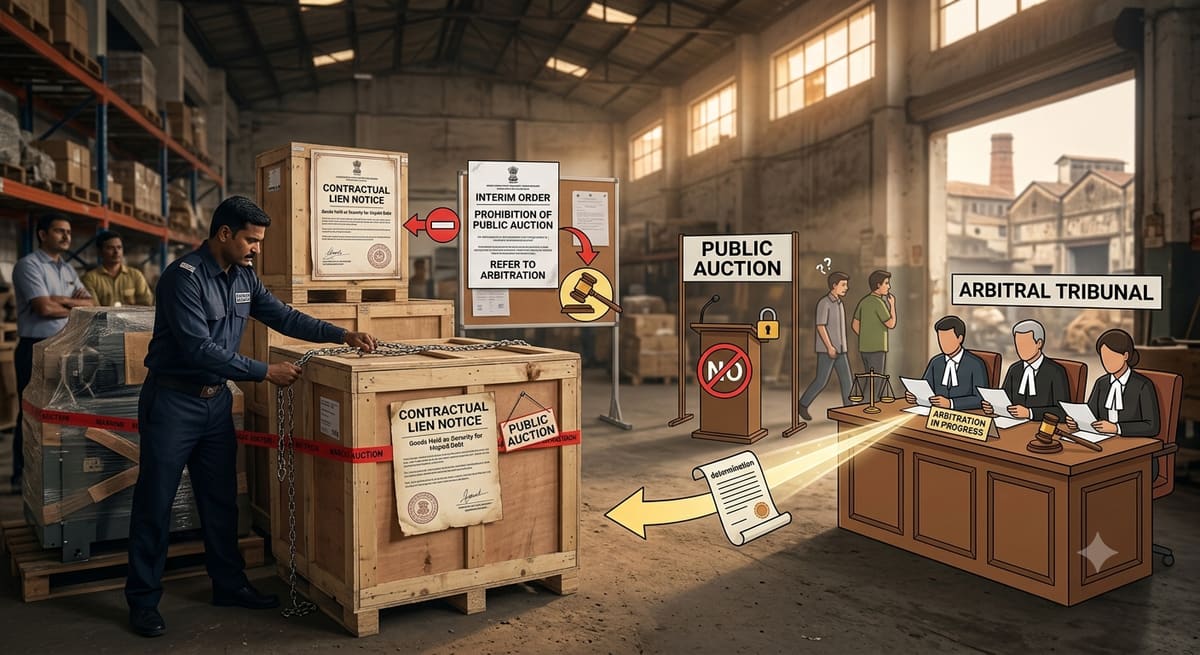
The petitioner, Dp World Express Logistics Private Limited, is a logistics service provider that entered into a contract with the respondent, VVP Business Logistics Private Ltd., for the handling and transportation of goods. Clause 4.2.5(b) of the agreement granted the petitioner a contractual right of lien over goods in its possession in the event of the respondent’s default in payment or performance. The petitioner alleges that the respondent failed to make payments due under the agreement, thereby triggering its right to retain the goods.
Key Facts
The goods subject to the lien are listed in the Schedule annexed to the petition, comprising multiple consignments of cargo held at the petitioner’s warehouse
The petitioner claims outstanding dues exceeding Rs. 1.2 crore
The petitioner invoked its lien under Clause 4.2.5(b) on or about 15 November 2025
The petitioner filed the present arbitration petition under Section 9 on 12 January 2026
The petitioner sought two reliefs: (a) permission to retain the goods under the lien, and (b) permission to conduct a public auction and appropriate the proceeds
Procedural History
12 January 2026: Arbitration Petition No. 641 of 2025 filed before the Bombay High Court
5 December 2025: Court granted ad interim relief permitting the petitioner to exercise its lien under Clause 4.2.5(b) of the agreement
1 July 2026: Petitioner pressed for further relief under prayer clause (b) - authorization to auction goods
No appearance or response filed by the respondent despite service of notice
No evidence of counter-claim, dispute over ownership, or third-party interest on record
Relief Sought
The petitioner sought:
Continuation of the lien over the goods
Permission to conduct a public auction of the goods and appropriate the sale proceeds to recover its dues
Protection of its financial interest pending conclusion of arbitration
The Legal Issue
Can a court, under Section 9 of the Arbitration and Conciliation Act, 1996, grant interim relief that effectively determines the final rights of the parties - such as authorizing the sale and appropriation of goods - before the arbitral tribunal has adjudicated the dispute?
Arguments Presented
For the Petitioner
The petitioner argued that its contractual right of lien under Clause 4.2.5(b) is a proprietary right that must be preserved to prevent irreparable loss. It contended that the respondent’s prolonged default and absence from proceedings justify the auction of goods to recover dues. It relied on the principle that interim relief must be effective and practical, and that delay in constituting the tribunal necessitates stronger protective measures.
For the Respondent
The respondent did not appear or file any written submission. No counter-arguments were presented on record.
The Court's Analysis
The Court emphasized that Section 9 is designed to preserve the subject matter of the dispute until the arbitral tribunal renders its award. It observed that the power under Section 9 is ancillary and provisional, not adjudicatory. The Court noted that permitting the petitioner to auction the goods and appropriate the proceeds would amount to a final determination of its claim, effectively deciding the very issue the tribunal is meant to resolve.
"If the petitioner is permitted to sell the goods by way of a public auction and thereafter appropriate the sale proceeds, the goods would no longer remain available and the rights of the parties in relation to those goods may stand finally affected. Such a course would practically grant to the petitioner the main relief which it seeks even before the arbitral proceedings are concluded."
The Court rejected the argument that the respondent’s non-appearance justifies granting final relief. It held that absence cannot be equated with consent or waiver of substantive rights. The Court further clarified that while courts may, in rare and exceptional cases, grant relief that borders on finality, no such exceptional circumstances were demonstrated here. The petitioner’s financial interest, while legitimate, does not override the statutory framework that reserves final adjudication for the arbitral tribunal.
The Verdict
The Court upheld the ad interim order dated 5 December 2025 permitting the petitioner to retain the goods under its contractual lien. However, it denied permission to conduct a public auction or appropriate sale proceeds. The interim protection shall continue during the pendency of arbitration, subject to the petitioner constituting the arbitral tribunal within 90 days from 1 July 2026. Failure to do so shall entitle the respondent to apply for vacation of the order. No monetary relief, auction, or appropriation of proceeds is authorized at this stage.
What This Means For Similar Cases
Interim Relief Must Preserve, Not Pre-empt
Practitioners must not seek auction, sale, or appropriation of assets under Section 9 unless the case falls into the narrow category of exceptional circumstances
Courts will not permit Section 9 to function as a summary enforcement mechanism
Any request for disposal of subject matter must be reserved for the arbitral tribunal
Absence of Respondent Does Not Justify Final Orders
Non-appearance or default by the respondent cannot be treated as acquiescence to final relief
Courts must still evaluate whether the relief sought is truly interim or de facto final
The burden remains on the petitioner to demonstrate why preservation alone is insufficient
Procedural Compliance Is Non-Negotiable
Section 9(2) imposes a mandatory obligation to constitute the arbitral tribunal within 90 days
Failure to comply opens the door for the respondent to seek vacation of the interim order
Courts will enforce this timeline strictly to prevent abuse of interim remedies