
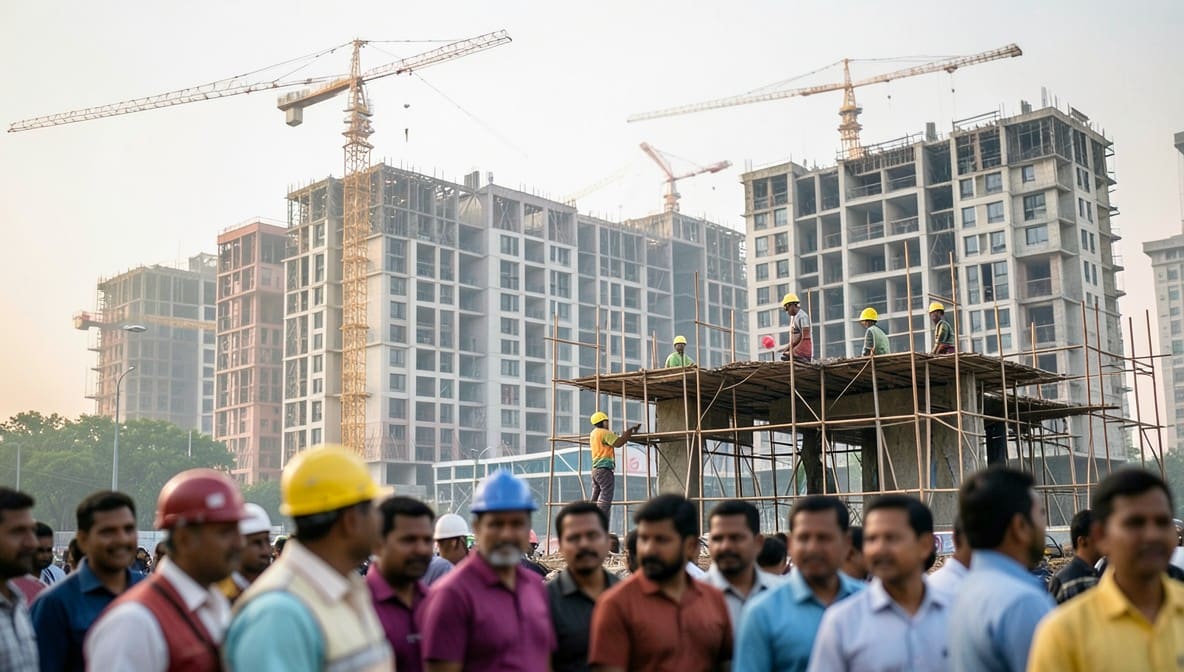
The Supreme Court has clarified that when subsidiary companies are functionally indistinguishable from the corporate debtor and serve only as conduits for its operations, the corporate veil may be pierced to protect homebuyers and ensure the viability of stalled real estate projects under the Insolvency and Bankruptcy Code. This landmark ruling resolves a critical conflict between statutory corporate separateness and the public interest imperative of completing housing projects.
Background & Facts
The Dispute
The dispute arose from the Corporate Insolvency Resolution Process (CIRP) initiated against Earth Infrastructures Limited (EIL), a real estate developer, by financial creditor Deepak Khanna under Section 7 of the Insolvency and Bankruptcy Code, 2016. EIL had developed three major residential and commercial projects - Earth Towne, Earth TechOne, and Earth Sapphire Court - on land leased by Greater Noida Industrial Development Authority (GNIDA) to three wholly owned or controlled subsidiaries: Earth Towne Infrastructures Private Limited (ETIPL), Neo Multimedia Limited, and Nishtha Software Private Limited. The CIRP led to the approval of two resolution plans: one by Roma Unicon Designex Consortium for Earth Towne and another by Alpha Corp Development Private Limited for Earth TechOne, Earth Sapphire Court, and a separate freehold project, Earth Copia, in Gurugram.
Key Facts
- GNIDA allotted three plots of land to EIL’s subsidiaries under lease deeds dated 01.09.2010 (ETIPL), 04.02.2008 (Neo Multimedia), and 01.09.2009 (Nishtha Software).
- The lease deeds required the lessees to complete construction within seven years and mandated GNIDA’s prior approval for any transfer of leasehold rights.
- ETIPL was incorporated on 21.07.2010 as a Special Purpose Company (SPC) under GNIDA’s Scheme Code BRS-01/2010-(I), with EIL holding 78% (later increased to 98%) and acting as the lead member.
- EIL paid over ₹51.88 crores of the ₹74.27 crore lease premium on behalf of ETIPL, despite ETIPL’s paid-up capital being only ₹1 lakh.
- Construction on all three projects stalled by 2016, with only partial completion of towers and foundations.
- Homebuyers and office space buyers collectively paid over ₹438 crore to EIL and its subsidiaries.
- The CIRP was initiated on 06.06.2018, with public announcement on 12.06.2018.
- GNIDA received notice of the CIRP from the Interim Resolution Professional (IRP) on 19.12.2018 and from the Resolution Professional (RP) on 28.05.2019 but failed to file any claims.
- GNIDA first submitted a claim for ₹148.37 crores on 18.09.2019 - after Roma’s plan was approved by the CoC on 26.08.2019 - and filed a belated claim for Neo Multimedia on 11.11.2021, addressed to the IRP who had been replaced in March 2019.
- GNIDA never filed a claim for Nishtha Software Private Limited.
- GNIDA issued sporadic default notices between 2012 and 2020, with most notices issued after the CIRP commenced.
- Earth Copia, developed on freehold land in Gurugram, had no connection to GNIDA or its leasehold rights.
- On 16.06.2023, GNIDA unilaterally cancelled the leases of Neo Multimedia and Nishtha Software, a move later withdrawn on 19.08.2025 after court intervention.
- As of 31.08.2025, GNIDA claimed total dues of ₹359.20 crores, of which ₹73.80 crores were penal interest, penalties, and time-extension charges.
Procedural History
- 06.06.2018: CIRP initiated against EIL under Section 7 of the Code.
- 12.06.2018: Public announcement of CIRP by NCLT.
- 19.12.2018: IRP notified GNIDA of CIRP.
- 18.03.2019: Akash Singhal appointed as RP.
- 28.05.2019: RP wrote to GNIDA seeking dues for all three projects.
- 26.08.2019: CoC approved Roma’s resolution plan for Earth Towne.
- 18.09.2019: GNIDA first claimed dues of ₹148.37 crores from RP.
- 11.11.2019: CoC approved Alpha’s resolution plan for Earth TechOne, Earth Sapphire, and Earth Copia.
- 05.04.2021: NCLT approved Roma’s plan.
- 08.06.2021: NCLT approved Alpha’s plan.
- 07.12.2021: NCLT directed GNIDA to transfer leasehold rights to Roma.
- 30.01.2023: NCLAT set aside all three NCLT orders, held GNIDA not bound, and directed waiver of penal interest.
- 04.05.2023: Appeals filed before Supreme Court.
- 13.04.2023: Supreme Court ordered status quo.
- 16.06.2023: GNIDA cancelled leases of Neo Multimedia and Nishtha Software.
- 19.08.2025: GNIDA withdrew cancellation order.
- 05.05.2026: Supreme Court judgment delivered.
The Parties' Positions
For the Appellants (Alpha, Roma, Homebuyer Associations)
- Argued that EIL was the de facto developer of all three projects, with subsidiaries acting as legal fronts.
- Contended that GNIDA was fully aware of EIL’s role, evidenced by its own letter to police authorities and acceptance of building plans certified by EIL.
- Asserted that GNIDA’s failure to file timely claims barred it from challenging approved resolution plans.
- Highlighted that Alpha’s plan included Earth Copia, which had no connection to GNIDA, and that the plan was severable.
- Cited Section 25A(3A) of the Code to affirm that majority homebuyer votes bind dissenting individuals.
- Emphasized that the NCLAT’s order jeopardized over 4,000 homebuyers’ rights.
For the Respondent (GNIDA)
- Claimed that subsidiaries were separate legal entities and their leasehold assets could not be treated as EIL’s assets under Section 18 of the Code.
- Argued that transfer of leasehold rights required its prior consent under lease deeds.
- Contended that the RP failed to notify it of CIRP proceedings and that its claims were belated.
- Demanded full payment of penal interest, time-extension penalties, and lease rent.
- Asserted that the NCLAT erred in waiving penal charges and that its lease terms were sacrosanct.
- Sought to prevent any transfer of leasehold rights without its approval.
Relief Sought
- Alpha and Roma sought restoration of NCLT’s orders approving their resolution plans.
- Homebuyer associations sought completion of stalled projects without burdening buyers with GNIDA’s dues.
- GNIDA sought to nullify the resolution plans, retain penal interest, and prevent transfer of leasehold rights.
- Earth Copia Owners Society sought exclusion of Earth Copia from the NCLAT’s order, as it involved freehold land unrelated to GNIDA.
The Legal Issue
The central question was whether the corporate veil can be pierced to treat the assets of wholly owned subsidiaries as assets of the corporate debtor in a CIRP, where the subsidiaries are mere conduits for the parent company’s operations, and whether a public authority like GNIDA can claim penal interest after prolonged inaction and failure to monitor project development.
Arguments Presented
For the Appellant/Petitioner
The appellants relied on ArcelorMittal India Private Limited v. Satish Kumar Gupta and Life Insurance Corporation of India v. Escorts Ltd. to argue that when associated companies are inextricably connected and operate as a single economic unit, the corporate veil must be lifted. They emphasized that EIL funded the subsidiaries, controlled their boards, paid lease premiums, and executed all development activities. GNIDA’s own correspondence acknowledged EIL as the developer. The resolution plans did not seek transfer of land title but only development rights, and the homebuyers’ majority vote under Section 25A(3A) validated the plans. The belated claims by GNIDA were barred under RPS Infrastructure Limited v. Mukul Kumar. The waiver of penal interest was justified by GNIDA’s gross negligence.
For the Respondent/State
GNIDA contended that Section 2(87) of the Companies Act, 2013, and BRS Ventures Investments Limited v. SREI Infrastructure Finance Limited established the sanctity of separate legal personality. It argued that Section 18 of the Code explicitly excludes subsidiary assets from the corporate debtor’s estate. The lease deeds were contractual instruments binding on all parties, and GNIDA’s consent was mandatory for any transfer. It claimed that its notices constituted due diligence and that the NCLAT erred in waiving penal interest. GNIDA also argued that the resolution plans were invalid for failing to secure its consent and that the Supreme Court lacked jurisdiction to override lease terms.
The Court's Analysis
The Supreme Court undertook a rigorous analysis of corporate structure, statutory intent under the Code, and the public interest imperative of protecting homebuyers. It began by acknowledging the general principle that holding companies and subsidiaries are distinct legal entities, as affirmed in Vodafone International Holdings BV v. Union of India and Jaypee Kensington Boulevard Apartments Welfare Association v. NBCC. However, the Court emphasized that this principle is not absolute and must yield when the corporate structure is used to evade obligations or conceal control.
"The question that arises is whether this was a fit case to lift the corporate veil... Given the facts obtaining presently, we are of the firm view that this was an eminently fit case for lifting the corporate veil, as EIL was the main driving force in the development of the projects and in payment of GNIDA’s dues. The subsidiary companies were only a front."
The Court found that ETIPL, Neo Multimedia, and Nishtha Software had no independent business, no separate management, and no financial autonomy. All three were wholly owned by EIL, shared common directors, and were used solely to hold land for EIL’s development projects. GNIDA’s own records, including its letter to police authorities and acceptance of building plans certified by EIL, confirmed its awareness that EIL was the real developer. The Court held that the subsidiaries were not independent entities but instruments of EIL’s operations.
The Court further rejected GNIDA’s claim to penal interest, noting its gross inaction over years. Notices were issued only intermittently, with long gaps between them, and most were sent after the CIRP commenced. GNIDA failed to monitor development, ignored repeated complaints from homebuyers, and did not initiate recovery proceedings despite clear defaults. The Court invoked the public trust doctrine from Noida Entrepreneurs Association v. Noida, holding that public authorities must act diligently when entrusted with land for public housing.
"GNIDA contributed greatly to the present imbroglio by its persistent inaction and ineptitude all through... Having executed lease deeds for development of the lands, it failed to keep track of and monitor the development being undertaken on such lands to ensure timely completion thereof within the stipulated period of seven years."
The Court also clarified that Earth Copia, developed on freehold land in Gurugram, was entirely unrelated to GNIDA and had no connection to the leasehold disputes. The NCLAT’s order setting aside Alpha’s entire resolution plan was therefore erroneous. The resolution plan was severable, and the approval of the Earth Copia component stood unaffected.
The Court further held that the homebuyers’ majority vote under Section 25A(3A) was binding, and dissenting individuals could not override the collective decision of their class. The intervenor Earth Buyers Association for Justice, having failed to challenge the NCLT’s order in a timely manner, had no locus to intervene.
The Verdict
The Supreme Court allowed the appeals filed by Alpha, Roma, and homebuyer associations. It set aside the NCLAT’s judgment dated 30.01.2023 insofar as it affected the resolution plans for Earth Towne, Earth TechOne, and Earth Sapphire Court. The NCLT’s orders approving the resolution plans dated 05.04.2021 and 08.06.2021 were restored. GNIDA’s claims for penal interest, time-extension penalties, and punitive charges were wholly waived. GNIDA was directed to recalculate its principal dues - ₹250.75 crores for ETIPL, ₹17.57 crores for Nishtha Software, and ₹31.83 crores for Neo Multimedia - within two weeks of the judgment. Alpha and Roma were required to pay these dues in 24 equated monthly instalments, commencing on 07.07.2026, without burdening homebuyers. No interest was to be charged on the principal during this period. Registration of units in favour of buyers was to be completed only after full payment to GNIDA and its active participation. The Earth Copia component of Alpha’s plan was fully upheld. Civil Appeals filed by GNIDA were dismissed. The CIRP period was extended to ensure compliance.
What This Means For Similar Cases
Corporate Veil Can Be Lifted in Real Estate CIRPs
- Practitioners must now argue that where a holding company controls a subsidiary’s finances, management, and operations, and the subsidiary holds no independent assets or business, the subsidiary is an alter ego.
- Evidence of common directors, funding flows, and operational control will be decisive.
- Public authorities cannot claim ignorance of the parent company’s role if they have accepted documents certified by it.
Penal Interest Is Not Automatic Against Inactive Authorities
- Public authorities that fail to monitor development, ignore buyer complaints, and delay filing claims forfeit the right to penal interest.
- Courts will apply the public trust doctrine to hold authorities accountable for inaction.
- Dues must be recalculated excluding penalties if the authority’s negligence contributed to default.
Resolution Plans Must Be Severable for Unrelated Projects
- If a resolution plan includes both affected and unaffected projects, courts will uphold the unaffected portions.
- Parties must clearly delineate which assets are subject to the dispute.
- A single CIRP can cover multiple projects, but relief must be tailored to the scope of the dispute.
Homebuyer Majority Votes Are Binding
- Section 25A(3A) of the Code gives legal force to majority decisions of homebuyer classes.
- Individual dissenters cannot challenge approved plans after the fact.
- Associations representing homebuyers must be treated as legitimate parties in CIRP proceedings.
Procedural Compliance Is Non-Negotiable
- Creditors must file claims with the RP within the stipulated timeline.
- Claims addressed to the IRP after the RP’s appointment are invalid.
- Failure to participate in CIRP proceedings bars later challenges to approved resolution plans.





