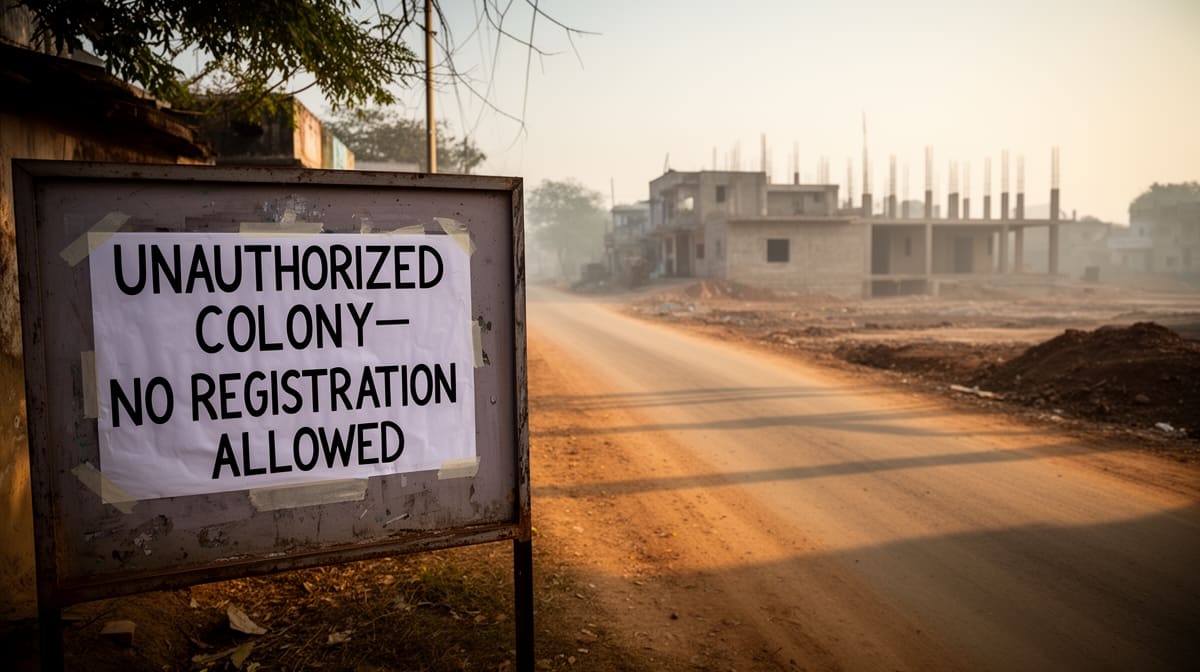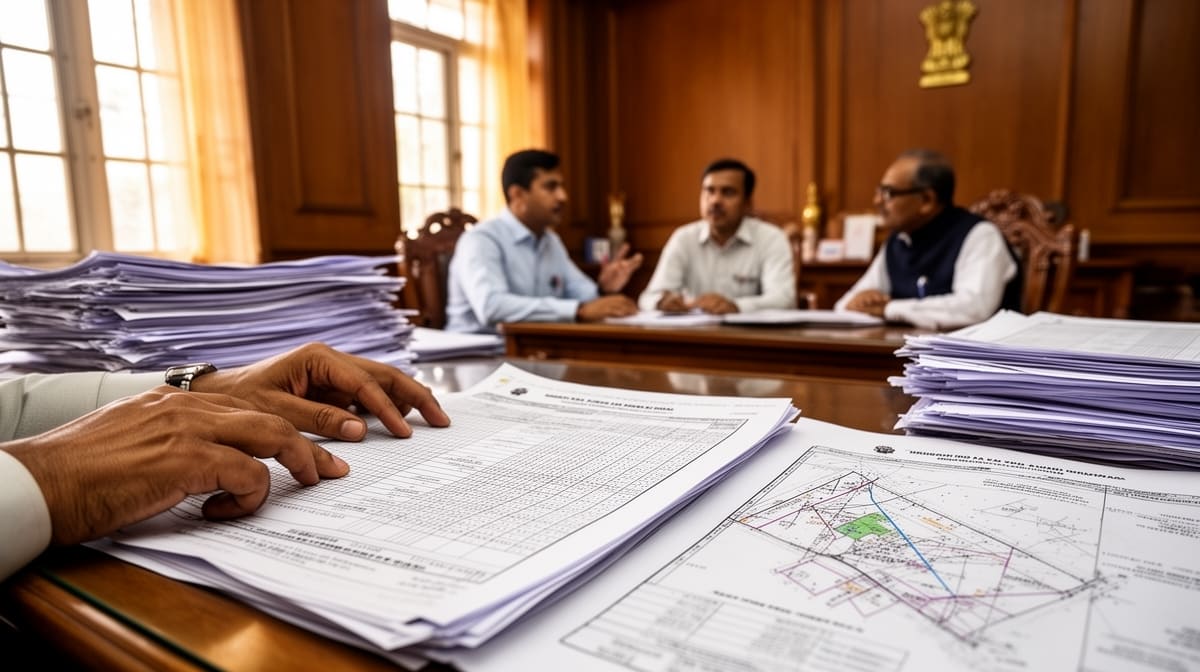
In a significant interim order, the Madhya Pradesh High Court has clarified that administrative authorities lack the power to impose penalties for unauthorised colonisation under the Colony Development Rules, 2021 and Section 339-C of the M.P. Municipalities Act, 1961. The Court stayed the operation of impugned orders, reinforcing that only courts can adjudicate and penalise such offences, not collectors or revenue officers.
Background & Facts
The Dispute
The petitioner, Jitendra Chore, challenged orders passed by the respondent No.2 (Collector) and respondent No.4 (Sub Divisional Officer, Revenue) under the Colony Development Rules, 2021. The impugned orders sought to penalise the petitioner for alleged unauthorised colonisation, including potential criminal action under Rule 22(4) of the Colony Development Rules, 2021 and Section 339-C(3) of the M.P. Municipalities Act, 1961.
Key Facts
-
The petitioner was allegedly involved in unauthorised colonisation, triggering action under Rule 22(4) of the Colony Development Rules, 2021, which mandates:
"(4) In case, the development/construction is not removed in the unauthorised colony within the period specified in sub-rule (3) hereinabove, the competent authority shall take action for removal of the development/construction and also file complaint against the developer and landowner in the concerned police station for taking necessary penal action under the relevant provisions of the Act."
-
The respondents relied on Section 339-C(3) of the M.P. Municipalities Act, 1961, which prescribes:
"(3) Whoever commits or abets the commission of an offence of illegal diversion or illegal colonization shall be punished with an imprisonment of not less than three years and not more than seven years and with a minimum fine of ten thousand rupees, and the Court may, in passing the judgment in respect of any such offence, order the accused to pay to the Council, such amount of compensation as specified in the judgment, taking into consideration the amount required to be incurred towards the development of such illegal colony, and such offence shall be a cognizable offence."
-
The petitioner contended that the Collector and SDO (Revenue) are not competent authorities to impose penalties or initiate criminal action under the aforementioned provisions. Only a court of law possesses such jurisdiction.
Procedural History
- 10.06.2026: The present writ petition (WP No. 19074 of 2026) was filed before the Madhya Pradesh High Court, Jabalpur.
- 10.06.2026: The Court issued notice to the respondents on payment of process fee within seven working days, failing which the petition would stand dismissed.
- 10.06.2026: The Court heard arguments on interim relief and stayed the operation of the impugned orders.
The Court also directed that this petition be listed along with several analogous matters for hearing:
- WP No. 49713/2025
- WP No. 44588/2025
- WP No. 42570/2025
- WP No. 49172/2025
- WP No. 1029/2026
- WP No. 820/2026
- WP No. 817/2026
- WP No. 4525/2026
- WP No. 5868/2026
Relief Sought
The petitioner sought interim relief in the form of a stay on the impugned orders, arguing that the Collector and SDO (Revenue) lacked jurisdiction to impose penalties or initiate criminal proceedings under the Colony Development Rules, 2021 and Section 339-C of the M.P. Municipalities Act, 1961.
The Legal Issue
The central question before the Court was: Whether administrative authorities, such as the Collector or Sub Divisional Officer (Revenue), possess the power to impose penalties or initiate criminal action for unauthorised colonisation under the Colony Development Rules, 2021 and Section 339-C of the M.P. Municipalities Act, 1961, or whether such powers are exclusively vested in courts of law?
Arguments Presented
For the Petitioner
- The petitioner relied on Rule 22(4) of the Colony Development Rules, 2021 and Section 339-C(3) of the M.P. Municipalities Act, 1961, arguing that these provisions exclusively vest penal powers in courts, not administrative authorities.
- Cited a precedent from WP No. 49713/2025, wherein the High Court had granted similar interim relief under analogous circumstances.
- Contended that the impugned orders were without jurisdiction, as the Collector and SDO (Revenue) are not competent authorities to impose penalties or initiate criminal action.
For the Respondents
- The State counsel did not dispute the petitioner’s contention that the Collector and SDO (Revenue) lacked jurisdiction to impose penalties or initiate criminal proceedings.
The Court's Analysis
The Court observed that the Colony Development Rules, 2021 and Section 339-C of the M.P. Municipalities Act, 1961 do not explicitly empower administrative authorities (such as the Collector or SDO) to impose penalties or initiate criminal action for unauthorised colonisation. Instead, these provisions contemplate judicial adjudication by courts of law.
The Court noted that Rule 22(4) of the Colony Development Rules, 2021 directs the competent authority to file a complaint with the police, implying that further action must be judicial. Similarly, Section 339-C(3) of the M.P. Municipalities Act, 1961 prescribes punishment and fines to be imposed by courts, not administrative bodies.
"The impugned orders appear to have been passed by authorities who are not vested with the power to impose penalties or initiate criminal proceedings under the relevant statutory provisions. The jurisdiction to adjudicate and penalise such offences lies exclusively with courts of law."
The Court further relied on the precedent set in WP No. 49713/2025, wherein similar interim relief was granted, reinforcing the principle that administrative authorities cannot usurp judicial functions.
The Verdict
The Court stayed the operation of the impugned orders passed by the Collector and SDO (Revenue) until the next date of hearing. The respondents were granted liberty to file a response and a stay-vacating application, if any. The matter was directed to be listed along with several analogous writ petitions for analogous hearing.
What This Means For Similar Cases
Administrative Authorities Cannot Impose Penalties
- Only courts possess the power to impose penalties, fines, or initiate criminal action under Rule 22(4) of the Colony Development Rules, 2021 and Section 339-C(3) of the M.P. Municipalities Act, 1961.
- Administrative authorities, such as Collectors or SDOs (Revenue), lack jurisdiction to adjudicate or penalise unauthorised colonisation. Their role is limited to filing complaints with the police or concerned authorities.
Judicial Adjudication Is Mandatory
- Criminal offences under the M.P. Municipalities Act, 1961 require judicial determination of guilt, punishment, and compensation. Administrative bodies cannot substitute this judicial function.
- Practitioners must challenge any orders passed by non-judicial authorities imposing penalties or initiating criminal action, as such orders are without jurisdiction.
Interim Relief as a Safeguard
- Courts may grant interim relief where administrative authorities overstep their jurisdiction, as seen in this case and WP No. 49713/2025.
- Petitioners should highlight analogous precedents to strengthen their case for interim protection.