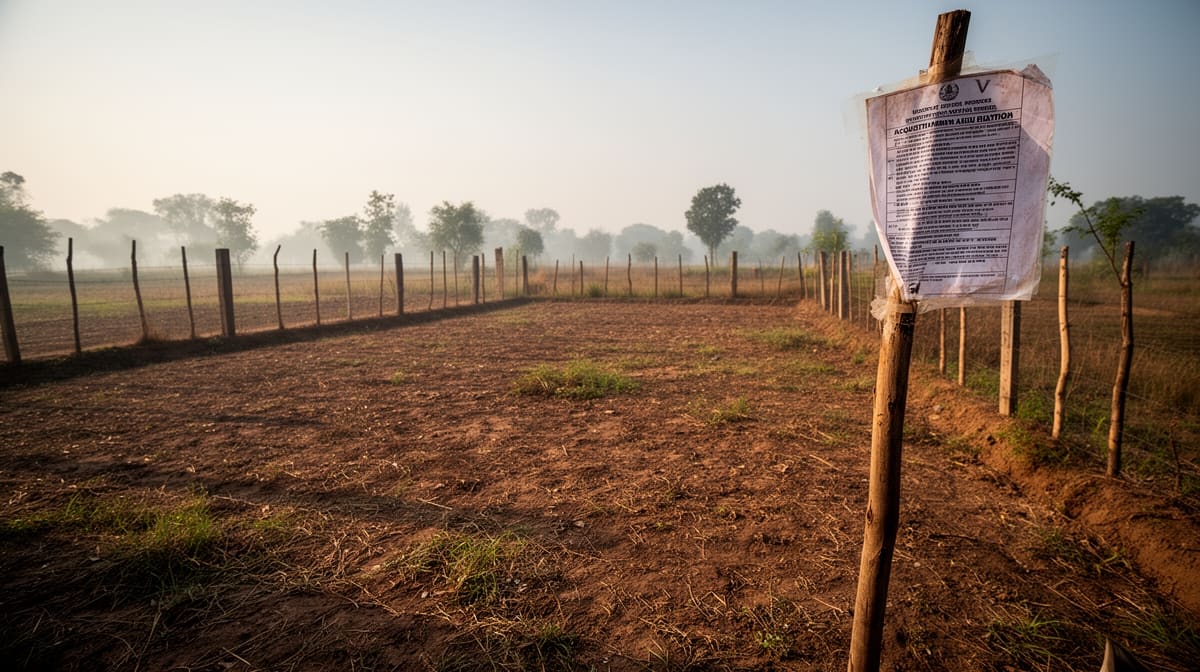
The Bombay High Court has delivered a stern rebuke to the National Highway Authority of India for taking possession of private land without disbursing compensation, despite a two-year-old land acquisition award. The judgment underscores that possession without payment is not merely a procedural lapse but a violation of fundamental rights under Article 300A of the Constitution.
Background & Facts
The Dispute
The petitioners, legal heirs of Balkrishna Lalji Metha, were landowners whose property was acquired under the Land Acquisition Act for a national highway project. On 08 April 2024, the Competent Authority issued a formal land acquisition award and immediately forwarded a copy to the National Highway Authority of India (NHAI), requesting funds to disburse compensation. Despite this, NHAI failed to release any payment.
Procedural History
- 08 April 2024: Land acquisition award issued and sent to NHAI with explicit instruction to release compensation funds
- Post-April 2024: Possession of the land was taken by the Competent Authority and handed over to NHAI
- 2024 - 2025: Petitioners repeatedly sought payment without response
- 2026: Writ petition filed before the Bombay High Court seeking direction for payment and accountability
- 21 January 2026: Competent Authority filed reply affidavit confirming NHAI’s refusal to release funds
Relief Sought
The petitioners sought immediate payment of compensation, a direction to NHAI to explain its inaction, and personal appearance of the Executive Engineer before the Court.
The Legal Issue
The central question was whether taking possession of land under land acquisition proceedings without disbursing compensation violates Article 300A of the Constitution, and whether NHAI’s silence and non-filing of reply can be construed as an abuse of power.
Arguments Presented
For the Petitioner
The petitioners’ counsel argued that possession without payment renders the acquisition unconstitutional under Article 300A, which guarantees protection against deprivation of property except by authority of law. They cited State of Maharashtra v. Manubhai Pragjibhai Patel to assert that the state’s duty to pay compensation is immediate and non-negotiable upon taking possession. The failure to file a reply despite multiple opportunities, they contended, amounted to an admission of default.
For the Respondent
The State’s counsel acknowledged the delay but attributed it to administrative bottlenecks and the classification of the land as forest land, which allegedly restricted NHAI’s ability to proceed. NHAI’s counsel offered no affidavit or substantive explanation, relying instead on general assertions of procedural complexity.
The Court's Analysis
The Court rejected NHAI’s justification outright, noting that forest land status does not absolve the authority of its statutory and constitutional obligation to pay compensation. The Court emphasized that possession is the critical trigger for payment, not the completion of administrative formalities.
"The State cannot take away the property of a citizen and then remain silent on the most fundamental obligation - payment of compensation. This is not mere delay; it is a denial of justice."
The Court further held that NHAI’s failure to file a reply affidavit despite repeated opportunities constituted a serious dereliction of duty. The Court observed that the Competent Authority had fulfilled its part by issuing the award and forwarding it promptly, yet NHAI, as the ultimate beneficiary and user of the land, had abdicated its responsibility. The Court found this conduct to be in direct conflict with the principle of accountability under public law.
The Verdict
The petitioners succeeded. The Court held that taking possession without paying compensation violates Article 300A and directed NHAI to file a detailed reply within two weeks. The Executive Engineer of NHAI, Taluka Pen, was ordered to appear personally before the Court on 05 March 2026.
What This Means For Similar Cases
Compensation Is Not Discretionary
- Practitioners must now treat possession as the trigger for mandatory compensation payment, regardless of project status or land classification
- Delay cannot be justified by administrative inconvenience or bureaucratic hurdles
- Any state agency taking possession must have funds pre-allocated or face judicial intervention
Silence Is Not an Answer
- Failure to file a reply affidavit in land acquisition writs will now be treated as admission of default
- Courts may impose personal accountability on officials, including direct appearance orders
- Legal strategies should include applications for contempt or adverse inference where replies are omitted
NHAI Is Not Above the Law
- Public infrastructure agencies like NHAI are bound by the same constitutional obligations as other state entities
- Claims of special status or project urgency cannot override the right to compensation
- Petitioners in similar cases should cite this judgment to demand immediate payment and personal accountability