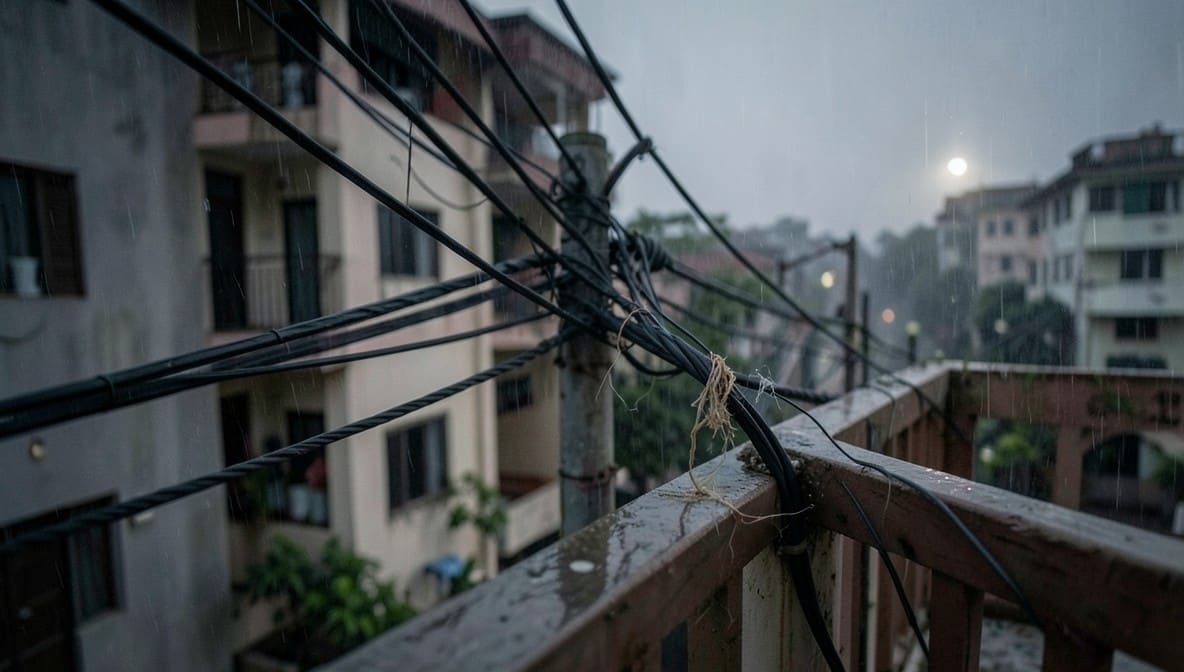
The Bombay High Court’s Nagpur Bench has affirmed that writ jurisdiction can be invoked to grant humanitarian compensation in cases of catastrophic personal injury caused by public utility negligence, even when civil remedies remain available. This ruling underscores the court’s power to act on immediate justice grounds without prejudicing future claims.
Background & Facts
The Dispute
The petitioners, a father and his minor daughter, sought redress after the daughter, aged seven, suffered severe electrocution due to contact with a high-tension electric line passing over the roof of a private residence. The accident resulted in the amputation of her right hand and both legs. The petitioners alleged that the respondents, including the state electricity distribution company and the building owner, violated safety norms under the Indian Electricity Rules, 1956, by permitting unsafe clearance of live wires.
Procedural History
- 2012: Writ petition filed under Article 226 seeking compensation and criminal prosecution
- 2008: Court directed Respondents 5 and 6 (Electricity Company) to pay Rs. 1,00,000 and Respondent 7 (builder) to pay Rs. 1,00,000
- 2026: Petition heard again after prolonged medical treatment; petitioners narrowed claim to compensation only
- Prior payments: Rs. 1,18,750 from Electricity Company under Administrative Circular No. 411; Rs. 1,00,000 from builder
Relief Sought
The petitioners initially sought multiple reliefs including criminal prosecution, lifetime medical support, compassionate job, and Rs. 2 crore compensation. At hearing, they restricted their claim to the compensation prayer under paragraph (ii) of the petition.
The Legal Issue
The central question was whether a writ court, under Article 226, can award substantial monetary compensation for grievous injury caused by public utility negligence when a parallel civil remedy remains available, and whether humanitarian grounds justify such an award without adjudicating liability on merits.
Arguments Presented
For the Petitioner
Counsel argued that the scale of injury - permanent, life-altering disability to a child - demanded immediate judicial intervention. They relied on Vishaka v. State of Rajasthan and Nilabati Behera v. State of Orissa to assert that the state’s duty under Article 21 extends to providing compensation for violations of fundamental rights arising from negligence by state instrumentalities. They emphasized that the delay in civil litigation necessitated interim relief.
For the Respondent
The State and Electricity Company contended that writ jurisdiction is not a substitute for civil suits and that compensation claims must be adjudicated under tort or consumer law. They cited K. S. Puttaswamy v. Union of India to argue that while Article 21 guarantees life and dignity, it does not automatically create a right to monetary compensation in the absence of a proven violation of a specific fundamental right. They also noted prior payments had been made in good faith.
The Court's Analysis
The Court acknowledged that while writ petitions are not ordinarily the forum for determining civil liability, exceptional circumstances may warrant intervention. It emphasized that the injury was not merely accidental but stemmed from systemic failure in enforcing safety norms for high-tension lines near habitations.
"The nature of the injuries suffered and the permanent disability caused thereby are of an extremely serious character."
The Court held that the child’s right to life under Article 21 includes the right to health and bodily integrity, and that the state’s failure to ensure compliance with safety regulations constituted a failure in its constitutional obligation. The Court distinguished this from routine tort claims by noting the gravity of harm, the victim’s minority, and the public nature of the utility involved.
It further clarified that its order was not a determination of liability but a humanitarian measure under its extraordinary jurisdiction. The Court explicitly preserved the petitioners’ right to pursue civil remedies, and importantly, granted the benefit of Section 14 of the Limitation Act, 1963 to exclude the pendency period of this writ petition from limitation calculations.
The Verdict
The petitioners succeeded in part. The Court directed the electricity distribution company to pay an additional Rs. 25 lakh as humanitarian compensation within two months. It dismissed all other prayers, clarified that the order was not a precedent, and preserved the petitioners’ right to institute civil proceedings with limitation relief under Section 14 of the Limitation Act.
What This Means For Similar Cases
Humanitarian Compensation Is Available in Writ Jurisdiction
- Practitioners may now invoke Article 226 to seek immediate compensation in cases of catastrophic injury caused by public utility negligence, even without establishing strict legal liability
- The threshold is high: injuries must be life-altering, involve minors, and arise from clear regulatory failure
- Courts may act on humanitarian grounds without adjudicating fault
Limitation Period Is Suspended During Writ Pendency
- Section 14 of the Limitation Act applies to exclude time spent in writ proceedings when filing subsequent civil suits
- This applies even if the writ is dismissed or partially granted
- Practitioners must explicitly pray for this benefit and cite S. R. Rajan v. State of Tamil Nadu to reinforce the argument
Public Utilities Bear Higher Duty of Care
- Electricity distribution companies are deemed to be discharging public functions
- Non-compliance with Indian Electricity Rules, 1956, especially regarding clearance distances, strengthens claims under Article 21
- Documentation of safety violations (e.g., inspection reports, photographs) is critical to substantiate claims