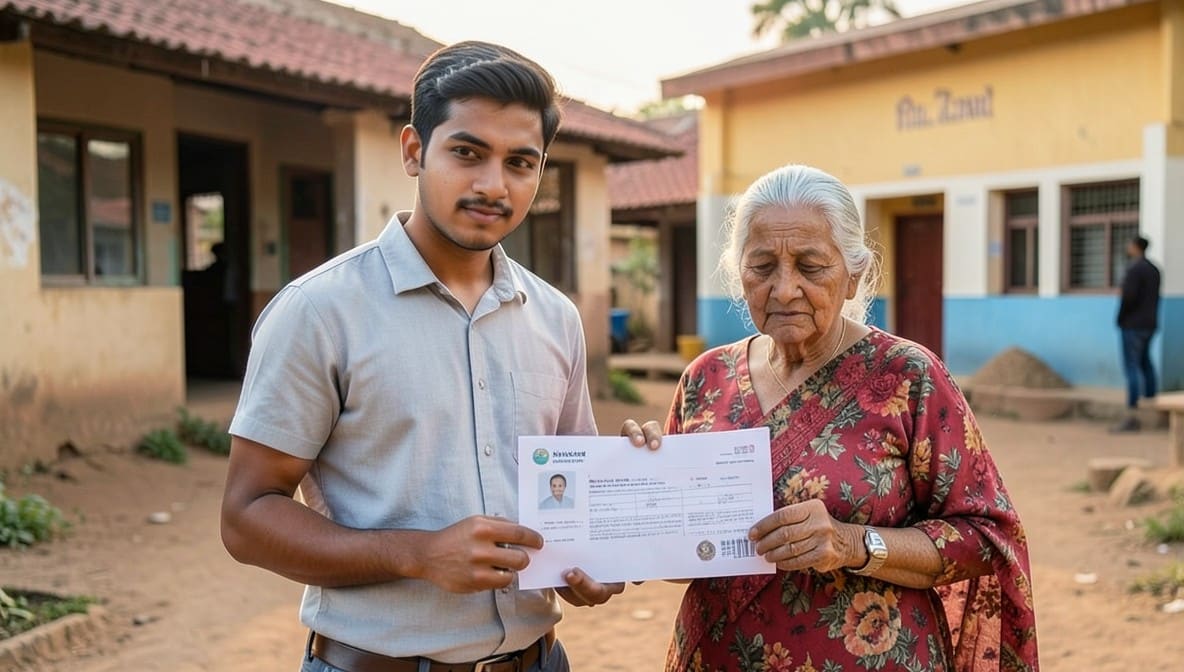
The Bombay High Court has clarified that substitution of a deceased government employee’s dependent in a compassionate appointment waiting list is legally permissible even after the original applicant exceeds the age limit of 45 years, provided the application remains pending and a revised policy permits such substitution. This ruling reinforces procedural fairness and substantive justice in welfare-based appointments.
Background & Facts
The Dispute
The petitioner, Rohit s/o Suryakantrao Mali, seeks substitution of his name in place of his mother, Smt. Anita Suryakantrao Mali, for appointment on compassionate grounds following the death of his father, Suryakantrao Ramrao Mali, who was serving as Superintendent with Respondent Nos. 4 and 5 (educational institutions in Degloor, Nanded). The father expired on 10.06.2009, leaving behind his wife, two children, and a claim for compassionate employment under applicable government policy.
Key Facts
- The petitioner was 13 years old at the time of his father’s death on 10.06.2009.
- His mother, Smt. Anita, filed an application for compassionate appointment on 01.07.2009 with the Commissioner, Disability Welfare Commissionerate, Pune, and a copy was sent to Respondent No. 3 (District Social Welfare Officer, Nanded).
- On 05.01.2010, the Commissioner directed Respondent No. 3 to consider the application and submit a report.
- No formal action was taken by Respondent No. 3 despite this directive.
- Smt. Anita pursued her claim repeatedly, including in 2018, and was included in the waiting list for 2019 - 2020, though with a remark that her application lacked prescribed format, affidavit, or school proposal.
- On 22.04.2018, Smt. Anita submitted a request to substitute the petitioner’s name due to her deteriorating health and inability to take up employment.
- The petitioner filed his own application for substitution on 26.05.2019 and again on 21.02.2022.
- Smt. Anita turned 45 years old in March 2020.
- No written communication was issued to Smt. Anita rejecting her application.
- The petitioner produced an heirship certificate dated 23.07.2009 and a medical certificate confirming his mother’s orthopaedic condition.
Procedural History
- 10.06.2009: Death of Suryakantrao Ramrao Mali.
- 01.07.2009: First application filed by Smt. Anita.
- 05.01.2010: Commissioner directs Respondent No. 3 to process application.
- 08.09.2015: Respondent No. 3 issues notice to Respondents 4 and 5 to submit proposal in prescribed format.
- 22.04.2018: Smt. Anita requests substitution of petitioner’s name due to ill health.
- 26.05.2019: Petitioner files first application for substitution.
- 2019 - 2020: Smt. Anita’s name appears on waiting list.
- 21.02.2022: Petitioner files second formal application.
- 29.02.2024: Affidavit-in-reply filed by Respondent No. 3.
- 24.04.2026: Petitioner files additional affidavit with supporting documents.
- 22.06.2026: Judgment delivered by Bombay High Court.
The Parties' Positions
Petitioner: Argued that substitution is legally permissible under binding precedents and that the delay was due to administrative inaction, not his or his mother’s fault. Emphasized that his mother’s health condition renders her unfit for employment and that the policy now permits substitution within three years of attaining age 45.
Respondent No. 3: Claimed Smt. Anita’s application was never formally received or processed, that no proposal was submitted by the school, and that substitution is barred once the applicant exceeds 45 years. Relied on outdated interpretation of policy and failed to disown the 2019 - 2020 waiting list.
Relief Sought
The petitioner seeks substitution of his name in place of his mother’s for compassionate appointment, with direction to process the application within a stipulated time, and to treat the pending application as valid despite procedural irregularities.
The Legal Issue
Can the name of a dependent be substituted in a compassionate appointment waiting list after the original applicant has crossed the age limit of 45 years, where the application remains pending and a revised government policy explicitly permits such substitution?
Arguments Presented
For the Petitioner
The petitioner relied on the Full Bench judgment in Kalpana wd/o Vilas Taram v. State of Maharashtra (28.05.2024), which held that substitution of names in compassionate appointment cases is permissible to achieve the policy’s humanitarian objective. He also cited the Supreme Court’s decision in Govind Janardan Gaikwad v. State of Maharashtra (06.11.2023), which allowed substitution even after the original applicant reached the age limit. He emphasized that the petitioner’s mother, though eligible at the time of application, became medically unfit and that the policy as amended by Government Resolution dated 17.07.2025 permits substitution within three years of attaining age 45.
For the Respondent/State
Respondent No. 3 contended that no application was received in the prescribed format, no proposal was forwarded by the school, and therefore Smt. Anita was never formally included in the waiting list. He argued that substitution is impermissible once the applicant exceeds 45 years, relying on an outdated interpretation of the 2005 Government Resolution. He failed to produce any communication rejecting the application or informing the applicant of deficiencies.
The Court's Analysis
The Court observed that the administrative machinery failed in its duty to process the application despite clear directives from the Commissioner dated 05.01.2010. The affidavit of Respondent No. 3 was inconsistent: while denying inclusion of Smt. Anita’s name in the waiting list, he could not disown the 2019 - 2020 list that included her name. The Court noted that a waiting list cannot exist for applicants whose applications have been rejected without formal communication.
"Informing the candidate of the rejection of his candidature or taking an appropriate decision regarding inclusion of the name for compassionate appointment is mandatory on the part of the institution and the concerned officers."
The Court held that Respondent No. 3’s claim of ignorance regarding the school’s non-submission of the proposal cannot absolve it of its statutory duty to follow up. The fact that the Commissioner had directed action in 2010, and that the application was acknowledged in 2015, establishes constructive knowledge.
The Court further held that the policy as amended by Government Resolution dated 17.07.2025, Clause VII(b)(2), explicitly permits substitution within three years of the applicant attaining age 45. Since Smt. Anita turned 45 in March 2020 and the petitioner’s application was pending as of 2026, the substitution request falls squarely within the revised limitation period.
The Court rejected Respondent No. 3’s reliance on Fertilizers and Chemicals Travancore Limited v. Anusree K.B. as inapposite, since that case dealt with eligibility criteria, not substitution after age limit. The precedents in Kalpana Vilas Taram and Govind Janardan Gaikwad were binding and directly applicable.
The Verdict
The writ petition is allowed. The respondents are directed to substitute the name of the petitioner, Rohit s/o Suryakantrao Mali, in place of his mother, Smt. Anita Suryakantrao Mali, for appointment on compassionate grounds. The petitioner shall either submit the application in the prescribed format through Respondent Nos. 4 and 5, or Respondent No. 3 shall obtain and process the same within 15 days. The substitution shall be completed within 30 days of the completion of the above process.
What This Means For Similar Cases
Substitution Is Not Barred by Age Limit Alone
- Practitioners may now argue that compassionate appointment policies must be interpreted dynamically, especially when revised resolutions explicitly permit substitution after age limit expiry.
- Administrative delays or procedural lapses by authorities cannot be used to deny substantive relief to dependents.
- Waiting lists must be transparent; inclusion of a name implies acknowledgment of claim, even if deficiencies exist.
Duty to Communicate Rejection Is Non-Negotiable
- Authorities must issue written orders rejecting applications, specifying deficiencies and providing opportunity to cure.
- Silence or inaction cannot be construed as rejection; the burden lies on the state to prove due process.
- Failure to communicate rejection renders the administrative process void ab initio.
Policy Amendments Apply Retroactively to Pending Applications
- Revised government policies that expand eligibility or provide procedural relief apply to applications pending at the time of amendment.
- Courts will favor interpretations that advance the humanitarian purpose of compassionate appointments.
- Petitioners may invoke subsequent policy changes to overcome procedural objections raised by authorities.